
Knit
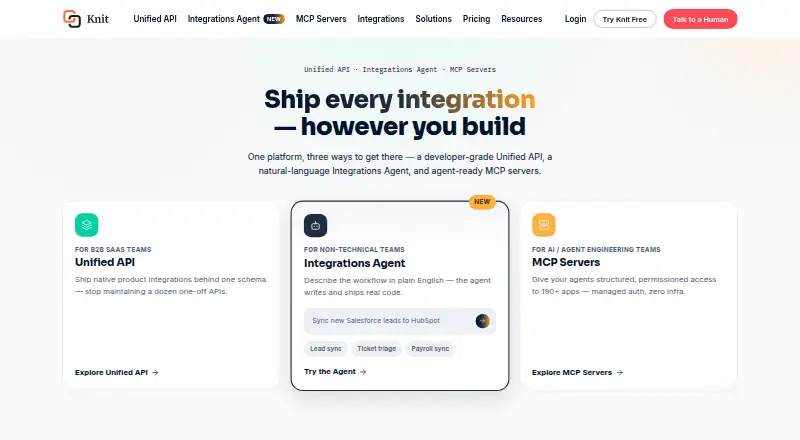
Knit provides integration tools for software teams and workflow builders: a Unified API, a natural-language Integrations Agent, and MCP servers.
What Knit is
Knit provides integration tools for software teams and workflow builders: a Unified API, a natural-language Integrations Agent, and MCP servers. The Unified API offers normalized data models, read and write access, and two-way synchronization across product integrations. The Integrations Agent turns plain-English workflow descriptions into integration code that can be deployed and monitored. MCP servers provide managed-auth access to more than 190 apps without customer-managed infrastructure. Its directory lists 194 integrations across HRIS, ATS, CRM, accounting, email, and ticketing, including Salesforce, HubSpot, QuickBooks, Workday, BambooHR, Asana, Gmail, and Jira. Knit supports Android, iOS, web, and API. Plans include a free option, a 30-day trial, and paid offerings such as Starter at $29 a month and Professional at $99 a month. Security measures stated by Knit include AES-256 encryption at rest, TLS 1.3 in transit, and data-processing residency options in the US, EU, and India.
Good
- Unified API supports read and write access
- Two-way syncs across product integrations
- Agent turns workflow descriptions into deployable code
- Free plan and 30-day trial are listed
Watch out
- Starter plan has 800 usage credits monthly
- Free Integrations Agent plan allows three connected accounts
- Unified API Start Up sync frequency is 24 hours
Who it suits
The Unified API is aimed at B2B SaaS teams, while the Integrations Agent is intended for non-technical teams. MCP servers are for AI and agent engineering teams.
Verdict
Knit covers API-based integration, workflow generation, and managed-auth MCP access. The free plan and paid plans have defined usage and account limits.
Plans and prices
From Knit's own pricing page, checked 20 Sep 2026.
| Plan | Price | What it gives you |
|---|---|---|
| Start Up | $499 a month | 100K API calls/month · Unlimited data usage · 3 test accounts · 3-day log retention · billed monthly |
| Scale Up | — | 1M API calls/month · Unlimited data usage · 3 test accounts · 30-day log retention |
| Enterprise | — | Contract-based API calls · Unlimited data usage · Unlimited test accounts · 90-day log retention |
| Free | Free | 500 usage credits/month · 3 active workflows · 3 connected accounts · 7-day run history |
| Starter | $29 a month | 800 usage credits/month · 10 active workflows · 5 connected accounts · 30-day run history · billed monthly |
| Professional | $99 a month | 2,200 usage credits/month · Unlimited active workflows · Unlimited connected accounts · 90-day run history · billed monthly |
| Launchpad | — | Up to 5 servers · 100 API calls/month |
| Individual | $29 a month | 5K API calls/month · Unlimited MCP servers · billed monthly |
| Launchpad (MCP Servers) | Free | Up to 5 servers · 100 API calls/month · remote MCP servers · create your own MCP server · Free |
| Free (Integrations Agent) | Free | 500 usage credits/month · 3 active workflows · 200 AI credits/month · 3 connected accounts · 7-day run history · 15-minute trigger frequency · community support · Free |
| Starter (Integrations Agent) | $29 a month | 800 usage credits/month · 10 active workflows · 400 AI credits/month · 5 connected accounts · 2 premium apps · 30-day run history · 5-minute trigger frequency · email support · $29/mo |
| Individual (MCP Servers) | $29 a month | 5K API calls/month · unlimited MCP servers · chat support · $29/month |
| Professional (Integrations Agent) | $99 a month | 2,200 usage credits/month · unlimited workflows and connected accounts · 800 AI credits/month · 6 premium apps · 90-day run history · 1-minute trigger frequency · priority support · $99/mo |
| Start Up (Unified API) | $499 a month | 100K API calls/month · 24-hour sync frequency · 3-day log retention · 30-day free trial · $499/month |
| Enterprise (MCP Servers) | Priced on request | Managed embedded auth · multiple instances of the same server · dynamic tool packaging API · custom MCP tools · Slack support · role-based access control · regular security reports · Get in touch |
| Scale Up (Unified API) | Priced on request | 1M API calls/month · configurable sync frequency · 30-day log retention · 99.9% uptime SLA · 30-day free trial · Get in touch |
| Enterprise (Integrations Agent) | Priced on request | Contract-based usage, workflows, AI credits, accounts, apps, and run history · real-time triggers · dedicated support · Custom |
| Enterprise (Unified API) | Priced on request | Contract-based API calls · 90-day log retention · 99.99% uptime SLA · 90-day free trial unavailable · Get in touch |
The facts
Each one read from Knit's own pages, with the date it was checked.
The company
- Company
- Knit says it started in January 2024 and is based at The Pavillion, 62/63 Church Street, MG Road, Bengaluru, India 560001.checked 30 Sep 2026
- Founded
- 2024checked 28 Sep 2026
- Headquarters
- Bengaluru, Indiachecked 28 Sep 2026
What it does
- Compliance
- Knit states that it complies with SOC 2, GDPR, and ISO 27001.checked 30 Sep 2026
- Connectors
- The integrations directory lists 194 apps across categories including HRIS, ATS, CRM, accounting, email, and ticketing.checked 30 Sep 2026
- Data residency
- Knit supports data processing residency in the US, EU, and India.checked 30 Sep 2026
- Integration examples
- Listed integrations include Salesforce, HubSpot, QuickBooks, Workday, BambooHR, Asana, Gmail, and Jira.checked 30 Sep 2026
- Integrations Agent
- The Integrations Agent turns plain-English workflow descriptions into custom integration code that can be deployed and monitored as workflows.checked 30 Sep 2026
- Intended users
- Knit describes the Unified API for B2B SaaS teams, the Integrations Agent for non-technical teams, and MCP servers for AI and agent engineering teams.checked 30 Sep 2026
- MCP servers
- Knit says its MCP servers give AI agents managed-auth access to more than 190 apps without customer-managed infrastructure.checked 30 Sep 2026
- Paid from
- 29checked 20 Sep 2026
- Product
- Knit offers a Unified API, a natural-language Integrations Agent, and MCP servers for building software integrations and workflows.checked 30 Sep 2026
- Security
- Knit says it does not store end-user data on its servers and encrypts data at rest with AES-256 and in transit with TLS 1.3.checked 30 Sep 2026
- Support
- Support varies by plan: the listed options include community, email, priority, dedicated, Slack, and on-call support.checked 30 Sep 2026
- Unified API
- The Unified API provides normalized data models, read and write access, and support for two-way syncs across product integrations.checked 30 Sep 2026
Money
- Free plan
- Yeschecked 20 Sep 2026
- Plan limits
- The Unified API Start Up plan has 100K API calls per month and 24-hour sync frequency; Scale Up provides 1M calls per month and configurable sync frequency.checked 30 Sep 2026
The full review of Knit
Overview
Knit is a platform for building app integrations and automated workflows, with an additional route for connecting AI agents to business software. It is best suited to SaaS product teams, workflow owners and agent engineers whose needs fit its three distinct products. Its appeal is breadth: normalized API integrations, generated workflow code and managed-auth MCP servers sit under one roof, though each has its own limits and pricing.
The Unified API offers normalized data models, read and write access, and two-way syncs across product integrations. That is a useful foundation for B2B SaaS teams that need to connect customer systems without treating every integration as a separate interface. The trade-off is that plan capacity and sync terms matter: the Start Up tier allows 100K API calls monthly and syncs every 24 hours, which may not suit products needing more frequent updates.
Knit’s directory covers 194 apps across HRIS, ATS, CRM, accounting, email and ticketing, including Salesforce, HubSpot, QuickBooks, Workday, BambooHR, Asana, Gmail and Jira. The Integrations Agent turns plain-English workflow descriptions into custom code that can be deployed and monitored. MCP servers provide managed-auth access to more than 190 apps without customer-managed infrastructure, a focused proposition for AI teams.
Key features
Three integration paths
The Unified API is the clearest fit for product teams that need read/write access and two-way sync. Scale Up raises the allowance to 1M API calls per month and makes sync frequency configurable, a substantial step up from Start Up’s 24-hour cadence. The Integrations Agent instead targets non-technical teams: it translates workflow descriptions into code, but usage credits, AI credits, active workflows and connected accounts constrain how much can be built at lower tiers.
MCP access is aimed at engineering teams building AI agents. Knit’s managed authentication can remove the need to operate customer-managed infrastructure for app access. The free Launchpad plan permits up to five servers but only 100 API calls monthly; Individual costs $29 a month and includes 5K calls and unlimited MCP servers.
Security and deployment considerations
Knit says it does not store end-user data on its servers, encrypts data at rest with AES-256 and in transit with TLS 1.3, and complies with SOC 2, GDPR and ISO 27001. Data processing residency is supported in the US, EU and India. Those are relevant assurances for teams handling connected business data, while support options vary by plan, from community and email to priority, dedicated, Slack and on-call support.
The workflow builder is code-based, and custom connectors and webhook triggers are supported. Teams seeking a purely visual workflow editor should weigh that code-based approach before committing.
Pricing
Knit is freemium, with several product-specific plan ladders rather than one universal allowance. The free Integrations Agent tier includes 500 usage credits, 200 AI credits, three active workflows, three connected accounts, 15-minute trigger frequency and seven-day run history, with community support. It is a practical way to start small, but the workflow, account and history caps are restrictive for production use.
Starter costs $29 a month and raises the limits to 800 usage credits, 400 AI credits, 10 workflows and five accounts; it also adds two premium apps, five-minute triggers, 30-day run history and email support. Professional at $99 a month includes 2,200 usage credits, unlimited workflows and connected accounts, and 90-day run history. Starter suits a modest deployment; Professional is more appropriate when workflow and account caps would otherwise impede growth, though its published allowance remains finite in usage credits.
For the Unified API, Start Up costs $499 a month, billed monthly, for 100K API calls, unlimited data usage, three test accounts and three-day log retention. Scale Up has custom pricing and includes 1M calls, unlimited data usage, three test accounts and 30-day retention, plus configurable sync frequency. Enterprise also has custom pricing, contract-based API calls, unlimited data usage and test accounts, and 90-day retention. Start Up’s daily sync cadence and short retention make it the constrained entry point; Scale Up or Enterprise is the more plausible choice for higher call volumes or longer operational history.
MCP Launchpad is free, with up to five servers and 100 API calls per month. Individual costs $29 a month and includes 5K API calls, unlimited servers and chat support. The listing also states a free plan, paid plans from $29/mo and a 30-day trial; trial terms are not otherwise detailed. The Unified API and Integrations Agent plan terms shown above are billed monthly where stated.
Platforms
Knit is listed for Android, iOS, web and API access. The API emphasis makes it relevant to teams embedding integrations into products, while web and mobile platform availability broadens where users can engage with the service.
Who it's for
Choose Knit if you are a B2B SaaS team seeking normalized integration access, a non-technical team describing workflows for code generation, or an AI engineering team that needs managed-auth MCP connections. It is less compelling for a small operation that can manage only minimal monthly call or credit limits, or for teams that need a plan price before evaluating higher-capacity Unified API tiers.
Pros and cons
- Pros: 194 listed app integrations span major business categories, reducing the need to start each connection from scratch.
- Pros: Unified API read/write access and two-way sync support product integrations that need more than one-way data pulls.
- Pros: MCP plans provide managed-auth app access, with a free tier for up to five servers.
- Pros: Stated encryption, compliance and regional processing options address important data-handling concerns.
- Cons: Free workflow access is capped at three active workflows and three connected accounts, limiting experimentation at scale.
- Cons: Unified API Start Up syncs only every 24 hours and retains logs for three days, limiting timeliness and troubleshooting history.
- Cons: Scale Up and Enterprise use custom pricing, making higher-capacity costs harder to compare upfront.
- Cons: The workflow builder is code-based, which may not fit teams expecting a visual, no-code editor.
Alternatives
Consider Nango if you want an API-oriented alternative with a free tier of 10 connections, 10 compute hours per month and 10GB data transfer; its listed $50.00 USD monthly Pay-as-you-go plan offers a different entry point from Knit’s product-specific pricing. Windmill is worth comparing when self-hosted and Linux or Windows platform options matter; its free and open-source plan includes three workspaces and 50 users. Choose Celigo if a flow-and-endpoint structure better matches the integration project: its free plan allows two endpoints, one flow and one production environment.
Workato Agent Studio may suit teams comparing an agent-focused option, with a free tier that includes 50,000 one-time credits and AI and agentic capabilities. Google Cloud Application Integration is another API and web option, with a free tier capped at 400 integration executions and 20 GiB of data processed per month. For a self-hosted route, n8n offers a Community Edition described as a standard self-hosted version available through GitHub. Apache Camel is a free alternative for Linux, Windows and macOS. If spreadsheet-driven requests are the priority, Sheety has a free plan with 200 requests per month and 100 rows per sheet.
Browse the API Integration Platforms and Integration Platform as a Service Software lists to compare more options.
Verdict
Knit is a strong fit for teams that want one vendor for product integrations, natural-language-to-code workflows or managed-auth MCP access, backed by a broad app directory and stated security controls. Its main reasons to look elsewhere are the restrictive free-tier caps, the Unified API’s slow Start Up sync cadence, code-based workflow building and custom pricing at higher API capacity. Start with Knit when one of its three integration paths closely matches your work; compare alternatives if predictable high-volume pricing or a visual builder is essential.
Getting started
- Visit https://www.getknit.dev/.
- Choose the Unified API, Integrations Agent, or MCP server offering that fits your team.
- Start with the free plan or use the 30-day trial.
- Select a paid plan if needed; listed paid options include Starter at $29 a month and Professional at $99 a month.
Limits worth knowing
The free Integrations Agent plan includes 500 usage credits per month, 3 active workflows, 200 AI credits per month, 3 connected accounts, 7-day run history, and 15-minute trigger frequency. The Unified API Start Up plan has 100K API calls per month and 24-hour sync frequency; Scale Up has 1M calls per month and configurable sync frequency.
Questions
Is Knit free?
Yes. Its free plan is listed as free. The Integrations Agent free plan includes 500 usage credits per month and 3 active workflows.
How much does Knit cost?
Listed prices include Starter at $29 a month and Professional at $99 a month.
What platforms does Knit support?
Knit lists Android, iOS, web, and API.
What does Knit provide for integrations?
It offers a Unified API, a natural-language Integrations Agent, and MCP servers. Its directory lists 194 apps, and its MCP servers provide managed-auth access to more than 190 apps.
What security and compliance does Knit state?
Knit says it does not store end-user data on its servers and encrypts data at rest with AES-256 and in transit with TLS 1.3. It states compliance with SOC 2, GDPR, and ISO 27001.
Who makes Knit?
Knit is the maker. It was founded in 2024 and is headquartered in Bengaluru, India.
Alternatives to Knit
- 1

Nango
Free planOpen sourceWebAPISelf-hosted7.9Free plan - 2

MX
Free planAndroidiOSWebAPI7.0Free plan - 3
Pipedream
Free planWebAPI7.0From $99 a month - 4
TrueLayer Data API
Free planAndroidiOSWebAPI6.9Free plan - 5

Nylas Scheduler
Free planWeb6.7From $15 a month - 6

API2Cart
WebAPISelf-hosted6.6From $300 a month