
Apache Camel
Apache Camel is an integration framework for linking applications, services, APIs, and data across cloud and on-premises environments.
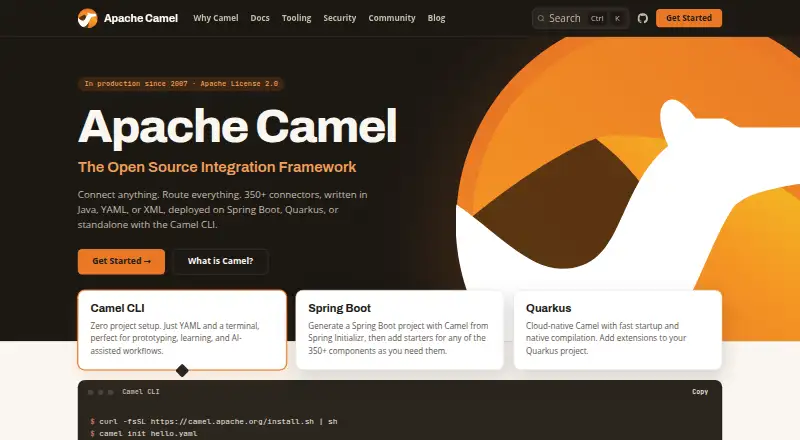
What Apache Camel is
Apache Camel is an integration framework for linking applications, services, APIs, and data across cloud and on-premises environments. It supports hybrid deployment on Linux, macOS, Windows, and self-hosted setups. Its capabilities include workflow orchestration, data transformation, real-time synchronization, on-premises connectors, and API management. Camel provides more than 350 connectors and 65 integration patterns, with listed integrations for Kafka, REST, JDBC, AWS, Azure, GCP, SAP, and Salesforce. Routes can be written in Java, YAML, or XML, then run on Spring Boot, Quarkus, or as standalone applications. An included MCP server connects AI assistants with Camel’s component catalog. Security features cover routes, payloads, endpoints, and configuration, including SSL/TLS utilities and external vault support. Security-sensitive settings are checked at startup, and production mode refuses insecure configuration by default unless that behavior is overridden. Long Term Support releases receive bug and security fixes for up to one year. Camel 4.22.1 LTS supports Java 17, 21, and 25 and lists August 2027 as its end of life. The project is free under the Apache License 2.0, with commercial SLA support available from multiple vendors.
Good
- More than 350 connectors
- Provides 65 integration patterns
- Supports hybrid and self-hosted deployment
- Includes workflow orchestration and data transformation
- Offers route and configuration security controls
- Free under Apache License 2.0
Watch out
- Routes can be written in Java, YAML, or XML
- Current LTS release supports Java 17, 21, and 25
- Camel 4.22.1 LTS lists August 2027 end of life
- Commercial SLA support comes from external vendors
Who it suits
It suits teams connecting cloud and on-premises applications, APIs, services, and data. Developers can choose Java, YAML, or XML routes and run them on Spring Boot, Quarkus, or standalone deployments.
Verdict
Choose Apache Camel when integrations must span cloud and on-premises systems with orchestration, transformation, synchronization, and API management. Its connector catalog, route-language choices, runtimes, and security controls support varied integration architectures. Consider alternatives if your environment cannot use its supported Java versions or route languages.
Plans and prices
From Apache Camel's own pricing page, checked 7 Oct 2026.
| Plan | Price | What it gives you |
|---|---|---|
| Apache Camel | Free | Apache License 2.0 · free, no cost, forever |
| Apache Camel Open Source | Free | Apache License 2.0 · 350+ connectors included · no per-connector fees |
The facts
Each one read from Apache Camel's own pages, with the date it was checked.
What it does
- AI extensibility
- Camel provides an MCP server plus LangChain4j and OpenAI components for AI-enabled integrations.checked 15 Oct 2026
- AI tooling
- Camel includes an MCP server that connects AI assistants to its component catalog.checked 7 Oct 2026
- API and SDK model
- Camel exposes a fluent Java API and endpoint URI model, with reusable components, data formats, languages and route templates.checked 15 Oct 2026
- API management
- Yeschecked 20 Sep 2026
- CLI limitation
- The CLI needs internet access on first use to download dependencies unless mirrors or offline installation options are configured.checked 15 Oct 2026
- Cloud integrations
- The catalog includes AWS, Azure and Google Cloud components, plus services such as S3, SQS, Lambda and Pub/Sub.checked 15 Oct 2026
- Connectors
- The project advertises more than 350 connectors covering messaging, databases, cloud services, SaaS APIs and file protocols.checked 15 Oct 2026
- Connectors and patterns
- Camel provides 350+ connectors and 65+ integration patterns.checked 7 Oct 2026
- Database integrations
- Components support databases and data stores including JDBC, MongoDB, Cassandra and ArangoDB.checked 15 Oct 2026
- Data transformation
- Yeschecked 20 Sep 2026
- Deployment model
- hybridchecked 20 Sep 2026
- Documentation depth
- Documentation includes a user manual, architecture references, testing guidance, component catalog, JavaDoc links, examples and migration guides.checked 15 Oct 2026
- Download requirements
- The current Camel 4.22.1 LTS release supports Java 17, 21, and 25 and lists an end of life in August 2027.checked 7 Oct 2026
- GitHub project scale
- The public repository shows Apache Camel as an open-source framework with more than 350 connectors and about 6,400 stars.checked 15 Oct 2026
- Installation
- The Camel CLI installs through shell or PowerShell scripts, or through JBang, and needs Java 17 or later.checked 15 Oct 2026
- Integration patterns
- Camel provides more than 65 Enterprise Integration Patterns, including routers, splitters, aggregators, circuit breakers and sagas.checked 15 Oct 2026
- Integrations
- The site lists Kafka, REST, JDBC, AWS, Azure, GCP, SAP, and Salesforce among its out-of-the-box connectors.checked 7 Oct 2026
- Latest release information
- The download page lists Camel 4.22.1 LTS from September 2026, supporting Java 17, 21 and 25 through August 2027.checked 15 Oct 2026
- License
- Apache Camel is released under the permissive Apache License 2.0.checked 15 Oct 2026
- Limit: documentation and big-data gaps
- TrustRadius reviewers report deficient documentation and missing framework integration for big-data capabilities.checked 15 Oct 2026
- Limit: documentation for beginners
- G2 reviewers repeatedly describe the documentation as lacking and challenging for beginners.checked 15 Oct 2026
Money
- Free plan
- Yeschecked 20 Sep 2026
The company
- Maker founded
- LinkedIn states that The Apache Software Foundation was established in 1999.checked 15 Oct 2026
- Maker headquarters
- The Apache Software Foundation lists its primary headquarters at 1000 N West Street, Suite 1200, Wilmington, Delaware, United States.checked 15 Oct 2026
The full review of Apache Camel
Overview
Apache Camel is an open-source integration framework for connecting applications, services, APIs, and data across cloud and on-premises environments. It suits development teams that need broad connector coverage and control over integration routes and runtimes. The zero-cost Apache License 2.0 model is a major advantage, while Java requirements and a limited LTS window affect longer-term planning.
Key features
Camel offers more than 350 connectors and over 65 integration patterns, giving teams a substantial base for assembling integrations instead of starting each connection from scratch. Out-of-the-box options include Kafka, REST, JDBC, AWS, Azure, GCP, SAP, and Salesforce. Workflow orchestration, data transformation, real-time synchronization, on-premises connectivity, and API management cover a wide range of integration workloads. This breadth favors organizations with varied systems; it is less suited to buyers seeking a narrowly packaged workflow product.
Routes can be written in Java, YAML, or XML and run on Spring Boot, Quarkus, or standalone runtimes. Those choices let teams align route authoring and deployment with existing architecture, but they also make technical ownership important. Camel 4.22.1 LTS supports Java 17, 21, and 25 and reaches end of life in August 2027, so teams must plan upgrades rather than expect indefinite support for one release.
An included MCP server connects AI assistants to Camel's component catalog. That can make the catalog easier to access in AI-assisted workflows, but it complements rather than replaces integration design and operations.
Security controls cover routes, payloads, endpoints, and configuration. SSL/TLS utilities and external vault support address common protection needs, while startup validation checks security-sensitive configuration. In production mode, Camel refuses to start with insecure configuration by default unless that behavior is overridden, a useful safeguard for teams that want insecure defaults blocked.
Pricing
Apache Camel — free. The plan is free forever under the Apache License 2.0, with no subscription cost. That makes Camel practical for organizations able to provide their own engineering, deployment, and operational support. Commercial support with service-level agreements is available from multiple vendors when a project needs vendor-backed assistance, but that support is separate from the free software plan.
Platforms
Camel supports Linux, macOS, Windows, and self-hosted deployments. Its hybrid deployment model fits estates that combine cloud services with on-premises systems, particularly where on-premises connectors and control over runtime placement are requirements. The supported runtimes—Spring Boot, Quarkus, and standalone—give teams several ways to host routes, subject to the current Java 17, 21, or 25 requirement.
Who it's for
Choose Camel for integration teams connecting diverse cloud and enterprise systems, especially when orchestration, transformation, synchronization, and API management must coexist. It is a strong option for Java-oriented organizations that value route-level control, multiple expression formats, and self-hosted or hybrid deployment. Look elsewhere if your team cannot support the required Java versions, does not want to operate a framework-based integration layer, or prefers a tightly managed service with less implementation responsibility.
Pros and cons
Pros
- Broad connectivity: More than 350 connectors, including major cloud, data, messaging, and business platforms, reduce the need to build common adapters.
- Flexible route and runtime choices: Java, YAML, and XML routes can run on Spring Boot, Quarkus, or standalone deployments.
- Hybrid capability: On-premises connectors and support for cloud and self-hosted platforms suit mixed estates.
- Strong security posture: Route, payload, endpoint, and configuration controls are reinforced by TLS utilities, vault support, and secure startup checks.
- No license fee: The Apache License 2.0 and free-forever plan remove subscription cost.
Cons
- Java dependency: The current LTS release requires Java 17, 21, or 25, excluding environments that cannot adopt those versions.
- Finite LTS horizon: Camel 4.22.1 LTS ends in August 2027, requiring upgrade planning.
- Operational responsibility: A framework with multiple route languages and runtimes gives control but expects engineering and platform ownership.
Alternatives
Apache NiFi is another free Apache-licensed option for teams seeking a different integration approach across Linux, macOS, Windows, web, API, and self-hosted environments.
Pick Knit instead when a freemium, web-and-mobile-accessible service with a $499.00 USD-per-month Start Up plan, 100K API calls per month, and three test accounts fits better than a self-managed framework.
Windmill suits teams wanting a free and open-source freemium platform with web, API, Linux, Windows, and self-hosted access, including a free tier capped at three workspaces and 50 users.
Choose Celigo when a web-based managed platform with a free plan limited to two endpoints, one flow, and one production environment is preferable.
TransportAPI is an alternative for API users whose needs fit a free tier of 30 API hits per day.
Nango fits teams seeking a freemium API and self-hosted service, with its free tier allowing 10 connections, 10 compute hours per month, and 10GB of data transfer per month.
Workato Agent Studio is a choice for teams focused on agentic capabilities through a web/API freemium service with 50,000 one-time credits on its free plan.
Azure Logic Apps is the alternative when Azure-hosted consumption or standard single-tenant deployment is the priority.
Verdict
Apache Camel is best for technically capable teams building broad, hybrid integrations that need connector depth, route flexibility, and control over deployment and security. Its free Apache-licensed model and extensive integration surface are compelling reasons to choose it. Look elsewhere when Java-version constraints, upgrade obligations, or the need for a more managed, packaged integration service outweigh that control.
Getting started
- Open the Apache Camel website
- Choose Linux, macOS, Windows, or self-hosted deployment
- Use the free Apache Camel plan under Apache License 2.0
- Select Java, YAML, or XML for route definitions
- Run routes on Spring Boot, Quarkus, or standalone
- Use the listed connectors and integration patterns for connected systems
Limits worth knowing
Camel 4.22.1 LTS supports Java 17, 21, and 25 and lists an end of life in August 2027. Long Term Support releases receive bug and security fixes for up to one year.
Questions
Does Apache Camel cost anything?
The Apache Camel plan is free forever under the Apache License 2.0.
Which platforms and deployment models are supported?
It supports Linux, macOS, Windows, and self-hosted use, with hybrid deployment.
Which route languages can I use?
Routes can be written in Java, YAML, or XML.
What runtimes can run Camel routes?
Routes can run on Spring Boot, Quarkus, or standalone.
Which integrations are listed?
Listed out-of-the-box connectors include Kafka, REST, JDBC, AWS, Azure, GCP, SAP, and Salesforce.
Is commercial support available?
Commercial support with service-level agreements is available from multiple vendors.
Alternatives to Apache Camel
- 1

Make
Free planAndroidiOSWebAPI8.9From $9 a month - 2

Kestra
Free planOpen sourceWebAPILinuxmacOS8.7Free plan - 3

Azure Logic Apps
Free planWebAPILinuxmacOS8.7Free plan - 4

Informatica Intelligent Data Management Cloud
Free planWebAPIExtensionLinux8.6From £26,550 a year - 5
Workato Agent Studio
Free planiOSWebAPILinux8.6Free plan - 6

Nango
Free planOpen sourceWebAPISelf-hosted8.4Free plan