KairosDB
KairosDB is a free, open-source distributed time-series database built on Cassandra.
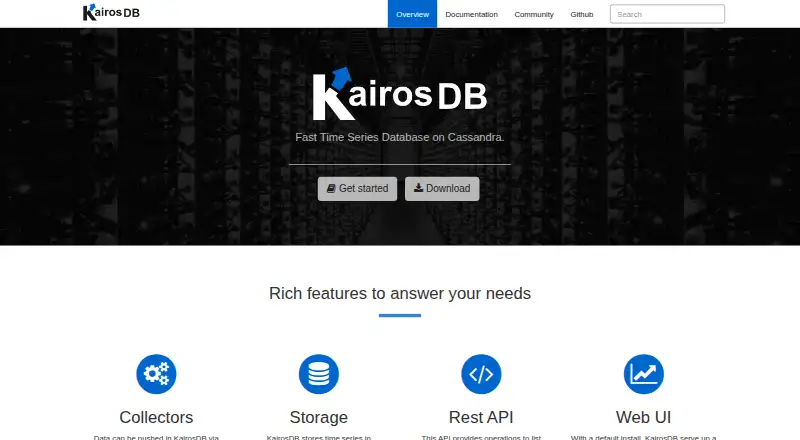
What KairosDB is
KairosDB is a free, open-source distributed time-series database built on Cassandra. It accepts metrics through REST, Telnet, Graphite plaintext or pickle, and plugins. The REST API queries data by metric name and time range, with optional tag filters, aggregation, and downsampling. Built-in aggregators include minimum, maximum, sum, count, and mean. H2 is the default in-memory datastore, while Cassandra provides an alternative for persistent storage. Retention policies and horizontal scaling are supported. A default installation serves a browser query page intended mainly for development, and command-line tools import or export data. Guice-based plugins can add data-point listeners, datastores, protocol handlers, and system monitors. A separate Java client sends metrics and queries data points. KairosDB runs with Java 1.8 or later, supports Linux, API use, and self-hosted deployment, and can run under Kubernetes while remaining mostly stateless. It is licensed under Apache License 2.0. Cassandra row width defaults to about three weeks and cannot be changed after schema creation without risking data loss.
Good
- Open-source Apache 2.0 license
- Multiple metric ingestion methods
- REST queries support aggregation and downsampling
- Retention policies and horizontal scaling
- Plugin extension points
Watch out
- Requires Java 1.8 or later
- Cassandra row width becomes fixed after schema creation
- Default query page is mainly for development
- Cassandra can be harder to run efficiently on Kubernetes
Who it suits
KairosDB suits developers and operators building self-hosted, distributed time-series systems. It fits teams needing multiple ingestion protocols, retention, scaling, and Cassandra-backed storage.
Verdict
KairosDB provides a flexible, self-hosted time-series database with several ingestion paths and extensibility options. Plan the Cassandra schema carefully because row width cannot be changed safely after creation.
The facts
Each one read from KairosDB's own pages, with the date it was checked.
What it does
- Aggregators
- Available aggregation functions include min, max, sum, count, and mean.checked 11 Oct 2026
- Data collection
- It accepts data through Telnet, REST, Graphite, and plugins.checked 5 Oct 2026
- Data ingestion
- Data can be submitted through Telnet, REST, Graphite, or plugins.checked 11 Oct 2026
- Deployment
- The documentation says KairosDB runs under Kubernetes and is mostly stateless, while Cassandra can be harder to run efficiently there.checked 11 Oct 2026
- Extensibility
- Guice-based plugins can add data point listeners, data stores, and protocol handlers.checked 11 Oct 2026
- Import and export
- The server provides command-line tools to import and export data.checked 5 Oct 2026
- Java client
- KairosDB provides a Java client library using HttpClient to send metrics and query the server.checked 11 Oct 2026
- License
- The repository identifies the license as Apache License 2.0.checked 11 Oct 2026
- Notable configuration limit
- The Cassandra row width can be changed when the schema is created, but not afterward.checked 11 Oct 2026
- Notable limit
- The Cassandra row width defaults to about three weeks and cannot be changed after the schema is created without risking data loss.checked 5 Oct 2026
- Product
- KairosDB is a distributed time-series database built on Cassandra.checked 5 Oct 2026
- Purpose
- KairosDB is a fast, distributed, scalable time-series database built on Cassandra.checked 11 Oct 2026
- Queries
- The REST API supports querying by metric and time range, with optional tags, aggregation, averaging, min and max calculations, and downsampling.checked 11 Oct 2026
- Requirements
- The installation guide says KairosDB runs with Java 1.8 or later.checked 5 Oct 2026
- Runtime requirement
- KairosDB runs with Java 1.8 or later.checked 11 Oct 2026
- Security
- The KairosDB pages reviewed do not state security certifications or compliance claims.checked 5 Oct 2026
- Storage backends
- KairosDB can use an in-memory H2 database or Cassandra to store data points.checked 11 Oct 2026
- Support
- The project README directs users to a KairosDB discussion group for questions and community involvement.checked 5 Oct 2026
- Web interface
- A default install serves a browser-based query page that the documentation describes as designed primarily for development.checked 11 Oct 2026
Alternatives to KairosDB
- 1

TDengine
Free planOpen sourceWebAPILinuxmacOS8.3Free plan - 2

Amazon Timestream
Free planWebAPILinuxmacOS7.9Free plan - 3

Apache IoTDB
Free planOpen sourceWebAPILinuxmacOS7.7Free plan - 4

InfluxDB
Free planWebAPILinuxmacOS7.4$0.01 usage-based - 5

VictoriaMetrics
Free planWebAPILinuxmacOS7.4From $200 a month - 6

LinDB
Free planWebAPILinuxmacOS6.9Free plan