K Framework
The facts below are what the maker publishes about K Framework, checked and dated. Our editors have not written about it yet.
The facts
Each one read from K Framework's own pages, with the date it was checked.
What it does
- Command line
- The project README says K users should be comfortable with the command line and that GUI tools are not provided.checked 9 Oct 2026
- Concurrency
- The site says K's rules make read and write access explicit, which supports defining concurrent languages with shared state.checked 9 Oct 2026
- Configurations and rules
- K configurations organize program state into labeled, nestable cells, and rewrite rules describe how terms change.checked 9 Oct 2026
- Control flow
- K represents computations as terms that can be matched, moved, modified, or deleted, supporting features such as exceptions and abrupt termination.checked 9 Oct 2026
- Core tools
- The manual identifies kompile, kparse, krun, and kprove as its main user-facing tools.checked 8 Oct 2026
- Dependency requirement
- K requires Z3 version 4.8.15; the installation page says other versions are unsupported and may cause incorrect behavior or performance issues.checked 8 Oct 2026
- Docker
- The installation instructions provide Docker images with K pre-installed.checked 8 Oct 2026
- Documentation status
- The K User Manual says it is still under construction and some features may have partial or missing documentation.checked 8 Oct 2026
- Editor integrations
- The editor support page lists syntax support or plugins for Atom, BBEdit/TextWrangler, Emacs, IntelliJ IDEA, Notepad++, Pygments, Vim, and Visual Studio Code.checked 8 Oct 2026
- Editor support
- The official site links to editor syntax highlighting support for popular editors and IDEs.checked 9 Oct 2026
- Execution and analysis
- K’s command-line tools support compiling, running concrete or symbolic executions, and analyzing specifications through theorem proving.checked 8 Oct 2026
- Generated tools
- A K language definition can provide tools such as a parser, interpreter, state-space explorer, and deductive program verifier.checked 9 Oct 2026
- Installation
- The official site directs users to install K from GitHub releases and provides a `kup` installation command.checked 9 Oct 2026
- Known limitation
- The FAQ says K does not provide explicit support for metamodel technologies such as EMF.checked 9 Oct 2026
- Purpose
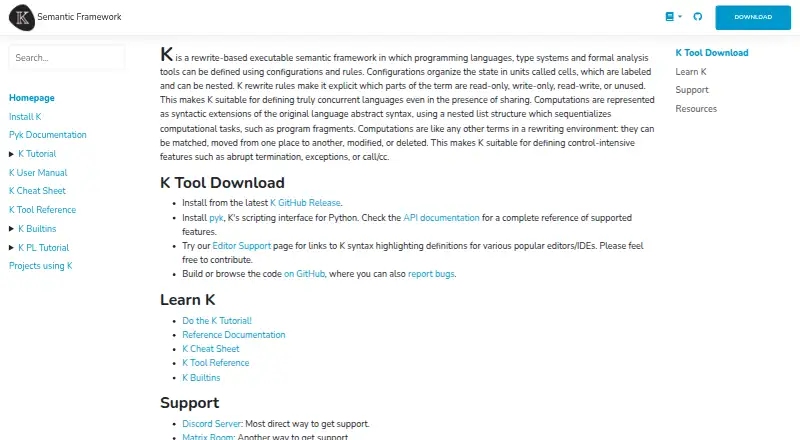
- K is a rewrite-based executable semantic framework for defining programming languages, type systems, and formal analysis tools.checked 9 Oct 2026
- Python interface
- pyk is K's scripting interface for Python and has API documentation.checked 9 Oct 2026
- Support
- The official site lists Discord as its most direct support channel and also links to a Matrix room.checked 9 Oct 2026
- Supported systems
- The installation guide lists Ubuntu 22.04, macOS via Homebrew, and Docker images; it says native Windows is not supported and recommends WSL 2.checked 9 Oct 2026
- Use cases
- The official site links to projects using K, including examples and tools based on K definitions.checked 9 Oct 2026
The company
- Headquarters
- The K site lists the address 202 S Broadway Ave #31, Urbana, IL.checked 8 Oct 2026
- Maker and founding
- Runtime Verification says it was founded in 2010 by Grigore Rosu, and that it released the K Framework in 2014.checked 8 Oct 2026
Where it runs
- Supported installation platforms
- The installation page lists Ubuntu Jammy 22.04 and macOS Ventura 13 via Homebrew, and says K is not currently supported natively on Windows.checked 8 Oct 2026