JianTeX
JianTeX is a free academic writing tool with desktop, browser, and self-hosted options for Linux, macOS, and Windows.
What JianTeX is
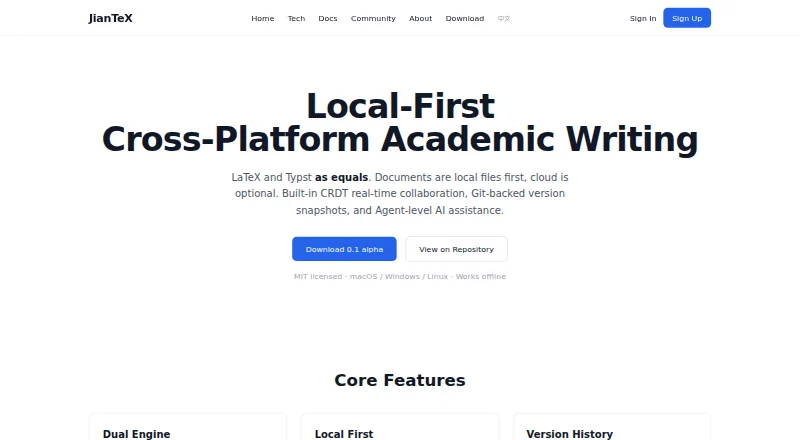
JianTeX is a free academic writing tool with desktop, browser, and self-hosted options for Linux, macOS, and Windows. Its desktop editor handles LaTeX and Typst, with syntax highlighting, code completion, and live preview. The app works offline and saves projects as local files; SyncTeX connects the editor and PDF preview for navigation in either direction. The site lists more than 35 templates, including choices for NeurIPS, ICML, IEEE, Chinese theses, and résumés. In its online version, collaborators can work in real time and see one another’s cursors and selections. Automatic snapshots provide a timeline for restoring earlier versions. Users can import Overleaf projects through a Git link or ZIP file, or clone Git repositories. Listed engines include Tectonic, Typst, LuaLaTeX, XeLaTeX, and pdflatex. Desktop use does not require registration; online sign-in supports GitHub and Google. Teams can self-host, keeping collaboration data on their internal network without third-party servers. The English homepage describes the code as MIT-licensed and offers version 0.1 alpha.
Good
- Free plan and MIT-licensed code
- Desktop app works offline with local files
- SyncTeX links editor and PDF preview
- Online collaboration shows cursors and selections
- Imports Overleaf projects and clones Git repositories
Watch out
- English homepage offers version 0.1 alpha
- Code signing and notarization are rolling out per platform
Who it suits
JianTeX suits academic writers who want LaTeX or Typst tools, offline desktop work, and PDF navigation. Its collaboration and self-hosting options may suit teams that need shared editing while keeping data on an internal network.
Verdict
JianTeX brings LaTeX and Typst editing together with offline desktop use, online collaboration, and self-hosting. Its English homepage identifies the release as 0.1 alpha, so that release status is worth noting.
Plans and prices
From JianTeX's own pricing page, checked 30 Sep 2001.
| Plan | Price | What it gives you |
|---|---|---|
| Free and open source | Free | Desktop app · Online version · Self-hosted option |
The facts
Each one read from JianTeX's own pages, with the date it was checked.
What it does
- Collaboration
- Online projects support real-time collaborative editing using CRDT, with collaborators’ cursors and selections visible.checked 30 Sep 2001
- Engines
- Supported typesetting engines include Tectonic, Typst, LuaLaTeX, XeLaTeX, and pdflatex.checked 30 Sep 2001
- Git support
- JianTeX can clone projects from any Git repository and can sync version history with self-hosted Gitea or GitLab.checked 30 Sep 2001
- Integrations
- The online version supports OAuth sign-in with GitHub and Google; version history can sync to self-hosted Gitea or GitLab servers.checked 29 Sep 2001
- LaTeX and Typst
- The desktop version supports LaTeX and Typst, with syntax highlighting, code completion, and live preview.checked 29 Sep 2001
- License and availability
- The English product page describes JianTeX as MIT licensed and available for macOS, Windows, and Linux, with offline use.checked 30 Sep 2001
- License and sign-in
- The English homepage describes MIT-licensed code and says sign-in is never required; the Chinese homepage describes the product as free and open source.checked 29 Sep 2001
- Offline use
- The desktop app works offline and stores projects as ordinary local files.checked 29 Sep 2001
- Offline writing
- The desktop app works offline and stores projects as ordinary local files.checked 30 Sep 2001
- Overleaf and Git
- Users can import Overleaf projects from a Git link or ZIP file and clone projects from Git URLs.checked 29 Sep 2001
- Overleaf import
- Users can import Overleaf projects by Git link or ZIP upload.checked 30 Sep 2001
- PDF navigation
- SyncTeX links the PDF preview and editor with bidirectional navigation.checked 30 Sep 2001
- Privacy and deployment
- The site says self-hosting keeps data inside an organization’s intranet and collaboration content does not pass through third-party servers in self-hosted deployments.checked 29 Sep 2001
- Purpose
- JianTeX is a cross-platform tool for academic writing, with desktop and browser-based versions.checked 30 Sep 2001
- Release
- The English homepage offers JianTeX 0.1 alpha and says code signing and notarization are rolling out per platform.checked 29 Sep 2001
- Self-hosting
- JianTeX supports self-hosting for organizations and teams that want data to stay within their internal network.checked 30 Sep 2001
- Sign-in
- The desktop app does not require registration; the online version supports GitHub and Google OAuth sign-in.checked 30 Sep 2001
- Templates
- The desktop app includes 35+ templates, including NeurIPS, ICML, IEEE, Chinese theses, and résumés.checked 30 Sep 2001
- Version history
- The service creates version snapshots automatically on save and supports manual labels and restoring prior versions.checked 30 Sep 2001
- Writing tools
- Its LaTeX and Typst editor includes syntax highlighting, code completion, and live preview.checked 30 Sep 2001
Where it runs
- Platforms
- The site lists macOS, Windows, and Linux desktop versions, plus browser access on devices including tablets.checked 29 Sep 2001
The full review of JianTeX
Overview
JianTeX is an academic writing tool for people working in LaTeX or Typst, with desktop, browser, and self-hosted options. It is best suited to writers who want local offline editing alongside a route to collaborative or organization-hosted work.
The desktop editor combines source tools with PDF navigation, while the online version adds live collaboration and version history. Its 0.1 alpha status makes it a more tentative choice for anyone who needs a mature, settled release.
Key features
Source editing and PDF workflow
The desktop app supports LaTeX and Typst, with syntax highlighting, code completion, and live preview. SyncTeX links the PDF and source in both directions, making it easier to move from a rendered passage to the code behind it and back. Support for Tectonic, Typst, LuaLaTeX, XeLaTeX, and pdflatex gives users several engine choices in one editor.
More than 35 templates include formats for NeurIPS, ICML, IEEE, Chinese theses, and résumés. That breadth can shorten setup for common academic and document formats, though the editor is source-based rather than visual.
Local work, collaboration, and project portability
The desktop app works offline, saves projects as ordinary local files, and does not require registration. That makes JianTeX a practical fit for writing without a network connection or account dependency. Overleaf projects can be imported from a Git link or ZIP, and projects can be cloned from Git URLs.
The online version supports real-time collaboration through CRDT, with collaborators’ cursors and selections visible. Automatic snapshots can be restored from a timeline, and version history can sync to self-hosted Gitea or GitLab servers. This combination suits teams that want shared editing with a traceable revision history.
Organizations can self-host JianTeX to keep data within their intranet; in self-hosted deployments, collaboration content does not pass through third-party servers. The online version also supports GitHub and Google OAuth sign-in. The code is described as MIT licensed.
Pricing
JianTeX is free and open source: the free plan is free and includes the desktop app, online version, and self-hosted option. No paid tier is described, so there is no stated seat or usage allowance to weigh against the free offering. It is a straightforward fit for individuals and teams seeking these capabilities without a subscription price.
Platforms
JianTeX is available for macOS, Windows, Linux, and web browsers, with self-hosting also supported. Desktop use is the choice for offline editing and local files; browser use provides real-time collaboration.
Who it's for
JianTeX makes the most sense for LaTeX or Typst writers who want offline desktop work, Git-based project handling, and a path to browser collaboration or intranet deployment. It is less suitable for writers who require a visual editor, or who prefer to wait for a release beyond the 0.1 alpha stage.
Pros and cons
- Pro: LaTeX and Typst editing, live preview, and bidirectional SyncTeX navigation keep source and rendered output connected.
- Pro: Offline local files, Overleaf import, and Git cloning support flexible project ownership and migration.
- Pro: Real-time collaboration, restorable snapshots, and self-hosting cover both shared work and intranet privacy needs.
- Con: The editor is not visual, so it is not aimed at people who want to compose documents through a visual layout interface.
- Con: The release is 0.1 alpha, which may give cautious users reason to choose a more established option.
Alternatives
For a broader comparison, browse LaTeX Editors.
- VerbTeX is worth considering if you need Android or iOS support; its free plan caps local and cloud projects, documents, and uploads.
- Texpile is a simpler option for an offline desktop editor on Linux, macOS, or Windows.
- TeXstudio is an alternative for a free, GPL v2 open-source desktop editor on Windows, Linux, or macOS.
- Oleafly is another free desktop option for Linux, macOS, and Windows; paid AI providers may charge for usage.
- TeXlyre is a free alternative available on Linux, macOS, Windows, and the web.
- TeXposit is a web-only alternative whose free plan includes unlimited projects and collaborators, full version history, and no compile timeouts.
- MiKTeX is a free option for Linux, macOS, and Windows.
- Overleaf is a web-based alternative: its free plan allows one collaborator per project with unlimited projects, while its Student plan supports ten collaborators per project.
Verdict
Choose JianTeX if you want LaTeX and Typst in one free, offline-capable desktop editor and value the option to collaborate online or self-host. Its strongest case is the range from local files to intranet deployment; look elsewhere if a visual editor or a release beyond alpha is essential.
Getting started
- Download the desktop app for macOS, Windows, or Linux, or open the browser version.
- Use the desktop app without registering, or sign in to the online version with GitHub or Google OAuth.
- Create a project from a built-in template, or import an Overleaf project through a Git link or ZIP file.
- Clone a project from a Git URL if you want to work from a repository.
- Choose a supported engine: Tectonic, Typst, LuaLaTeX, XeLaTeX, or pdflatex.
- Set up the self-hosted option if your organization wants deployment within its intranet.
Questions
Is JianTeX free and open source?
Yes. It is described as free and open source, and its English product page describes the code as MIT licensed.
Which platforms does JianTeX support?
It is available for macOS, Windows, and Linux, as well as in a web browser. It also offers a self-hosted option.
Can I use JianTeX offline?
Yes. The desktop app works offline and stores projects as ordinary local files.
Can I collaborate with others?
The online version supports real-time collaboration and shows collaborators’ cursors and selections. Self-hosted deployments keep collaboration content from passing through third-party servers.
Can I import an Overleaf project?
Yes. You can import an Overleaf project from a Git link or ZIP file.
Do I need an account to use it?
The desktop app does not require registration. The online version supports sign-in through GitHub or Google OAuth.