IRS IRIS Taxpayer Portal
The IRS IRIS Taxpayer Portal is a free web service for filing information returns.
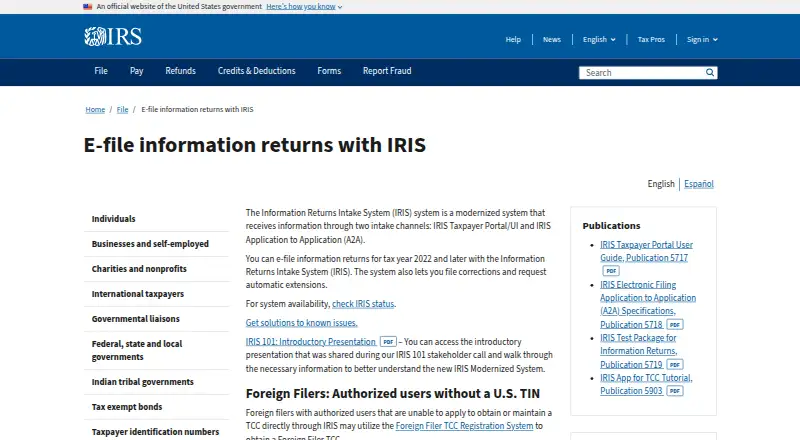
What IRS IRIS Taxpayer Portal is
The IRS IRIS Taxpayer Portal is a free web service for filing information returns. Filers can enter returns manually or upload CSV files, keep filing records, manage issuer information, and download payee copies. The portal also accepts corrections and requests for automatic extensions. It requires an IRIS Transmitter Control Code, a five-digit code used only for IRIS, and supports up to 100 returns at a time through its listed free plan. Filers using their own or third-party software can submit through Application to Application (A2A), which can handle thousands of returns and uploads up to 100 MB at a time. A2A setup requires an A2A TCC, API Client ID, schema package, and successful Assurance Testing System transmissions. IRIS accepts information returns for tax year 2022 and later. CSV formatting guidance and templates are available in the portal. For processing year 2026, listed forms cover tax years 2025, 2024, and 2023, with additional forms available through the portal only.
Good
- Free portal supports manual entry and CSV uploads.
- Supports corrections and automatic extension requests.
- A2A handles thousands of returns, up to 100 MB per submission.
- CSV guidance and templates are available for each form.
Watch out
- Portal use requires an IRIS Transmitter Control Code.
- Free plan handles up to 100 returns at a time.
- A2A setup requires multiple credentials and successful testing.
Who it suits
It suits filers who need to submit information returns online, including those who prefer manual entry or CSV upload. Filers submitting through A2A need the required credentials, schema package, and successful testing transmissions.
Verdict
IRIS offers portal filing and a separate A2A route, with correction and extension options. Check the TCC requirement, form coverage, and A2A setup before choosing a filing method.
Plans and prices
From IRS IRIS Taxpayer Portal's own pricing page, checked 15 Oct 2026.
| Plan | Price | What it gives you |
|---|---|---|
| IRIS Taxpayer Portal | Free | Up to 100 returns per submission · manual entry or IRS CSV upload · IRIS TCC required |
The facts
Each one read from IRS IRIS Taxpayer Portal's own pages, with the date it was checked.
What it does
- A2A bulk channel
- IRIS A2A lets software transmit thousands of returns, with transmissions up to 100 MB.checked 15 Oct 2026
- A2A setup
- A2A setup requires an A2A TCC, an API Client ID, a schema package, and successful Assurance Testing System transmissions.checked 2 Oct 2026
- A2A volume
- Filers using third-party software or their own software can use A2A to submit thousands of returns, up to 100 MB at a time.checked 2 Oct 2026
- API identity
- The API Client ID is generated after its application is completed, while the A2A User ID is created during consent.checked 15 Oct 2026
- Authentication and authorization
- SADI provides authentication and ESAM supplies authorization and the user's TCC context.checked 15 Oct 2026
- Available forms
- For processing year 2026, the page lists supported forms for tax years 2025, 2024, and 2023, with additional forms available through the Taxpayer Portal only.checked 2 Oct 2026
- Corrections and extensions
- The system lets filers submit corrections and request automatic extensions.checked 2 Oct 2026
- CSV guidance
- CSV formatting guidelines and templates for each form are available in the portal.checked 2 Oct 2026
- CSV upload
- Users can upload a CSV file in the IRS template format to populate portal forms.checked 15 Oct 2026
- Data format
- A2A uses XML schemas, and the schemas also permit XML response types for status or acknowledgment resources.checked 15 Oct 2026
- Developer onboarding
- A2A onboarding requires an A2A TCC, API Client ID, schema package and Assurance Testing System transmissions.checked 15 Oct 2026
- Electronic filing threshold
- Starting tax year 2023, filers with 10 or more information returns must file them electronically; Forms W-2 are e-filed with the Social Security Administration.checked 2 Oct 2026
- Forms supported
- The 2026 processing-year list includes forms such as 1042-S, 1098, 1099 series, 3921, 3922, 5498 series and W-2G.checked 15 Oct 2026
- Issuer copy limit
- Some continuous-use forms no longer include an issuer/payer copy because of form updates.checked 2 Oct 2026
- Issuer management
- Issuer information can be saved and managed for reuse.checked 15 Oct 2026
- Known-issues process
- The IRS publishes tax-year-specific known-issue spreadsheets for the portal, A2A and ATS, including updates in 2026.checked 15 Oct 2026
- Limit: correction workflow
- Reddit users reported accepted-with-errors returns whose correction submit control remained disabled.checked 15 Oct 2026
- Limit: CSV compatibility
- Independent guidance warns that arbitrary accounting exports do not import directly because uploads must match the IRS template layout.checked 15 Oct 2026
- Limit: manual workload
- Independent analysis says each payer requires a separate hand-driven portal session, making multi-client filing labor intensive.checked 15 Oct 2026
- Limit: no portal API
- An independent IRIS guide says the portal itself has no API; programmatic filing requires the separate A2A channel.checked 15 Oct 2026
- Limit: outages and slowness
- Reddit filers reported pages stuck loading, severe slowness, crashes and difficulty submitting during the 2024 filing rush.checked 15 Oct 2026
- Limit: TCC lead time
- Independent filing guidance reports that IRS TCC issuance can take up to 45 calendar days.checked 15 Oct 2026
The company
- Maker founded
- LinkedIn lists the Internal Revenue Service as founded in 1862.checked 15 Oct 2026
- Maker headquarters
- The IRS lists its main office at 1111 Constitution Ave. NW, Washington, DC 20224.checked 15 Oct 2026
The full review of IRS IRIS Taxpayer Portal
IRS IRIS Taxpayer Portal is a free web service for submitting information returns to the IRS. It is best for filers who can work within batches of up to 100 and have an IRIS TCC; the separate A2A route serves larger volumes but has a more demanding setup. The price is compelling, but the TCC and form-coverage constraints matter before committing to a workflow.
Overview
IRIS accepts information returns through its browser portal or through Application to Application (A2A), and covers tax years 2022 and later. The portal combines filing with issuer-information management, filing records, and payee-copy downloads. Corrections and requests for automatic extensions are also supported, making it useful beyond the initial submission.
Portal access requires an IRIS Transmitter Control Code, a five-digit code restricted to IRIS. Starting with tax year 2023, filers with 10 or more information returns must file electronically. W-2 forms are filed electronically with the Social Security Administration, so IRIS does not handle every information-return filing obligation.
Key features
Portal filing and records
Returns can be entered manually or uploaded by CSV. Manual entry is a reasonable route for small batches; CSV is more practical when preparing multiple returns outside the portal. Form-specific templates and formatting guidance support that process, though filers still need to prepare files in the required format. The portal handles up to 100 returns at a time, a clear ceiling for organizations with larger batches.
Saved issuer information and filing records reduce repetitive administration, while payee-copy downloads provide a way to retrieve recipient copies. PDF files may take up to 10 minutes to appear in portal notifications, and company firewalls can block external downloads. Some updated continuous-use forms no longer include an issuer or payer copy, which limits what filers can retrieve for those forms.
A2A for larger volumes
Filers using their own or third-party software can transmit thousands of returns through A2A, with up to 100 MB per transmission. That avoids the portal's 100-return batch ceiling, but the route is not a simple extension of CSV upload: setup requires an A2A TCC, API Client ID, schema package, and successful Assurance Testing System transmissions. It suits teams with the software resources and volume to justify that work, not occasional filers seeking the shortest path.
Pricing
The IRIS Taxpayer Portal plan costs free, billed Free. It allows up to 100 returns at a time, supports manual entry or CSV upload, and requires an IRIS TCC. There is no free trial because the plan is free. The zero price is a strong fit for eligible filers with modest batches, but it does not remove the TCC requirement or increase the portal's batch limit.
The plan supports federal and state e-file and correction filing, with a free-plan form limit of 100 forms. IRIS lists supported forms for processing year 2026 for tax years 2025, 2024, and 2023, with additional forms available through the Taxpayer Portal only. Check that the needed form and year are supported before building a filing process around the service.
Platforms
IRIS is available on the web. A2A is the alternative for sending larger volumes using filer-owned or third-party software, but it brings separate credentials, schema, and testing requirements.
Who it's for
IRIS is a sensible choice for individuals, businesses, and other filers who need a no-cost federal filing route, have a supported form, and can obtain an IRIS TCC. CSV templates and recordkeeping features help with routine batches; the free plan is less suitable when filing volume regularly exceeds 100 returns at a time.
Organizations submitting thousands of returns may find A2A a better fit if they can complete its technical setup. Filers who need W-2 e-filing should account for the separate Social Security Administration process. The IRIS Help Desk is available Monday through Friday, 7:30 a.m. to 7 p.m. Eastern time.
Pros and cons
- Pros: The portal is free, supports corrections and automatic-extension requests, and combines CSV or manual filing with issuer records and payee-copy access.
- Pros: A2A supports thousands of returns per transmission, up to 100 MB, for filers whose volume exceeds the portal workflow.
- Cons: Portal filing requires an IRIS-only TCC and is capped at 100 returns at a time.
- Cons: A2A requires additional credentials, a schema package, and successful testing, so it carries a substantial setup burden.
- Cons: Form coverage varies by year and route, and W-2 filings must be handled through the Social Security Administration.
Alternatives
Tax Information Reporting Software is a useful starting point for comparing filing tools. Tax1099 offers a free Essential plan for individuals and small businesses with pay-per-form filing, plus a $249 a year Teams plan for SMBs and collaborative finance; choose it if that pay-per-form or team-oriented model better suits your workflow.
Yearli has a free-to-start Core plan covering W-2 and 1099 forms, quarterly filing, chat and email support, and per-form TIN matching, but charges an annual subscription plus filing fees. It may suit filers who need those services and accept those ongoing costs. Avalara 1099 & W-9 uses pay-as-you-go pricing, including $3.10 a month for 1 to 15 IRS forms and $2.30 a month for the next 150; consider it when that form-based pricing better matches your volume.
1099Online charges per form when filing, with pricing varying by form type and volume; it may suit readers who prefer paying only when they file. 1099-etc is a Windows option whose 2026 W2/1099 Forms Filer costs $94 a year and requires a base program for add-ons; consider it if a Windows-based filing program fits better than a web portal. BoomTax offers a free plan and a Premium (ACA) option at $349, paid once for Tax Year 2025, with up to 145 employees; it is a more specific alternative for ACA filing needs.
eFileMyForms charges $4.89 a month for its 1099 eFile, Print and Mail plan, for 1–20 forms per order, with possible additional per-form processing fees on print-and-mail orders. 1099 Pro offers a Windows Enterprise single-user plan at $699, paid once for 5,000+ forms and unlimited filing entities; consider it when that high-volume, single-user setup fits your operation.
Verdict
Choose IRS IRIS Taxpayer Portal if you need direct, free information-return filing and your forms, volume, and TCC are a fit. Its corrections, extensions, CSV workflow, and recordkeeping make the no-cost plan useful for routine work. Look elsewhere if the 100-return portal limit, supported-form boundaries, or TCC requirement do not suit you; A2A handles larger volumes but demands technical setup.
Getting started
- Open the IRS IRIS information returns page.
- Obtain an IRIS TCC for Taxpayer Portal access.
- Enter return details manually or upload a CSV using the portal's form guidance.
- For A2A, obtain an A2A TCC and API Client ID, prepare a schema package, and complete successful Assurance Testing System transmissions.
- Submit returns, corrections, or automatic extension requests through the applicable filing route.
Limits worth knowing
The free portal plan allows up to 100 returns at a time, using manual entry or CSV upload, and requires an IRIS TCC. A2A submissions can be up to 100 MB at a time and require separate setup. Some forms do not include an issuer or payer copy; PDF downloads may take up to 10 minutes to appear in portal notifications.
Questions
How much does the IRIS Taxpayer Portal cost?
It is free.
Which platforms can I use?
The portal is web-based.
What information returns can it accept?
IRIS accepts information returns for tax year 2022 and later. For processing year 2026, supported forms are listed for tax years 2025, 2024, and 2023, with additional forms available through the portal only.
Can I upload a file instead of entering forms manually?
Yes. The portal supports CSV uploads and provides formatting guidance and templates for each form.
What does portal access require?
You need an IRIS Transmitter Control Code, a five-digit code that can only be used for IRIS.
Does it support corrections and extensions?
Yes. Filers can submit corrections and request automatic extensions.
Alternatives to IRS IRIS Taxpayer Portal
- 1

TaxBandits
Free planAndroidiOSWebAPI8.2From $199 a year - 2
efile4Biz
Free planAndroidiOSWebAPI8.1From $149 a year - 3

Tax1099
Free planAndroidiOSWebAPI8.1From $249 a year - 4

Yearli
WebAPIWindows7.6From $129 a year - 5
BoomTax
WebAPI6.8$349 one-time - 6
CheckMark 1099 Software
macOSWindows6.4From $239 a year