
InOrbit Space Intelligence
InOrbit Space Intelligence is a platform for enterprise robot operations that combines robotics, Physical AI, and systems integrations to give teams a facili…
What InOrbit Space Intelligence is
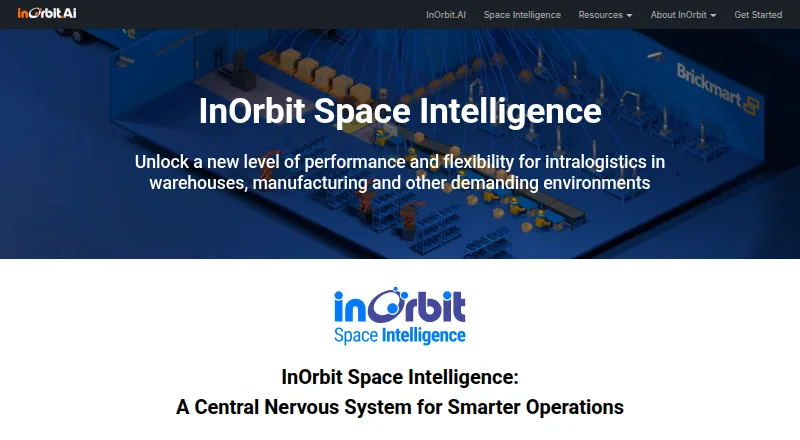
InOrbit Space Intelligence is a platform for enterprise robot operations that combines robotics, Physical AI, and systems integrations to give teams a facility-wide view. It connects warehouse management, ERP, and WES systems with robot operations for process visibility and fleet management, and can handle robots from multiple vendors on one screen. Listed workflows include material transport, goods-to-person picking, inventory management, replenishment, sorting, kitting, waste removal, and route optimization. Integrations can link WMS, MES, ERP, cameras, doors, and other IoT devices. RTLS connections, including SICK and Slamcore, can track robots, people, equipment, and tagged items. AI-powered vision provides monitoring and alerts, creates event summaries, and helps identify possible operational issues. Its Business Execution System links ERP and WMS planning to robot operations, converting production orders into robot missions. RobOps Copilot lets enterprise teams ask everyday-language questions about robot operations and fleet data. A free edition for basic RobOps has a navigation dashboard limited to one map and camera view, without high-resolution or full-screen navigation.
Good
- Manages robots from multiple vendors on one screen.
- Connects WMS, ERP, and WES with robot operations.
- Supports a range of intralogistics workflows.
- Copilot accepts everyday-language questions about fleet data.
Watch out
- Free navigation dashboard is limited to one map and camera view.
- Free dashboard omits high-resolution and full-screen navigation.
- Pricing is on request.
Who it suits
InOrbit Space Intelligence is aimed at enterprise teams managing robot operations in warehouses and other facilities. It may suit operations that need visibility across mixed robot fleets and connected facility systems.
Verdict
InOrbit Space Intelligence combines fleet visibility with connections to facility systems, RTLS, and operational workflows. Its free edition has a restricted navigation view, and pricing details are available on request.
Plans and prices
From InOrbit Space Intelligence's own pricing page, checked 15 Oct 2026.
| Plan | Price | What it gives you |
|---|---|---|
| Free Edition | Free | basic RobOps features · unlimited robots · free forever |
| Basic Support | Free | email support · online documentation · Discord community · free |
| Premium Support | $3,000 a month | named customer success manager · engineering access · real-time troubleshooting · consulting · 1-year commitment |
| InOrbit Standard Edition | Priced on request | Variable monthly fee based on monthly active robots · upfront annual payments can lower per-unit cost |
| Developer Edition | — | full functionality for up to 8 robots · advanced teleoperation · robot locks · multiple maps · advanced video · custom roles · secure data pipes · data backfill · flat-rate annual pricing |
| Premium Support package | Priced on request | dedicated CSM · live chat · guided onboarding · live configuration support · next-business-day support · bundle pricing |
| Standard Edition | — | core fleet functionality · premium add-ons available · variable monthly fee based on monthly active robots; annual prepayment can reduce unit cost |
| Total Support | Priced on request | 24/7 incident management · root-cause analysis · advanced incident definitions · monthly reporting · custom KPIs · bundle pricing |
The facts
Each one read from InOrbit Space Intelligence's own pages, with the date it was checked.
What it does
- Actionable insights
- AI vision, monitoring and alerts are used to summarize events and identify operational issues before they affect operations.checked 15 Oct 2026
- AI insights
- AI-powered vision provides real-time monitoring and alerts, generates event summaries, and helps identify potential operational issues.checked 29 Sep 2026
- AI optimization
- InOrbit says its analytics identify bottlenecks, improve resource allocation and continuously optimize robot operations.checked 15 Oct 2026
- API
- InOrbit publishes REST and streaming APIs for robot data retrieval, actions, mission tracking, collections and audit logs.checked 15 Oct 2026
- API authentication
- API and SDK access uses account API keys associated with service users and governed by role-based access control.checked 15 Oct 2026
- Business execution
- InOrbit Business Execution System connects ERP and WMS planning to robotic operations and translates production orders into robot missions.checked 29 Sep 2026
- Client requirements
- The web console generally requires Chrome 78 or newer with about 1GB RAM; Linux is the main test platform, with Windows and macOS expected to work.checked 15 Oct 2026
- Embeds and configuration as code
- Developers can embed configured robot widgets in web applications and manage settings through code.checked 15 Oct 2026
- Funding profile
- Crunchbase classifies InOrbit as a private Series A company and lists five funding rounds, although displayed amounts are obscured.checked 15 Oct 2026
- Incident management
- Users can filter captured incidents and inspect the underlying dynamic data for each event.checked 15 Oct 2026
- Independent review coverage
- RFP.wiki reports no verified G2, Capterra, Software Advice, Trustpilot or Gartner Peer Insights footprint for InOrbit.checked 15 Oct 2026
- Infrastructure integrations
- The product describes connections to WMS, MES, ERP, cameras, doors, and other IoT devices.checked 29 Sep 2026
- Integrations
- Documented integrations include Slack, Google Chat, Opsgenie and PagerDuty, plus webhooks and custom REST integrations.checked 15 Oct 2026
- Intelligent orchestration
- The product maps and manages workflows involving humans, robots and automation systems across facilities.checked 15 Oct 2026
- Intended users
- InOrbit describes Space Intelligence as serving enterprise teams managing robot operations in warehouses and other facilities.checked 29 Sep 2026
- Interoperability
- The platform is designed to manage robots from multiple vendors through one interface and connect with existing infrastructure.checked 15 Oct 2026
- Intralogistics use cases
- The intralogistics page lists material transport, goods-to-person picking, inventory management, replenishment, sorting, kitting support, waste removal and dynamic route optimization.checked 15 Oct 2026
- Intralogistics workflows
- The product describes use cases including material transport, goods-to-person picking, inventory management, replenishment, sorting, kitting, waste removal, and route optimization.checked 29 Sep 2026
- IOWA
- InOrbit Warehouse Automation covers interoperability, enterprise and fixed-infrastructure integration, mission execution and fleet-data collection.checked 15 Oct 2026
- Limit: configuration effort
- RFP.wiki says the product appears configuration-heavy and may favor robotics-experienced teams.checked 15 Oct 2026
- Limit: custom integration
- RFP.wiki says some advanced capabilities may require custom integration work and careful configuration.checked 15 Oct 2026
The company
- Company headquarters and founding
- InOrbit is headquartered in Mountain View, California; LinkedIn lists its founding year as 2017.checked 29 Sep 2026
- Headquarters
- Mountain View, California, United Stateschecked 23 Sep 2026
Money
- Free edition limits
- The docs describe a free edition for basic RobOps; its navigation dashboard is limited to one map and camera view and omits high-resolution and full-screen navigation.checked 29 Sep 2026
The full review of InOrbit Space Intelligence
InOrbit Space Intelligence is enterprise software for coordinating robots and facility workflows across warehouses and other sites. It is best suited to operations teams that need robot activity tied to warehouse and business systems, rather than fleet monitoring alone. Its strongest case is breadth of integration; custom pricing and a tightly limited free navigation view make it a poor fit for buyers seeking a self-serve, low-cost tool.
Overview
The platform connects robot operations with intralogistics processes such as material transport, goods-to-person picking, inventory management, replenishment, sorting, kitting, waste removal and route optimization. Its workflow-based orchestration, multi-site management and facility-wide view position it as an operations layer spanning robots and planning systems.
That scope can matter when robot work depends on orders and status flowing between warehouse and enterprise systems. Teams looking only to observe a standalone fleet may not need the broader integration footprint.
Browse our Warehouse Robotics Software directory for more options.
Key features
Connected fleet and facility systems
InOrbit brings WMS, ERP and WES connections together with robot operations for process visibility and fleet management. It can manage robots from multiple vendors on one screen, and connect to MES, cameras, doors and other IoT devices. That combination suits facilities where coordination crosses software and physical infrastructure, though its value depends on having systems and workflows to connect.
Location and operational insight
RTLS integrations, including SICK and Slamcore, can track robots, people, equipment and tagged items. AI-powered vision supports real-time monitoring and alerts, produces event summaries and helps identify potential operational issues. These capabilities broaden the operational picture beyond robot status, but the product facts do not establish specific accuracy or performance outcomes.
Planning to robot missions
The InOrbit Business Execution System connects ERP and WMS planning to robotic operations, translating production orders into robot missions. RobOps Copilot adds a conversational way for enterprise teams to ask everyday-language questions about fleet data and robot operations. Simulation tools and API access also support integration-oriented deployments; this is a platform for teams with operational systems to coordinate, not simply a robot dashboard.
Pricing
InOrbit is paid software with custom pricing, and there is no free trial. The free edition supports basic RobOps, but its navigation dashboard is restricted to one map and camera view and omits high-resolution and full-screen navigation. That is a limited entry point rather than a full navigation experience.
InOrbit Standard Edition has a variable monthly fee based on monthly active robots. Upfront annual payments can lower the per-unit cost, so robot activity and willingness to commit annually affect the economics; no fixed price is provided.
Premium Support costs $3,000 a month with a 1-year commitment. It includes a named customer success manager, access to InOrbit engineering, and real-time troubleshooting and consulting. This is aimed at organizations that need direct support and can commit for a year; Standard Support is free by email or chat. Enterprise Edition includes security capabilities such as single sign-on, while customers are directed to support for details on security protocols.
Platforms
InOrbit supports API, Linux and web, and is deployed in the cloud. API access favors integration with existing operational systems; the product is not presented as a mobile-platform offering.
Who it's for
Space Intelligence is aimed at enterprise teams managing robot operations in warehouses and other facilities, particularly those coordinating mixed fleets with warehouse, enterprise and facility systems. Its multi-site management and workflow-based orchestration suit operations spanning locations or processes. Smaller teams wanting only basic monitoring, or buyers needing transparent fixed pricing before engaging a vendor, should look elsewhere.
Pros and cons
- Pro: One view can bring mixed-vendor robots together with WMS, ERP and WES processes, useful when fleet activity must align with facility operations.
- Pro: RTLS, infrastructure integrations, AI vision and order-to-mission execution extend visibility and coordination beyond robot status alone.
- Pro: Free email or chat support provides a support route without the paid Premium Support commitment.
- Con: The free edition's navigation is confined to one map and camera view and lacks high-resolution and full-screen modes.
- Con: Standard Edition pricing varies with active robots, while Premium Support requires a 1-year commitment at $3,000 a month.
- Con: Security protocols require a conversation with support, which leaves security-conscious buyers without a self-contained account of those protocols.
Alternatives
Dematic Warehouse Execution System is another paid option, with Android, iOS and web platforms; choose it when configurable warehouse and production operations with scalable support are the priority.
LocusONE is a paid Android, API, iOS and web option; its Robots-as-a-Service subscription bundles robot technology, software, support, updates, maintenance and operational optimization, which may suit buyers seeking that bundled model.
Geek+ RMS is a paid option available by API and self-hosted deployment.
Mujin Pick System is a paid API and web option focused on mixed-SKU case picking and 3PL scalability, making it a more focused choice for those needs.
AutoStore is a paid, API-based custom warehouse automation system with fixed infrastructure and project configuration, sold, designed, installed and serviced through system integrator partners.
inVia Logic is a paid API and web alternative with a software-only subscription and no free plan.
Körber Transportation Management is a paid web-based alternative.
Verdict
Choose InOrbit Space Intelligence if your enterprise needs a shared operational view connecting mixed robot fleets, planning systems, location data and facility workflows. Its breadth is the main reason to choose it; custom pricing, the limited free navigation view and the year-long Premium Support commitment are reasons to compare alternatives before committing.
Getting started
- Open the InOrbit Space Intelligence website
- Choose the free edition for basic RobOps or request paid pricing
- Connect WMS, ERP, WES, and other facility systems
- Integrate robots, cameras, doors, IoT devices, or RTLS sources
- Use the cloud platform through its web interface, Linux environment, or API
Limits worth knowing
The free edition's navigation dashboard is limited to one map and one camera view, without high-resolution or full-screen navigation. Premium Support is $3,000 a month with a one-year commitment.
Questions
Is there a free plan?
Yes. A free edition is available for basic RobOps.
What does Premium Support cost?
Premium Support costs $3,000 a month, billed with a one-year commitment.
Which platforms are supported?
The platform lists API, Linux, and web access, with cloud deployment.
Can it manage robots from different vendors?
Yes. Mixed fleets from multiple vendors can be integrated and managed on one screen.
What systems can it connect?
Connections include WMS, MES, ERP, cameras, doors, other IoT devices, and RTLS sources such as SICK and Slamcore.
Alternatives to InOrbit Space Intelligence
- 1
Ocado Smart Platform
AndroidiOSWeb6.5 - 2

Mecalux Easy WES
AndroidWebAPISelf-hosted6.3 - 3

AutoStore
WebAPI6.0 - 4
LocusONE
AndroidiOSWebAPI5.9 - 55.7
- 65.6