
AutoStore
AutoStore develops warehouse robotics and software for automating and coordinating order fulfillment through a cube storage system.
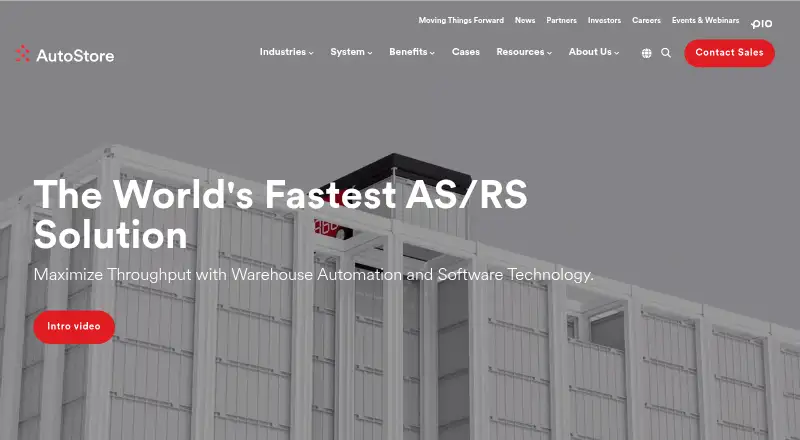
What AutoStore is
AutoStore develops warehouse robotics and software for automating and coordinating order fulfillment through a cube storage system. Its setup combines a Controller, Robots, an aluminum Grid, storage Bins and workstation Ports. The Grid can be configured around a warehouse’s floor area, corners and obstacles such as pillars, pipes and walls. CubeControl coordinates operations and Robot traffic; AutoStore Intelligence uses operational and historical data to optimize routes. CubeAnalytics offers system-status monitoring, predictive outlier information, module performance trends and dashboards. Open APIs and standard interfaces support connections to existing WMS, ERP, order-management systems and third-party hardware. For enterprise networks, the Qubit Fulfillment Platform supports multi-site operations, order management and batching, pick-and-pack workflows, replenishment and inventory tracking with lot and expiration controls. AutoStore says its Intelligence tools use aggregated operational and simulation data, not customer inventory data. The system is cloud-deployed and offers API access, simulation tools and multi-site management. Pricing is on request; the PPP option has a typical 3–5-year minimum term, monthly minimum fee and upfront Grid investment.
Good
- Grid layout adapts to floorspace and obstacles.
- CubeAnalytics provides status and performance monitoring.
- Qubit supports multi-site fulfillment workflows.
- Open APIs support links to existing systems.
- Cloud deployment, simulation tools and API access.
Watch out
- Pricing is available only on request.
- PPP typically requires a 3–5-year minimum term.
- PPP includes a monthly minimum fee and upfront Grid investment.
- Ports are intended for trained personnel.
Who it suits
It suits warehouse operators seeking goods-to-person automation and configurable cube storage, including enterprises managing fulfillment across multiple sites. Implementation and servicing are handled through qualified system integrator partners.
Verdict
AutoStore combines physical cube storage infrastructure with software for robot coordination, analytics and order fulfillment. Its partner-led delivery and PPP term and investment requirements are important considerations for buyers.
Plans and prices
From AutoStore's own pricing page, checked 15 Oct 2026.
| Plan | Price | What it gives you |
|---|---|---|
| AutoStore system | Priced on request | Custom warehouse automation; configuration, integration, installation and service handled through partners |
| Pay-per-pick (PPP) robotics-as-a-service | Priced on request | Upfront Grid infrastructure; Robots, Ports and software leased; available through partner network · Recurring fee per pick; monthly fees vary with volume |
| Performance per Pick (PPP) | Priced on request | Upfront investment for fixed Grid infrastructure; available through AutoStore’s partner network · Recurring fee per pick; monthly fees adjust based on volume; typically 3–5 year minimum term with a flat monthly minimum fee |
The facts
Each one read from AutoStore's own pages, with the date it was checked.
What it does
- AI capabilities
- AutoStore Intelligence uses 28 proprietary AI models and agents trained on more than 15 TB of operational and simulation data.checked 15 Oct 2026
- Analytics
- CubeAnalytics provides system status monitoring, predictive outlier information, module performance trends, and dashboards.checked 29 Sep 2026
- Cloud deployment
- CubeVerse is explicitly described as cloud-based, while the physical AutoStore system is installed in customer warehouses.checked 15 Oct 2026
- Data and analytics
- The software terms describe data-warehouse access with documented definitions and a real-time detailed event feed.checked 15 Oct 2026
- Design and simulation
- AutoStore and its partners use specialist design and simulation tools to evaluate layouts against space, inventory, workflow and throughput requirements.checked 15 Oct 2026
- Developer access
- The API developer portal requires account sign-in; public documentation is referenced in the software terms rather than openly displayed on the sign-in page.checked 15 Oct 2026
- Documentation and support
- AutoStore distributes, designs, installs and services systems through a qualified partner network that provides lifetime support services.checked 15 Oct 2026
- Energy use
- The company says a robot uses 100 watts while operating and that ten robots use about the energy of one vacuum cleaner.checked 15 Oct 2026
- Extensibility
- Integrators can build interfaces using AutoStore’s standard interface, but the controller FAQ says an NDA is required before development.checked 15 Oct 2026
- Fault handling
- When a robot fails, XHandler generally takes over and attempts recovery without stopping the system; shutdown can occur if recovery fails or collision risk exists.checked 15 Oct 2026
- Fulfillment functions
- Documented functions include product catalog synchronization, goods-in workflows, order creation and cancellation, multi-order grouping, picking, cycle counts and exception handling.checked 15 Oct 2026
- Integrations
- Supported integration targets include WMS/WES, e-commerce and ERP software plus pick-to-light, RFID, conveyors and other hardware.checked 15 Oct 2026
- Limit: maintenance guidance
- A G2 reviewer found some maintenance procedures insufficiently clear even though most instructions were understandable.checked 15 Oct 2026
- Limit: review depth
- G2 states that its three Autostore TOS reviews are insufficient to provide buying insight.checked 15 Oct 2026
- Limit: underdeveloped features
- A G2 reviewer said many features seemed underdeveloped and misaligned with customer priorities.checked 15 Oct 2026
- Notable news: Fall 2026
- On October 13, 2026 AutoStore announced capabilities including CubeExplore, CubeFleet and expanded AI-supported design, maintenance and analytics aimed at greater warehouse autonomy.checked 15 Oct 2026
- Notable pricing limit
- The PPP model has a typical minimum term of 3–5 years and a monthly minimum fee based on the number of operating Robots and Ports.checked 29 Sep 2026
The company
- Company founded and size
- LinkedIn lists AutoStore as founded in 1995, headquartered in Nedre Vats, Norway, with 1,001–5,000 employees.checked 15 Oct 2026
- Company scale
- AutoStore says it has more than 2,000 systems in nearly 68 countries and about 1,100 employees in 19 countries.checked 15 Oct 2026
- Founded
- 1996checked 28 Sep 2026
- Headquarters
- Nedre Vats, Norwaychecked 28 Sep 2026
- Legal name and ownership
- Crunchbase identifies the legal entity as AutoStore AS, headquartered in Vatne, Norway, and lists SoftBank as a funder and THL as acquirer.checked 15 Oct 2026
Where it runs
- CubeVerse platform
- CubeVerse is a cloud data and orchestration platform unifying AutoStore applications, integrations and operational data.checked 15 Oct 2026
Money
- Limit: variable cost
- PPP monthly charges change with picking volume and the remaining cost depends on system design and third-party integration requirements.checked 15 Oct 2026
The full review of AutoStore
AutoStore is a warehouse automation system that combines cube storage with robotics and fulfillment software. It best suits large operations investing in goods-to-person automation, especially networks that need to coordinate multiple sites. Its configurable storage grid and software breadth are compelling, but the infrastructure investment and partner-led delivery make it a substantial commitment.
Overview
AutoStore brings together a Controller, Robots, an aluminum Grid, storage Bins and workstation Ports. The Grid can be laid out around a warehouse’s available floor space, including corners and obstacles such as pillars, pipes and walls. That flexibility can help fit automation into an existing building, though it does not make the system a lightweight software-only purchase: fixed infrastructure and a configured project are central to the offering.
AutoStore says it has more than 2,000 systems in nearly 68 countries. Systems are distributed, designed, installed and serviced through qualified system integrator partners, so buyers should expect a partner-led project rather than direct, self-service deployment.
Key features
Robot coordination and analytics
CubeControl coordinates system operations and robot traffic, while AutoStore Intelligence uses historical and operational data to optimize routing. CubeAnalytics adds system-status monitoring, predictive outlier information, module performance trends and dashboards. Together, these tools address both day-to-day coordination and operational visibility; the value will be greatest for sites with enough system activity to make monitoring and routing optimization consequential.
Integrations and multi-site fulfillment
Open APIs and standard interfaces are intended to connect AutoStore with existing WMS, ERP and order-management systems, as well as third-party hardware. Qubit Fulfillment Platform extends the offer to complex, large-scale enterprise networks, with multi-site order management, order batching, pick-and-pack workflows, replenishment and inventory tracking that includes lot and expiration control. That scope makes Qubit relevant to organizations managing fulfillment across sites, rather than buyers seeking only a standalone storage installation.
AutoStore says its Intelligence software trains on aggregated operational and simulation data, not customer inventory data. It also says independent organizations evaluate and certify its devices, and its product approval process covers 19 areas. Ports have safety features that vary by model and are intended for trained personnel, so site teams must account for model-specific safety procedures.
Pricing
AutoStore is paid, with custom pricing. The two buying models differ in how the investment is structured:
- AutoStore system: A custom warehouse automation system with fixed infrastructure and project configuration, sold, designed, installed and serviced through system integrator partners. This fits buyers prepared to scope and fund a configured infrastructure project; it is not a published-price software subscription.
- Performance per Pick (PPP): A recurring fee per pick, with monthly fees adjusting to volume. It still requires upfront investment in fixed Grid infrastructure and typically has a 3–5 year minimum term, plus a flat monthly minimum fee based on operating Robots and Ports. The volume-linked fee may suit buyers seeking charges tied to throughput, but the minimum commitment and infrastructure spend limit flexibility.
Neither model has a published price, so buyers should compare a custom project quote with the PPP minimums and term before choosing.
Platforms
AutoStore lists API access and cloud deployment. It supports goods-to-person orchestration, multi-site management and simulation tools. Those capabilities suit operations integrating automation into a broader warehouse technology stack, rather than teams seeking a conventional standalone desktop or mobile app.
Who it's for
AutoStore is best for warehouse operators with substantial fulfillment needs, the appetite to invest in fixed storage infrastructure and access to an integrator partner. Qubit makes the broader package particularly relevant to enterprise networks coordinating several fulfillment sites. A smaller operation, a buyer seeking a quick software-only deployment or a business unwilling to accept a multi-year PPP commitment should look elsewhere.
Pros and cons
- Pros: The Grid can be configured around warehouse obstacles, offering flexibility within existing floor plans.
- Pros: Robot coordination, routing optimization and operational analytics cover both system execution and monitoring.
- Pros: Qubit includes multi-site workflows and inventory controls for complex enterprise fulfillment.
- Cons: Fixed Grid infrastructure requires upfront investment, including under PPP.
- Cons: PPP typically commits buyers for 3–5 years and carries a monthly minimum fee tied to operating Robots and Ports.
- Cons: Deployment and service depend on qualified system integrator partners, not a direct self-managed rollout.
Alternatives
Browse Warehouse Robotics Software for more options in the category. InOrbit Space Intelligence is worth considering when a free plan matters; its Premium Support is $3,000 a month with a 1-year commitment. Geek+ RMS is another paid option, with API and self-hosted platforms. Rologi Automation Suite is a paid web-based alternative.
LocusONE may suit buyers who prefer a Robots-as-a-Service subscription that includes robot technology, software, support, updates, maintenance and operational optimization. GreyMatter offers paid Pro, Premium and Power plans with custom pricing. HaiQ is another paid alternative. Exotec Skypod System is a paid warehouse automation option with pricing available by contacting Exotec. inVia Logic offers a paid software-only subscription, making it a point of comparison for buyers considering software without AutoStore’s fixed Grid infrastructure.
Verdict
Choose AutoStore if you need configurable cube storage, coordinated goods-to-person robotics and fulfillment software for a high-volume warehouse or multi-site enterprise network. Its strongest case is the combination of adaptable infrastructure and operational software, including Qubit’s multi-site capabilities. Look elsewhere if fixed-infrastructure investment, partner-led implementation or PPP’s typical 3–5 year minimum term does not fit your operation.
Alternatives to AutoStore
- 1

InOrbit Space Intelligence
Free planWebAPILinuxmacOS7.7From $3,000 a month - 2
Ocado Smart Platform
AndroidiOSWeb6.5 - 3

Mecalux Easy WES
AndroidWebAPISelf-hosted6.3 - 4
LocusONE
AndroidiOSWebAPI5.9 - 55.7
- 65.6