Infection Monkey
Infection Monkey is an open-source breach and attack simulation tool for organizations assessing resilience to perimeter breaches and infection of internal s…
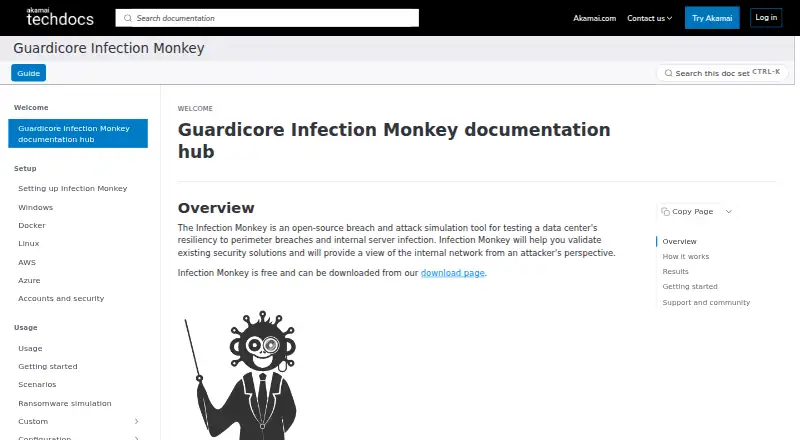
What Infection Monkey is
Infection Monkey is an open-source breach and attack simulation tool for organizations assessing resilience to perimeter breaches and infection of internal servers. Its agent-based simulations use two components: Monkey Agent scans systems and simulates attack techniques, while Monkey Island Server provides a web server with a user interface for managing the tool. Infection Monkey maps machines it can see, the services they expose, and possible paths between them. Its report summarizes security issues agents discover or exploit. The tool supports local networks, internal servers, on-premises data centers, and cloud-based environments, including on-premises systems, containers, and public and private clouds. Custom attack scenarios are supported, and plugins can be installed, updated, removed, or uploaded through the Monkey Island interface. For AWS, the documented integration uses Systems Manager to run Infection Monkey on EC2 instances. It can operate without internet access; an available connection is used for update checks and to see whether machines can reach the internet. The project is free, with a hybrid deployment model. Monkey Island runs on x86-64 processors, with Linux and Windows listed as supported operating systems. Credentials are required to access the server after first launch. The project offers a public Slack workspace, support email, and GitHub issue reporting.
Good
- Free and open-source.
- Maps visible machines, services, and potential network routes.
- Reports security issues agents discover or exploit.
- Supports custom attack scenarios and plugins.
- Can operate without internet access.
- Supports on-premises, container, and cloud environments.
Watch out
- Monkey Island requires an x86-64 processor.
- The documented Monkey Island operating systems are Linux and Windows.
- The AWS integration described uses Systems Manager on EC2 instances.
Who it suits
Infection Monkey suits organizations that want to validate security controls and identify potential gaps across networks, servers, data centers, and cloud environments. It is also relevant to teams that need custom attack scenarios or plugin management through a web interface.
Verdict
Choose Infection Monkey if you need a free, open-source way to simulate attacks and map potential routes across supported environments. Its agent-based scans and security reports can help organizations examine control gaps. Look elsewhere if your Monkey Island deployment cannot use x86-64 hardware or Linux or Windows.
Plans and prices
From Infection Monkey's own pricing page, checked 5 Oct 2026.
| Plan | Price | What it gives you |
|---|---|---|
| Free | Free | Open-source breach and attack simulation tool |
The facts
Each one read from Infection Monkey's own pages, with the date it was checked.
What it does
- Account security
- On first launch, users create credentials, after which the Monkey Island server is accessible only with those credentials.checked 5 Oct 2026
- Architecture
- It consists of Monkey Agent, which scans and simulates attack techniques, and Monkey Island Server, a C&C web server with a user GUI.checked 5 Oct 2026
- AWS integration
- The documented integration uses AWS Systems Manager to execute Infection Monkey on EC2 instances.checked 5 Oct 2026
- Credential protection
- The FAQ says sensitive data such as passwords, SSH keys, and hashes are stored encrypted in the Island database and sent to agents over HTTPS.checked 5 Oct 2026
- Intended users
- Akamai describes the tool as a way for organizations to validate security controls and identify how attackers might exploit network security gaps.checked 5 Oct 2026
- Internet access
- Internet access is not required for operation; when available, it is used to check for updates and whether machines can reach the internet.checked 5 Oct 2026
- Network map
- The product maps visible network machines, accessible services, and potential propagation routes.checked 5 Oct 2026
- Plugin support
- Plugins extend functionality and can be installed, updated, removed, or uploaded through the Monkey Island interface.checked 5 Oct 2026
- Purpose
- Infection Monkey is an open-source breach and attack simulation tool for testing data center resilience to perimeter breaches and internal server infection.checked 5 Oct 2026
- Safe operation
- The FAQ says the product avoids exploits or attacks that may impact victim systems, including EternalBlue.checked 5 Oct 2026
- Security report
- Its report presents security issues discovered or exploited by the agents.checked 5 Oct 2026
- Support
- The project offers a public Slack workspace, support email, and GitHub issue reporting.checked 5 Oct 2026
- Supported environments
- Akamai says the product supports on-premises environments, containers, and public and private clouds.checked 5 Oct 2026
The company
- Founded
- 2017checked 28 Sep 2026
Where it runs
- Platform requirements
- The documented Monkey Island runs on x86-64 processors, with Linux and Windows operating systems listed as supported.checked 5 Oct 2026
The full review of Infection Monkey
Infection Monkey is an open-source breach-and-attack simulation tool for organizations assessing internal network resilience. It is a strong fit for teams that can operate their own deployment and want to trace potential routes through systems, rather than buy a commercial testing service.
Its value is the combination of agent-based simulation, network mapping, and security reporting at no cost. The trade-off is a specific deployment requirement: Monkey Island runs on x86-64 hardware with Linux or Windows.
Overview
The tool has two parts: Monkey Agent scans and simulates attack techniques, while Monkey Island serves as the command-and-control web interface. The resulting map connects visible machines, accessible services, and possible propagation routes. A report summarizes security issues the agents discover or exploit, giving teams a way to consider how separate exposures may combine into a route through the network.
Infection Monkey is intended to help organizations validate security controls and identify potential gaps. Its FAQ says it avoids exploits or attacks that may affect victim systems, including EternalBlue. That makes it better suited to controlled resilience assessments than to destructive testing.
Key features
Agent-based simulation and mapping
Agents scan and simulate attack techniques across local networks, internal servers, on-premises data centers, and cloud-based data centers. The map shows the machines and services they can see and the propagation routes they identify. This is useful for teams investigating how access might extend beyond an initial boundary; it is not a substitute for assessing systems outside the tool’s visible reach.
Security reporting and plugins
The report collects security issues discovered or exploited during agent activity, helping teams focus follow-up on potential control gaps. Plugins can extend the tool and can be installed, updated, removed, or uploaded through the Monkey Island interface. Organizations with custom attack scenarios can use that flexibility to tailor simulations, though plugin management and deployment remain part of their operational work.
Deployment and safeguards
Supported environments include on-premises systems, containers, and public and private clouds. An AWS integration uses Systems Manager to run Infection Monkey on EC2 instances. Internet access is not required; when present, it is used to check for updates and whether machines can reach the internet.
On first launch, users create credentials, and the Monkey Island server is then accessible only with those credentials. Sensitive data such as passwords, SSH keys, and hashes is stored encrypted in the Island database and sent to agents over HTTPS. These protections matter for a tool that handles credentials, but they do not remove the need to secure and manage the server yourself.
Pricing
Infection Monkey is free and open source. The Free plan costs nothing and includes the breach-and-attack simulation tool. There is no paid tier or trial to weigh against it, which makes it accessible to organizations able to self-host; buyers seeking a commercial subscription or managed service should consider other products.
Platforms
The product is listed for Linux, Windows, web, and self-hosted use. The documented Monkey Island server requires an x86-64 processor and supports Linux and Windows. Teams should account for those requirements before choosing a deployment; an environment that cannot run the server on that hardware and operating system combination is not a fit.
Who it's for
Infection Monkey suits security teams and organizations that want to validate controls, examine internal exposure, and understand possible routes between networked systems. Its hybrid deployment model and support for on-premises, container, and cloud environments make it relevant to varied infrastructure, while its self-hosted architecture favors teams able to manage their own installation. Support is available through a public Slack workspace, email, and GitHub issue reporting.
It is less appropriate for teams that need a managed assessment service, commercial subscription, or a server platform outside the documented x86-64 Linux and Windows requirements.
Pros and cons
- Free and open source: organizations can use the simulation tool without a subscription charge.
- Useful network-level context: maps connect visible machines and services to potential propagation routes, with reports summarizing agent findings.
- Flexible environments: supports on-premises, container, and public or private cloud environments, with an AWS Systems Manager integration for EC2.
- Deployment responsibility: Monkey Island is self-hosted, so teams need to manage the server and its credentials.
- Specific server requirements: the documented deployment requires x86-64 hardware and Linux or Windows, ruling out incompatible environments.
Alternatives
Atomic Red Team is another free, open-source option, with tests designed to run in five minutes or less and minimal setup; choose it when quick, lightweight tests matter more than Infection Monkey’s network map and propagation-route view.
MITRE Caldera is a free, open-source cybersecurity framework available across API, Linux, self-hosted, and web platforms. It may suit teams looking for a framework rather than Infection Monkey’s focused breach-and-attack simulation tool.
OpenAEV offers a free Community Edition billed free forever, with on-premises core attack simulation, tabletop exercises, and community support. Consider it if tabletop exercises are also a priority.
AttackIQ Platform has a free tier with access to Free Testing Packages and Adversary Research, plus a pay-as-you-go plan at $300, paid once. It is an option for readers seeking those packages and research rather than a self-hosted open-source tool.
FourCore ATTACK is another alternative in the paid category.
Keysight Eggplant Test is a paid alternative with a free trial and enterprise software sold by quote.
Stratus Red Team is a free alternative available across API, Linux, macOS, self-hosted, and Windows platforms.
Pentera Platform is a paid alternative with custom pricing.
Browse more options in Breach and Attack Simulation Software.
Verdict
Choose Infection Monkey if your organization wants a free, open-source way to simulate attack techniques and see potential routes through supported environments. Its map and security report provide practical context for reviewing control gaps. Look elsewhere if you need a managed or commercial service, or cannot run Monkey Island on x86-64 Linux or Windows.
Getting started
- Open the Infection Monkey documentation website.
- Use a Linux or Windows system with an x86-64 processor for Monkey Island.
- On first launch, create credentials for access to Monkey Island.
- Run the Monkey Agent to scan systems and simulate attack techniques.
- For AWS EC2 execution, use the documented Systems Manager integration.
Questions
How much does Infection Monkey cost?
The Free plan costs nothing.
Is Infection Monkey open source?
Yes. It is an open-source breach and attack simulation tool.
Which platforms are supported?
The listed platforms are Linux, self-hosted, web, and Windows. Monkey Island is documented for x86-64 processors and Linux or Windows operating systems.
Does it require an internet connection?
No. Internet access is not required for operation; when available, it is used for update checks and checking whether machines can reach the internet.
How does Infection Monkey protect credentials?
Sensitive data such as passwords, SSH keys, and hashes are encrypted in the Island database and sent to agents over HTTPS. After first launch, the server is accessible only with credentials users create.
What support options are available?
The project offers a public Slack workspace, a support email, and GitHub issue reporting.
Alternatives to Infection Monkey
- 1
AttackIQ Platform
Free planWebAPILinuxmacOS7.9From $4,995 a month - 2
Google Cloud Secret Manager
Free planWeb6.5From $0.02 a month - 3
MITRE Caldera
Free planWebAPILinuxmacOS6.3Free plan - 4

OpenAEV
Free planWebAPILinuxSelf-hosted6.3Free plan - 5
SafeBreach Validate
WebAPILinuxmacOS6.3 - 6
Atomic Red Team
Free planAPILinuxmacOSWindows6.2Free plan