AttackIQ Platform
AttackIQ Platform is a continuous threat exposure management platform for modeling adversary behavior, finding attack paths, validating security controls, an…
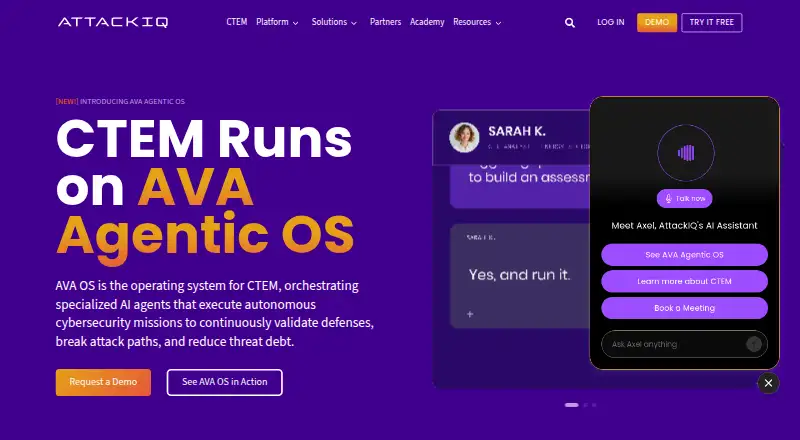
What AttackIQ Platform is
AttackIQ Platform is a continuous threat exposure management platform for modeling adversary behavior, finding attack paths, validating security controls, and measuring security improvement. AttackIQ Flex offers agentless, on-demand exposure checks through self-contained emulation packages. Its packages are reviewed in advance, and the company says they are designed to avoid disrupting production operations. Flex aligns its automated control checks and emulations with MITRE ATT&CK, but its content set is smaller than Enterprise and users can run only packages in its menu, not create custom reports.
AttackIQ Enterprise adds custom multi-stage simulations, enterprise-wide orchestration, centralized governance, role-based access, and framework-aligned reporting. Detection Rule Manager works with SIEMs including Splunk, Microsoft Sentinel, Google Chronicle, Elastic Security, and QRadar. Ready can ingest data from Tenable, Rapid7, and Qualys, connect with Jira, ServiceNow, and other ticketing systems, and provide API access for custom workflows. AttackIQ lists external and cloud asset discovery, attack-path analysis, and continuous monitoring. Flex currently supports Windows only. A free plan and trial are available; paid pricing is on request, with listed options including $300, paid once and $4,995 a month.
Good
- Agentless, on-demand exposure validation
- Emulations align with MITRE ATT&CK
- Integrations include major SIEMs and ticketing systems
- Free testing packages are available
Watch out
- Flex supports Windows only
- Flex has less content than Enterprise
- Flex users cannot generate custom reports
- Enterprise pricing is available on request
Who it suits
AttackIQ describes its intended users as Fortune 500 enterprises, federal agencies, and MSSPs. It suits teams seeking to validate security controls and model attack paths across their environments.
Verdict
AttackIQ combines exposure validation, security control checks, attack-path analysis, and detection-rule management. The right fit depends on whether Flex's packaged tests meet your needs or you require Enterprise's custom simulations and governance features.
Plans and prices
From AttackIQ Platform's own pricing page, checked 14 Oct 2026.
| Plan | Price | What it gives you |
|---|---|---|
| Flex Free | Free | Free testing packages · Adversary research |
| Free | Free | Access to Free Testing Packages · Access to Adversary Research |
| Pay-as-you-go | $300, paid once | Credit-based Purchases · Access to Value-based Discounts · Access to Adversary Research |
| Flex Pay-as-you-go | $300, paid once | Credit-based purchases · Value-based discounts · Adversary research |
| Monthly | $4,995 a month | Unlimited Testing (30 Days) · Access to Adversary Research · 1 Hour of Professional Services |
| Flex Monthly | $4,995 a month | Unlimited testing for 30 days · Adversary research · 1 hour professional services |
| Yearly | Priced on request | Unlimited Testing · Access to Adversary Research · 6 Hours of Professional Services |
| Flex Yearly | — | Programmatic testing all year · Contact us |
| AttackIQ Enterprise | Priced on request | Pricing details available by contacting a channel partner or requesting a quote · Quarterly subscription |
The facts
Each one read from AttackIQ Platform's own pages, with the date it was checked.
What it does
- Adversary emulation
- The platform executes more than 600 real-world MITRE ATT&CK techniques using authentic attacker commands and tools.checked 14 Oct 2026
- AI detection features
- Detection Rule Manager validates, measures, generates, and tunes detection rules across SIEMs, and lists Splunk, Microsoft Sentinel, Google Chronicle, Elastic Security, and QRadar integrations.checked 8 Oct 2026
- AI integrations
- AVA can be invoked from AttackIQ, ChatGPT, Claude, Cursor, Microsoft Copilot and AI-native partner applications.checked 14 Oct 2026
- AI operations
- AVA Agentic OS orchestrates specialized AI agents for CTI validation, detection coverage, control optimization, threat-debt reduction and AI security validation.checked 14 Oct 2026
- API capabilities
- The public-sector service listing says the API can create and run assessments and retrieve assessment results and test-point information.checked 14 Oct 2026
- API documentation
- The same listing says API documentation is available in OpenAPI/Swagger, HTML and PDF formats, without a sandbox environment.checked 14 Oct 2026
- Attack paths
- The platform maps attack paths to critical assets and prioritizes exposures using exploitability, reachability and business value.checked 14 Oct 2026
- Cloud marketplaces
- AttackIQ is available through AWS Marketplace and Azure Marketplace, with AWS ISV Accelerate and Microsoft IP Co-Sell Ready status stated by the vendor.checked 14 Oct 2026
- Control validation
- AttackIQ validates preventive and detective controls against real adversary behavior and measures performance across scenarios, assets and rules.checked 14 Oct 2026
- Deployment
- AttackIQ offers SaaS and on-premises software, and its federal solution is described as designed for on-premises operation.checked 14 Oct 2026
- Detection engineering
- The Detection Rule Manager validates detection coverage, measures rule performance and generates detection logic.checked 14 Oct 2026
- Documentation and support
- AttackIQ provides a support portal, email and phone support, private Slack support, knowledge-base articles, blueprints, bi-weekly release notes and Academy training.checked 14 Oct 2026
- Framework
- AttackIQ says its automated security control validation and adversary emulations align with MITRE ATT&CK.checked 8 Oct 2026
- Funding
- AttackIQ announced a $44 million Series C round on July 13, 2021, bringing total funding to approximately $79 million.checked 14 Oct 2026
- Integrations
- Published integration materials name Microsoft 365, Palo Alto Panorama, ServiceNow, Splunk, Elastic, IBM QRadar, LogRhythm, Azure Sentinel, Okta, Qualys, Tenable and AWS-related services.checked 14 Oct 2026
- Intended users
- AttackIQ says it serves Fortune 500 enterprises, federal agencies, and MSSPs.checked 8 Oct 2026
- License
- The Enterprise agreement grants a limited, non-exclusive license and identifies the AttackIQ Solution and Content Library as AttackIQ proprietary property.checked 14 Oct 2026
The company
- Company headquarters
- LinkedIn lists headquarters at 171 Main Street, Los Altos, California.checked 14 Oct 2026
- Company legal name
- AttackIQ, Inc. is identified as a Delaware corporation.checked 14 Oct 2026
- Company size
- LinkedIn lists AttackIQ as a privately held company with 51–200 employees.checked 14 Oct 2026
- Founded
- LinkedIn and Crunchbase list AttackIQ as founded in 2013.checked 14 Oct 2026
- Headquarters
- AttackIQ lists its headquarters at 171 Main Street, Suite 656, Los Altos, California 94022.checked 8 Oct 2026
Where it runs
- Compliance mapping
- AttackIQ says it maps tests to MITRE ATT&CK and compliance frameworks including NIST CSF, PCI DSS and SOC 2, with audit evidence generation.checked 14 Oct 2026
- Enterprise scenarios
- AttackIQ Enterprise supports custom multi-stage attack simulations, enterprise-wide orchestration, centralized governance, role-based access, and framework-aligned reporting.checked 8 Oct 2026
The full review of AttackIQ Platform
AttackIQ Platform is a continuous threat exposure management product for organizations that validate defenses against modeled adversary behavior. It is best suited to large enterprises, federal agencies, and MSSPs with teams to coordinate security testing. Flex makes repeatable packaged checks accessible, but custom simulations and centralized governance require Enterprise.
Overview
AttackIQ brings exposure validation, attack-path analysis, and control measurement into a continuous security program. External and cloud asset discovery extend its scope beyond simulations, while continuous monitoring and MITRE ATT&CK alignment give teams a framework for tracking security improvement. That breadth makes it a fit for organizations managing complex exposure, rather than buyers seeking only a small standalone testing utility.
Flex runs agentless, on-demand tests using self-contained packages and production-aware emulations reviewed in advance to avoid operational disruption, outages, or data issues. The safety-conscious approach supports routine validation, though it is not a promise that every exercise is risk-free in every environment.
Key features
Packaged validation and custom scenarios
AttackIQ Flex lets teams run the packages available in its menu, without deploying agents. Its content is a smaller subset of Enterprise, it is limited to Windows, and users cannot generate custom reports. That makes Flex a practical choice for teams whose needs match the packaged tests, but a poor fit when coverage must span other operating systems or scenarios need tailoring.
AttackIQ Enterprise adds custom multi-stage attack simulations, enterprise-wide orchestration, centralized governance, role-based access, and framework-aligned reporting. Those capabilities are more relevant to organizations coordinating validation across teams; they also place Enterprise in a different tier from Flex's bounded package runner.
Detection rules and integrations
Detection Rule Manager validates, measures, generates, and tunes detection rules across SIEMs, including Splunk, Microsoft Sentinel, Google Chronicle, Elastic Security, and QRadar. Ready can ingest data from Tenable, Rapid7, and Qualys, connect with Jira, ServiceNow, and other ticketing systems, and expose an API for custom workflows. These connections help teams tie exposure findings and detection work into existing security processes.
Support is offered through a portal, email, phone, a private Slack channel, a knowledge base, and blueprints, giving organizations several routes for operational help.
Pricing
AttackIQ has free access, paid options, and custom pricing. The Free plan costs nothing and includes free testing packages and adversary research. It is a way to access a limited package-based starting point, not a substitute for Enterprise's custom simulations and governance.
Pay-as-you-go costs $300, paid once and includes credit-based purchases, access to value-based discounts, and adversary research. Monthly costs $4,995 a month for unlimited testing for 30 days, adversary research, and one hour of professional services. The yearly plan has custom pricing and includes unlimited testing, adversary research, and six hours of professional services. AttackIQ Enterprise also has custom pricing, is billed as a quarterly subscription, and is priced through a channel partner or by quote. Choose among these options based on whether packaged access, credit purchases, a 30-day testing period, or Enterprise capabilities match your program; no seat limits are stated for the plans.
A free trial is available. The plan terms do not state a trial length or renewal conditions.
Platforms
AttackIQ lists API, web, and Windows platforms. Flex currently supports Windows only, so the broader platform listing should not be read as cross-operating-system Flex testing.
Who it's for
AttackIQ says it serves Fortune 500 enterprises, federal agencies, and MSSPs. It is most compelling for security organizations that need ongoing control validation, attack-path analysis, and coordinated governance. Smaller teams looking for custom simulations may find Flex too restrictive, while Enterprise's custom pricing and enterprise-wide features are likely unnecessary for teams that only need its packaged tests.
Pros and cons
- Pro: MITRE ATT&CK-aligned emulations and control validation give teams a consistent basis for evaluating defenses.
- Pro: Detection Rule Manager and integrations with SIEM, vulnerability, and ticketing tools connect validation to security operations.
- Pro: Enterprise adds multi-stage simulations, role-based access, and centralized governance for coordinated programs.
- Con: Flex is Windows-only and restricted to its available packages, limiting teams that need broader platform coverage or custom reporting.
- Con: Enterprise and yearly pricing require a quote, making cost planning less direct than the listed Free, Pay-as-you-go, and Monthly options.
Alternatives
For a free, open-source framework that runs on Linux, macOS, Windows, or self-hosted environments, consider OWASP Amass. If a 30-day no-cost option for external attack surface management is the priority, Qualys External Attack Surface Management offers one through its CSAM with EASM plan.
runZero is another option. For a free community platform with one authorized user per organization and access until revoked, consider CTM360. Bitdefender Total Security, Detectify Surface Monitoring, FullHunt, and Ivanti Neurons for Zero Trust Access are also alternatives.
AttackIQ is also relevant to broader comparisons of attack surface management software, exposure management software, and breach and attack simulation software.
Verdict
Choose AttackIQ when your organization needs recurring, ATT&CK-aligned validation plus attack-path analysis and, at the Enterprise level, custom simulations and governance. Flex is the more bounded route for teams content with packaged Windows tests. Look elsewhere if you need Flex to cover other operating systems or create custom reports, or if Enterprise's quote-based cost and governance depth exceed your needs.
Getting started
- Open the AttackIQ website
- Choose the Free plan, a trial, or a paid plan
- Use the platform through its API, web access, or Windows support
- Select available testing packages in AttackIQ Flex
- Connect listed security, SIEM, ticketing, or custom API integrations as needed
Limits worth knowing
The Free plan provides access to free testing packages and adversary research. Flex has a smaller content set than Enterprise, permits only packages shown in its menu, and does not generate custom reports.
Questions
Is there a trial?
Yes. AttackIQ lists a free trial.
Which platforms are supported?
The platform lists API, web, and Windows. AttackIQ Flex states that Windows is currently its only supported operating system.
Does it integrate with SIEM tools?
Detection Rule Manager lists Splunk, Microsoft Sentinel, Google Chronicle, Elastic Security, and QRadar integrations.
Can it connect with ticketing systems?
Ready can integrate with Jira, ServiceNow, and other ticketing systems, and offers API access for custom workflows.
Who is AttackIQ for?
AttackIQ says it serves Fortune 500 enterprises, federal agencies, and MSSPs.
Alternatives to AttackIQ Platform
- 1
Kali Linux
Free planOpen sourceAndroidLinuxmacOSSelf-hosted7.6Free plan - 2
OWASP ZAP
Free planOpen sourceAPIExtensionLinuxmacOS7.6Free plan - 3

ImmuniWeb
AndroidiOSWebAPI6.8From €595 a year - 4

Astra Security
WebAPI6.5From $699 a year - 5
Pentest-Tools.com API Scanner
WebAPILinuxmacOS6.5From $95 a month - 6
Atomic Red Team
Free planAPILinuxmacOSWindows6.2Free plan