
Hubs
Hubs is a browser-based platform for creating shared 3D spaces that people can join through a URL.
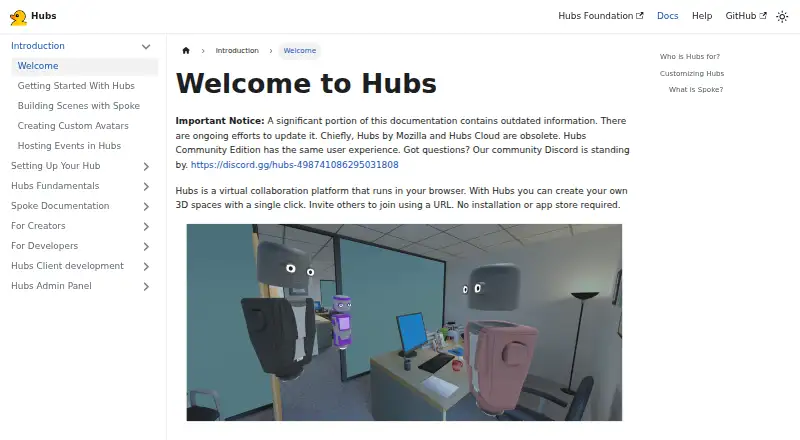
What Hubs is
Hubs is a browser-based platform for creating shared 3D spaces that people can join through a URL. Rooms support spatial audio and text chat, along with sharing images, videos, 3D models, and other media. The platform can be used for conferences, classes, art showcases, or remote socializing. Spoke, its browser-based scene editor, lets users assemble Hubs environments from 3D models, images, videos, and other assets; its media discovery includes Sketchfab. Hubs is open source and customizable, and Community Edition can be self-hosted. Administrators can configure an instance, import assets, manage users, and moderate contributed content. An account is not needed to use Hubs, though some features require sign-in. It works with VR headsets and can also be explored in 2D on computers, tablets, and mobile devices. Community Edition is free software, but hosting, domain, and email services can have separate costs. Documentation warns that a significant portion is outdated and that Hubs by Mozilla and Hubs Cloud are obsolete.
Good
- Join shared 3D rooms through a URL
- Rooms support spatial audio and text chat
- Spoke provides a browser-based scene editor
- Open-source Community Edition can be self-hosted
- Works with VR headsets and 2D devices
Watch out
- Hosting, domain, and email services cost separately
- Some features require an account sign-in
- Documentation warns that significant portions are outdated
- Mobile apps are not listed
Who it suits
Hubs suits people or organizations looking to create shared 3D spaces for events, teaching, showcases, or socializing. Its Community Edition is for those prepared to self-host and manage the instance.
Verdict
Hubs provides browser-based shared spaces and self-hosting options for Community Edition. Its documentation status and separate hosting needs are important considerations before choosing it.
Plans and prices
From Hubs's own pricing page, checked 3 Oct 2001.
| Plan | Price | What it gives you |
|---|---|---|
| Hubs Community Edition | Free | Self-hosted; hosting, domain and email service have separate costs |
The facts
Each one read from Hubs's own pages, with the date it was checked.
What it does
- Accounts
- An account is not required to use Hubs, though some features require sign-in; the docs say an email address is the only information required to create an account.checked 3 Oct 2001
- Administration
- Community Edition administrators can customize the instance, import assets, manage users, and moderate contributed content.checked 3 Oct 2001
- Capacity example
- The guide estimates that its DigitalOcean deployment supports 30–60 concurrent users, with lower capacity possible under heavy use.checked 3 Oct 2001
- Documentation status
- The welcome page warns that a significant portion of the documentation is outdated and says Hubs by Mozilla and Hubs Cloud are obsolete.checked 3 Oct 2001
- Integration
- Spoke's media discovery includes an integration with Sketchfab.checked 3 Oct 2001
- Open source
- Hubs is open source and customizable, and Community Edition can be self-hosted.checked 3 Oct 2001
- Privacy
- The Community Edition documentation says it does not store personally identifying information in its database.checked 3 Oct 2001
- Product
- Hubs is a browser-based virtual collaboration platform for creating shared 3D spaces and inviting others by URL.checked 3 Oct 2001
- Room features
- Rooms support spatialized audio, text chat, and sharing images, videos, 3D models, and other media.checked 3 Oct 2001
- Scene editor
- Spoke is a browser-based scene editor for building Hubs environments with 3D models, images, videos, and other assets.checked 3 Oct 2001
- Support
- The Foundation directs users to its Discord for community support and provides email contact for private questions.checked 3 Oct 2001
- Use cases
- The docs describe using Hubs to host conferences, teach classes, showcase art, or socialize remotely.checked 3 Oct 2001
Money
- Hosting cost example
- A Foundation setup guide estimates at least $38 USD per month for its DigitalOcean hosting example, plus domain and possible email-service charges; it is not a Hubs subscription price.checked 3 Oct 2001
Where it runs
- Supported devices
- The docs say Hubs works with VR headsets and can be explored in 2D on desktop computers, laptops, tablets, and mobile devices.checked 3 Oct 2001
The full review of Hubs
Overview
Hubs is a browser-based platform for gathering in shared 3D spaces, with access by URL and support for both VR and 2D browsing. It suits organizers who want to shape their own virtual venue, especially through a self-hosted Community Edition. Its combination of open-source customization and media-rich rooms is appealing, but self-hosting has real costs and the documentation warns that much of its guidance is outdated.
Rooms can serve conferences, classes, art showcases, or remote social gatherings. Participants can communicate through spatialized audio and text chat while sharing images, videos, 3D models, and other media. Guest access means joining does not require an account, though some features require sign-in; an email address is sufficient to create one.
Hubs is open source, and Community Edition administrators can customize an instance, import assets, manage users, and moderate contributed content. The Community Edition documentation says its database does not store personally identifying information. Room access is invite-only, and rooms are persistent, which favors planned spaces over open drop-in gatherings.
Compare it with other options in our Virtual Meeting Room Software list.
Key features
Rooms for shared media
Hubs supports screen sharing, spatial audio, text chat, and shared media in a room with a stated capacity of 25 participants. That ceiling makes it a better fit for classes, small conferences, and focused group sessions than for large events. The Foundation's DigitalOcean hosting example estimates 30–60 concurrent users, with lower capacity possible under heavy use; that deployment estimate does not override the plan's 25-participant room limit.
Build a custom venue with Spoke
Spoke is a browser-based scene editor for assembling Hubs environments from 3D models, images, videos, and other assets. Its Sketchfab integration helps discover media for scenes. This gives organizers a way to tailor a venue to an event or class, though it asks for more preparation than a conventional video meeting room.
Community Edition administration
Self-hosting gives administrators control over instance customization, assets, users, and contributed-content moderation. That control is valuable for organizations with specific venue or administration needs, but it also makes hosting and upkeep their responsibility. The Foundation directs users to Discord for community support and offers email contact for private questions.
Pricing
Hubs Community Edition
Hubs Community Edition costs nothing and is open source. It includes self-hosting, persistent rooms, spatial audio, guest access, screen sharing, and a 25-participant room capacity. There are no mobile apps; mobile access is through the browser. The free price is for the software, not the infrastructure: hosting, domain, and email service have separate costs.
A Foundation setup guide estimates at least $38 USD per month for its DigitalOcean hosting example, plus domain and possible email-service charges. It estimates 30–60 concurrent users for that deployment, potentially fewer under heavy use. This is a hosting example, not a Hubs subscription price, and actual capacity depends on use. The practical trade-off is clear: Community Edition avoids a software subscription but requires a self-hosted setup and ongoing hosting expenditure.
Platforms
Hubs supports Android, iOS, Linux, macOS, Windows, web, and self-hosted deployments. It works with VR headsets and can also be explored in 2D on desktop computers, laptops, tablets, and mobile devices. There are no dedicated mobile apps, so mobile use depends on the browser.
Who it's for
Hubs is best suited to organizers who want a customizable, persistent virtual venue and are willing to manage or arrange self-hosting. Teachers, conference hosts, art exhibitors, and remote social groups can use its shared 3D scenes and media tools to give a gathering more spatial character than a standard call. Invite-only access and a 25-person room capacity favor controlled, modest-sized sessions. It is a weaker fit for teams seeking a turnkey service, a dedicated mobile app, or current, dependable setup guidance.
Pros and cons
Pros
- Open-source customization: Community Edition administrators can tailor the instance and manage users, assets, and contributed content.
- Purpose-built shared spaces: Persistent rooms, spatial audio, screen sharing, and media support give events and classes more than a basic voice or video call.
- Guest participation: Joining does not require an account, reducing friction for invited participants.
- Multiple ways to explore: VR headset support sits alongside 2D access from computers, tablets, and mobile browsers.
Cons
- Self-hosting adds cost and work: The software is free, but hosting, domain, and possibly email services cost extra; administrators must run the instance.
- Room size is limited: The stated cap of 25 participants constrains larger meetings, regardless of the higher concurrent-user estimate for one hosting example.
- Documentation needs caution: The welcome page warns that a significant portion is outdated and says Hubs by Mozilla and Hubs Cloud are obsolete.
- No dedicated mobile apps: Mobile access is browser-based, which may not suit users looking for an app-based experience.
Alternatives
Choose WorkAdventure if a freemium option with a free plan limited to 10 users and unlimited duration better suits your group; its listed platforms include Android, iOS, Linux, macOS, self-hosted, web, and Windows.
Topia may suit organizers who want a free DEMO tier with 50-person capacity, or a PRO plan priced at $4 a month, billed at $4 per user per month.
Samudaia is another free option, billed Free during early access with a team-sized workspace; paid plans for large organizations are in development.
Consider flat.social for a browser-based free plan capped at five people at once, with unlimited session length, spatial audio and video rooms, custom maps and look, and an embed button.
Glue offers a free tier for teams needing up to 10 members and 10 team spaces, with 30-minute sessions and 2GB of team file storage.
RAUM is an option for buyers considering a paid Professional Plus plan at €99 a month when billed annually, with 12 concurrent users, three workspaces, and a 100-user maximum.
Overte is a free alternative for users on Windows or Linux.
Unyted.World is another option for web and iOS users.
Verdict
Choose Hubs if you want an open-source, customizable 3D venue for invite-only gatherings and can take responsibility for self-hosting. Its strongest case is the mix of persistent rooms, shared media, and administrator control without a software subscription. Look elsewhere if you need a managed setup, room capacity beyond 25, dedicated mobile apps, or documentation you can rely on as current.
Getting started
- Open the Hubs documentation website.
- Choose whether to use Hubs or self-host Community Edition.
- For a self-hosted setup, arrange hosting, a domain, and any needed email service.
- Build an environment in Spoke using 3D models, images, videos, or other assets.
- Create or enter a room and invite others by URL.
- Sign in if a desired feature requires an account.
Limits worth knowing
Community Edition software is free, but hosting, domain, and possible email-service costs are separate. A Foundation guide estimates 30–60 concurrent users for its DigitalOcean example, with lower capacity possible under heavy use.
Questions
Does Hubs cost anything?
Hubs Community Edition is listed as free open-source software. Self-hosting may involve separate hosting, domain, and email-service costs.
Can people join without an account?
An account is not required for Hubs use, though some features require sign-in. The documentation says an email address is the only information needed to create an account.
Which devices does Hubs support?
Hubs works with VR headsets and can be explored in 2D on desktop computers, laptops, tablets, and mobile devices. There are no mobile apps.
Can Hubs be self-hosted?
Yes. Community Edition can be self-hosted, and administrators can customize the instance, import assets, manage users, and moderate contributed content.
What can people do in a Hubs room?
Rooms support spatial audio and text chat, plus sharing images, videos, 3D models, and other media.
Where can users get support?
The Foundation directs users to its Discord for community support and provides an email contact for private questions.
Alternatives to Hubs
- 1

Glue
Free planAndroidiOSWebmacOS7.3From €50 a month - 2

Topia
Free planAndroidiOSWeb7.2From $4 a month - 3

WorkAdventure
Free planAndroidiOSWebAPI7.2From €8 a month - 4
Watch2Gether
Free planAndroidiOSWebWindows7.1From $9.99 a month - 5

RAUM
AndroidiOSWebmacOS6.9From €99 a month - 6
Frame
AndroidiOSWeb6.8From $10 a month