HRDocket Policy Management
HRDocket Policy Management helps teams publish policies and track employee acknowledgements within a broader HR document and employee records platform.
What HRDocket Policy Management is
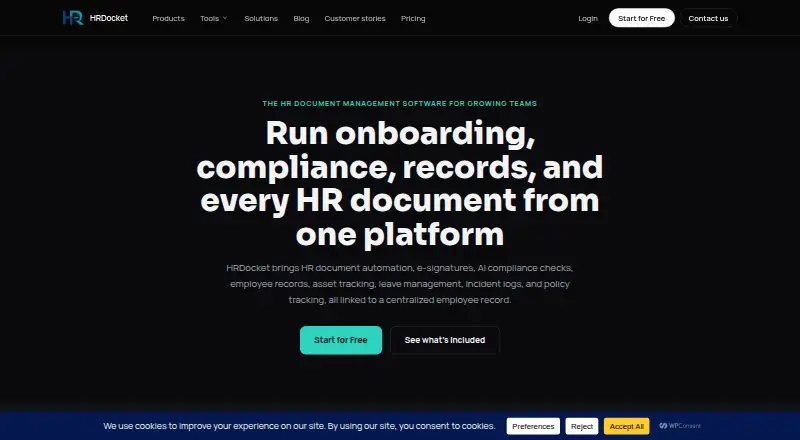
HRDocket Policy Management helps teams publish policies and track employee acknowledgements within a broader HR document and employee records platform. Policies can be assigned to individuals, departments, locations, or the whole organization. A dashboard identifies acknowledged and outstanding policies, with timestamped records tied to each version. Earlier versions stay archived, so acknowledgements for updated policies can be tracked separately. HRDocket can send reminders about outstanding acknowledgements, and records can be exported for audits. Users can create policies with AI or upload existing documents into a central library; employees review and acknowledge them through an Employee Portal. The wider platform also includes document generation, digital signatures, employee records, compliance checks, expiration alerts, leave management, incident logging, and asset tracking. The free plan supports up to one employee and one company. A 24-hour trial offers Business-plan access.
Good
- Assign policies by person, department, location, or organization
- Version-specific acknowledgement records include timestamps
- Automated reminders for outstanding acknowledgements
- Export acknowledgement records for audits
- Create policies with AI or upload existing ones
Watch out
- Free plan limited to one employee and one company
- Growth plan includes five tracking items
- Unlimited tracking requires the Business plan
- Business plan costs $82.50 a month, billed annually
Who it suits
It suits HR teams that need to distribute policies across teams or locations and track acknowledgements. Smaller teams can start with the free plan; larger organizations may need a paid tier for more tracking capacity.
Verdict
HRDocket combines policy publishing and version-aware acknowledgement tracking with broader HR records tools. Check the plan limits against the number of policies and employees you need to manage.
Plans and prices
From HRDocket Policy Management's own pricing page, checked 14 Oct 2026.
| Plan | Price | What it gives you |
|---|---|---|
| Free | Free | Up to 1 employee · 1 company · 10 AI credits · limited templates · watermarked PDFs · jurisdiction-based drafting |
| Starter | $19 a month | Up to 15 employees · 2 companies · 120 AI credits/month · digital signatures · expiration reminders · storage/history · $19/month; $15.83/month billed annually ($190), 2 months free |
| Growth | $49 a month | Up to 50 employees · 3 companies · 250 AI credits/month · AI compliance checks · incident logs · leave management · employee portal · 5 acknowledgement trackings · $49/month; $40.83/month billed annually ($490), 2 months free |
| Business | $99 a month | Unlimited employees · 4 companies · 600 AI credits/month · advanced compliance · multi-user management · advanced audit logs · unlimited policy acknowledgement tracking · dedicated support · $99/month; $82.50/month billed annually ($990), 2 months free |
The facts
Each one read from HRDocket Policy Management's own pages, with the date it was checked.
What it does
- 24-hour access
- HRDocket offers requested 24-hour access to Business-plan features without a card or commitment.checked 14 Oct 2026
- Acknowledgements
- The dashboard shows who has acknowledged a policy and who is still outstanding, with timestamped records tied to a specific policy version.checked 3 Oct 2026
- Acknowledgement tracking
- HR can see who acknowledged, viewed, or still needs to review each policy.checked 14 Oct 2026
- AI data processing
- AI features may process prompts, employee and company information, templates, submitted documents, and generated output.checked 14 Oct 2026
- AI policy generator
- Policies can be generated with AI or uploaded from existing files.checked 14 Oct 2026
- Automated reminders
- The system sends reminders to employees with outstanding acknowledgements.checked 14 Oct 2026
- Capterra listing
- Capterra lists a $19 monthly starting price and describes HRDocket as serving freelancers, small businesses, midsize businesses, and enterprises.checked 14 Oct 2026
- Central policy library
- The product stores company policies in one centralized library.checked 14 Oct 2026
- Creation and storage
- Users can generate policies with AI or upload existing policies, then manage them in a centralized policy library.checked 3 Oct 2026
- Digital acknowledgements
- Employees submit electronic acknowledgements that are timestamped against a specific policy version.checked 14 Oct 2026
- Employee portal
- Employees can review and acknowledge policies from their Employee Portal.checked 3 Oct 2026
- Employee record integration
- Each acknowledgement is added to the employee’s permanent HR record.checked 14 Oct 2026
- Integration handling
- The privacy policy says customer-authorized integrations can transfer information between HRDocket and connected services when available.checked 14 Oct 2026
- Integrations
- The maker pages reviewed do not specify third-party integrations.checked 3 Oct 2026
- Intended users
- HRDocket describes its policy management as suitable for small teams as well as organizations managing policies across larger teams and locations.checked 3 Oct 2026
- Launch date
- INITE reports that HR Docket launched on Product Hunt on 22 August 2026.checked 14 Oct 2026
- Limit: integrations
- HRDocket’s comparison content characterizes its integrations as limited.checked 14 Oct 2026
Where it runs
- Broader platform
- The wider HRDocket platform combines document generation, e-signatures, compliance checks, employee records, assets, leave, incidents, and policy tracking.checked 14 Oct 2026
- Browser access
- Employees can use the portal from desktop, tablet, or mobile browsers.checked 14 Oct 2026
The company
- Company description
- Crunchbase describes HRDocket as an AI HR documentation, employee-records, and workplace-management platform.checked 14 Oct 2026
- Company legal name
- Crunchbase identifies the legal name as HRDocket and operating status as active.checked 14 Oct 2026
- Company size
- Crunchbase lists HRDocket’s headcount as 1–10 people.checked 14 Oct 2026
Money
- Free access
- The free plan requires no credit card and includes one employee profile, one company, ten AI credits, limited templates, and watermarked PDFs.checked 14 Oct 2026
- Limit: free output
- The free plan produces watermarked PDF downloads and restricts template access.checked 14 Oct 2026
The full review of HRDocket Policy Management
Overview
HRDocket Policy Management combines policy workflows with employee records and HR documents, making it a practical fit for teams that want those jobs in one platform. Its strongest case is version-specific acknowledgement tracking; the main trade-off is that distribution capacity is limited on lower paid plans.
Key features
Policies can be created with AI or uploaded, then stored in a central library and assigned to individuals, departments, locations, or the organization as a whole. That range makes it possible to target a site-specific or role-specific policy without treating every employee the same.
The dashboard distinguishes acknowledged policies from outstanding ones. Each record carries a timestamp and identifies the policy version, while older versions remain archived and acknowledgements for a revision can be tracked separately. This is useful when HR needs to establish which employees confirmed which wording, rather than merely whether a policy was acknowledged at some point.
Automated reminders chase outstanding acknowledgements, and records can be exported for audits. Employees review and acknowledge policies through the Employee Portal. HRDocket also includes document generation, digital signatures, employee records, compliance checks, expiration alerts, leave management, incident logging, and asset tracking, so policy management sits alongside a wider set of HR tasks. The maker says signed documents are encrypted and stored securely.
Pricing
HRDocket has a free plan and paid plans. The Free plan costs nothing and caps use at 1 employee and 1 company, with 10 AI credits and watermarked PDF downloads. It is a narrow way to try the broader platform, not a workable policy program for a team.
Starter costs $15.83 a month, billed Annually ($190) with 2 months free. It supports up to 15 employees and 2 companies, includes 120 AI credits/month and 2 custom templates, but does not include distribution and acknowledgement tracking. That omission makes it a poor fit if policy sign-offs are the reason to choose HRDocket.
Growth costs $40.83 a month, billed Annually ($490) with 2 months free. It raises capacity to 50 employees and 3 companies, with 250 AI credits/month, 5 custom templates, and 5 distribution and acknowledgement tracking items. This is the entry point for teams that need the core policy workflow, but the five-item cap may constrain organizations with many policies.
Business costs $82.50 a month, billed Annually ($990) with 2 months free. It allows unlimited employees and policy distribution and acknowledgement tracking across 4 companies, with 600 AI credits/month and 7 custom templates; dedicated support is included. It is the clearest fit for larger teams or policy libraries that would outgrow Growth, though company count remains capped at four.
A 24-hour trial provides full access to Business-plan features without a card or commitment. HRDocket’s pricing model is freemium, and the paid plans shown use annual billing.
Platforms
HRDocket is available on the web. Third-party integrations are not part of the product’s stated offer.
Who it's for
HRDocket suits small HR teams that want policy acknowledgement records alongside employee documents and related HR processes, as well as organizations distributing policies across teams and locations. The free and Starter tiers are limited for policy tracking; teams that need acknowledgements should budget for Growth or Business. It is less compelling for buyers who need more than four companies on the top plan or broad integration options.
Pros and cons
- Pros: Version-specific, timestamped acknowledgement records make it easier to distinguish sign-offs on current and prior policies.
- Pros: Targeted distribution, automated reminders, and audit exports cover the core follow-up workflow.
- Pros: Policy work shares a platform with employee records, document generation, and other HR functions.
- Cons: Starter has no distribution or acknowledgement tracking, despite being a paid plan.
- Cons: Growth limits tracking to 5 items, while Business is required for unlimited tracking.
- Cons: Business allows unlimited employees but only 4 companies, which may not suit organizations managing more entities.
Alternatives
Compare options in Policy Management Software. Policyflow is worth considering for a smaller team: its free plan supports up to 15 employees with unlimited policies, version history, and audit-ready exports, without a time limit or card requirement; it has no free trial.
Keelstar offers free tools without an account and private signed share links, with web and API platforms; consider it if those specific free tools suit your needs. ComplianceBridge Policy Management, Zavanta, Go-EMP Policy Management, InspectWrk Policy Management, Mitratech CaseCloud, and EQS Integrity Line are other options to compare.
Verdict
Choose HRDocket if your team wants policy distribution, version-aware acknowledgements, and reminders within a broader HR records platform. Growth is the sensible starting point for policy tracking, but its five-item ceiling is a real constraint; look elsewhere if you need unlimited tracking without moving to Business or need more than four companies on the top plan.
Getting started
- Visit https://hrdocket.com/.
- Use HRDocket on the web.
- Start with the free plan, choose a paid plan, or use the 24-hour Business-feature trial.
- Generate a policy with AI or upload an existing policy.
- Add policies to the library and assign them to people, departments, locations, or the organization.
- Have employees review and acknowledge assigned policies through the Employee Portal.
Limits worth knowing
The free plan permits one employee and one company, includes 10 AI credits, and provides watermarked PDF downloads. Growth includes five distribution and acknowledgement tracking items; Business includes unlimited tracking.
Questions
Is there a free plan?
Yes. The Free plan costs nothing and includes up to one employee, one company, 10 AI credits, and watermarked PDF downloads.
How much do the paid plans cost?
Starter is $15.83 a month, billed annually at $190. Growth is $40.83 a month, billed annually at $490, and Business is $82.50 a month, billed annually at $990; each annual plan lists two months free.
Can I try Business features?
Yes. The pricing page offers full access to Business-plan features for 24 hours without a card or commitment.
What platforms does HRDocket support?
HRDocket is available on the web.
How many policy acknowledgements can Growth and Business track?
Growth includes five distribution and acknowledgement tracking items. Business includes unlimited distribution and acknowledgement tracking.
What else is included in the HRDocket platform?
The platform also includes HR document generation, digital signatures, employee records, compliance checks, expiration alerts, leave management, incident logging, and asset tracking.
Alternatives to HRDocket Policy Management
- 1
Go-EMP Policy Management
AndroidiOSWebmacOS7.7From ₹49 a month - 2
Keelstar
Free planWebAPI7.4From $49 a month - 3

Policyflow
Free planWeb7.3From €155 a month - 4

Diligram (MyStaff)
AndroidiOSWebAPI7.1From £850 a month - 5

InspectWrk Policy Management
AndroidiOSWebAPI6.9From $288 a year - 6
Akcepta
Free planWebSelf-hosted6.7From €129 a year