Hound
Hound is a free source code search engine that indexes repositories and lets users search them with regular expressions.
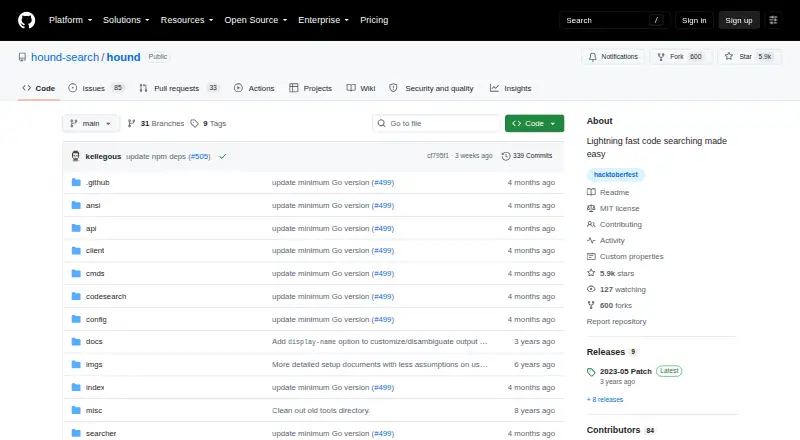
What Hound is
Hound is a free source code search engine that indexes repositories and lets users search them with regular expressions. Its Go backend maintains an index for each repository, while a React-based web interface and minimal API provide ways to use search. The search engine uses a trigram index to support regex matching. Hound works with Git, Mercurial, SVN, Bazaar, and local repositories; private repositories can be indexed from local directories or accessed through file or SSH-style URLs. It checks configured repository locations for changes every 30 seconds by default, with an interval that can be changed per repository. You can build it from source or run its Docker image, and the web interface defaults to localhost:6080. Plugins are available for Sublime Text, Vim, Emacs, and Visual Studio Code. Hound is tested on macOS and CentOS and is intended to work on Unix-like systems, but Windows is not supported. It does not provide TLS, so its documentation suggests using Apache or nginx in front of it. Hound is distributed under the MIT license.
Good
- Supports Git, Mercurial, SVN, Bazaar, and local repositories
- Indexes private repositories through local paths or URLs
- Editor plugins cover Sublime Text, Vim, Emacs, and VS Code
- Repository polling interval can be changed per repository
Watch out
- Windows is not supported
- Hound does not provide TLS
- Repository polling defaults to every 30 seconds
Who it suits
Hound suits developers and teams who want repository-wide regex search across supported version control systems, including private repositories. It is a fit for Unix-like environments, but not for Windows deployments.
Verdict
Hound offers repository indexing and regex search with support for several version control systems and editor plugins. Its lack of built-in TLS and Windows support are important deployment constraints.
The facts
Each one read from Hound's own pages, with the date it was checked.
What it does
- Architecture
- Hound has a static React frontend and a Go backend that maintains an up-to-date index for each repository and exposes a minimal API.checked 1 Oct 2026
- Creators
- Hound was created at Etsy by Kelly Norton and Jonathan Klein.checked 1 Oct 2026
- Deployment
- Hound can be built from source or run from the project's GitHub Container Registry Docker image.checked 2 Oct 2026
- Docker
- Hound provides a Docker image at ghcr.io/hound-search/hound:latest and instructions for building its own image.checked 1 Oct 2026
- Editor integrations
- The README lists plugins supporting Sublime Text, Vim, Emacs, and Visual Studio Code.checked 2 Oct 2026
- Index updates
- By default, Hound polls configured repository URLs for updates every 30 seconds; the interval can be changed per repository.checked 2 Oct 2026
- License
- The repository provides Hound under the MIT License.checked 2 Oct 2026
- Operating-system support
- Hound is tested on macOS and CentOS, should work on any Unix-like system, and is not supported on Windows.checked 1 Oct 2026
- Origin
- The README says Hound was created at Etsy by Kelly Norton and Jonathan Klein.checked 2 Oct 2026
- Private repositories
- Private repositories can be indexed from local directories, local clones, or SSH URLs when SSH keys are configured on the Hound host.checked 2 Oct 2026
- Purpose
- Hound is an extremely fast source code search engine with a React frontend and Go backend that maintains an index for each repository.checked 2 Oct 2026
- Release
- The latest release listed on the project's Releases page is v0.7.1, dated May 3, 2023.checked 2 Oct 2026
- Release status
- The latest listed release is v0.7.1, published in May 2023.checked 1 Oct 2026
- Repository updates
- Hound polls configured repository URLs for updates every 30 seconds by default.checked 1 Oct 2026
- Search engine
- Hound’s core is based on regular expression matching with a trigram index.checked 2 Oct 2026
- Search technology
- Its core is based on regular-expression matching with a trigram index.checked 1 Oct 2026
- Security limitation
- Hound does not currently support TLS and is commonly run behind Apache or nginx.checked 1 Oct 2026
- Support
- The README describes platform support and setup guidance but does not specify a support service.checked 2 Oct 2026
- TLS limitation
- Hound does not support TLS itself; the README suggests running it behind Apache or nginx.checked 2 Oct 2026
- Version control
- Hound supports Git, Mercurial, SVN, Bazaar, and local repositories.checked 2 Oct 2026
- Web interface
- Hound hosts a web UI by default at http://localhost:6080.checked 2 Oct 2026
Where it runs
- Platform support
- The README says Hound is tested on macOS and CentOS and should work on any Unix-like system; Windows is not supported, though it may compile and run.checked 2 Oct 2026
The full review of Hound
Overview
Hound is a self-hosted source-code search engine built around repository indexing and regular-expression queries. Its appeal is strongest for teams that want a web search interface across repositories they control, with editor plugins as an additional route in. The trade-off is operational: deployment is Unix-oriented, and serving it securely requires a separate TLS-terminating proxy.
Key features
Hound combines a static React frontend with a Go backend that maintains an index for each configured repository and exposes a minimal API. Its trigram index supports regular-expression matching, making it suited to searching source across repositories rather than offering broader code-intelligence capabilities. The web interface runs at http://localhost:6080 by default.
It supports Git, Mercurial, SVN, Bazaar, and local repositories. Private repositories can be indexed from local directories or through file:// and SSH-style URLs. Hound polls repository URLs every 30 seconds by default, and that interval can be changed per repository. That keeps indexes refreshed without manual updates, though teams with different freshness needs will want to tune the polling interval.
Deployment can be from source or the project's Docker image, ghcr.io/hound-search/hound:latest; instructions are also provided for building an image. Plugins supporting Hound are available for Sublime Text, Vim, Emacs, and Visual Studio Code. These broaden where users can access search, but the core remains a self-hosted index and web interface.
Pricing
Hound is free under the MIT license, with no free trial because there is no paid plan to trial. That makes it an option for teams prepared to operate the service themselves without a software license charge. No paid plans or seat and usage quotas are part of its pricing model.
Platforms
Hound provides a web UI and API and is intended for self-hosted deployment. It is tested on macOS and CentOS and is expected to work on Unix-like systems; Windows is not supported, even though it may compile and run. Organizations standardized on Windows should look elsewhere rather than treat possible compilation as supported deployment.
Hound does not provide TLS itself. The project recommends placing it behind Apache or nginx, so a secure deployment requires configuring and maintaining that additional layer. The latest listed release is v0.7.1, published May 3, 2023.
Who it's for
Hound suits developers and teams that need regex-based search across repositories using several version-control systems, and can manage a self-hosted service on a Unix-like system. Editor-plugin users may also value being able to bring Hound-backed search into Sublime Text, Vim, Emacs, or Visual Studio Code. It is a weaker fit for Windows-first environments or teams seeking built-in TLS or a specified support service.
Pros and cons
- Pros: Free and MIT-licensed, with no seat or usage caps stated in its pricing model.
- Pros: Supports five repository sources, including private repositories through local paths and file or SSH-style URLs.
- Pros: Regex search, configurable polling, and plugins for four editors give teams several ways to work with indexed code.
- Cons: No native TLS means secure web access depends on a proxy such as Apache or nginx.
- Cons: Windows is unsupported, narrowing its fit for Windows-based operations.
- Cons: The latest listed release dates to May 2023, and no support service is specified.
Alternatives
For a broader code search tools shortlist, compare options by platform and search approach; readers focused on detecting code clones can browse code clone detection tools.
Code Search is the better fit for teams wanting Windows support, unlimited users, full-text search, repository-wide find and replace, and CLI and MCP access in its free Community plan. For a local, open-source MIT tool that runs on Linux, macOS, and Windows, consider sqry.
Understand is an alternative for readers considering a freemium tool with a free trial and extension support. searchcode is another free option for API, self-hosted, and web use, with its free plan described as during beta. Sourcebot offers a free Basic plan and a self-hosted web option. Readers comparing other free, cross-platform choices can also consider CodeQuery, ripgrep, and The Silver Searcher.
Verdict
Choose Hound if you want free, self-hosted regex search across varied repositories and can run it on a Unix-like system behind a TLS proxy. Its repository coverage and editor plugins are useful strengths; Windows exclusion and the extra security layer are the clearest reasons to choose another tool.
Alternatives to Hound
- 1
Avidemux
Free planOpen sourceWebLinuxmacOSWindows7.3Free plan - 2

Understand
APIExtensionLinuxmacOS7.2From $100 a month - 3

ast-grep
Free planWebAPIExtensionLinux7.0Free plan - 4

Chromium
Open sourceAndroidiOSExtensionLinux6.9 - 5
Semantic Designs Source Code Search Engine
Free planAPILinuxSelf-hostedWindows6.7Free plan - 6

Code Fundi
Free planWebAPIExtension6.6From $21 a month