
sqry
sqry is a free, open-source code analysis tool from Verivus Pty Ltd.
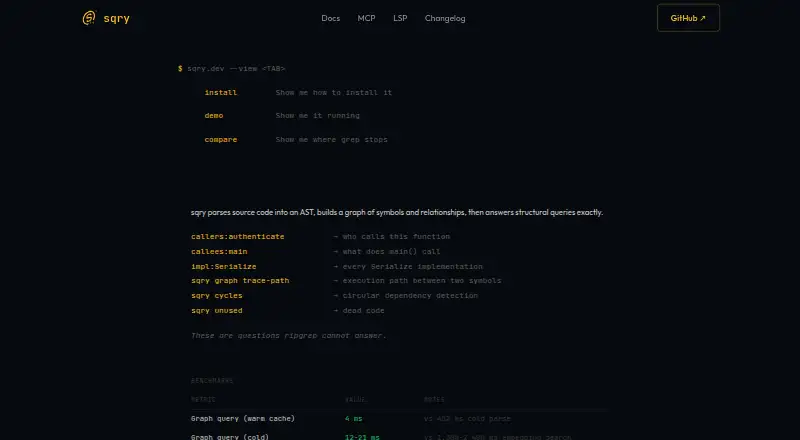
What sqry is
sqry is a free, open-source code analysis tool from Verivus Pty Ltd. It parses a codebase into an abstract syntax tree and a graph of symbols and relationships, then answers structural questions such as which functions call another. Its documented queries cover callers, callees, implementations, dependency cycles, and unused symbols. The project lists 37 language plugins: 28 support full relationship tracking, while nine extract symbols and imports. Users build an index before querying; it persists so later queries can load a cached graph snapshot. sqry runs locally on Linux, macOS, and Windows, and its maker says source code stays on the machine with no telemetry. For AI assistants, it provides an MCP server with 39 tools in standalone mode and a curated 16-tool set in daemon mode. An LSP server works with VS Code, Neovim, Helix, and LSP 3.17 clients. Installation options include installers for all three desktop platforms and cargo installation. The Windows release ZIP includes required MinGW runtime DLLs alongside the executables.
Good
- Free and open source under the MIT license.
- Lists 37 language plugins, with 28 supporting full relation tracking.
- Runs locally with no telemetry, according to its maker.
- MCP server offers 39 standalone tools.
- Release installation scripts verify checksums by default.
Watch out
- Users must build an index before querying.
- Windows executables require bundled MinGW runtime DLLs.
- The project does not currently publish a public composite GitHub Action.
Who it suits
sqry suits developers who want to query code relationships locally or connect code navigation to an LSP-compatible editor. Its MCP server also supports several AI assistants, including Claude, Codex, Gemini, Cursor, and Windsurf.
Verdict
sqry combines local code indexing with structural queries, editor support, and integrations for AI assistants. Its language plugins vary in relationship tracking, so check whether the support level meets your needs.
Plans and prices
From sqry's own pricing page, checked 30 Sep 2026.
| Plan | Price | What it gives you |
|---|---|---|
| sqry | Free | Open source · MIT license · runs locally |
The facts
Each one read from sqry's own pages, with the date it was checked.
What it does
- AI integrations
- Its MCP server supports Claude, Codex, Gemini, Cursor, and Windsurf; the standalone server exposes 38 tools, while daemon mode exposes a curated subset of 16.checked 30 Sep 2026
- CI
- The documentation describes using sqry's install script and CLI commands in GitHub Actions and says it does not currently publish a public composite action.checked 30 Sep 2026
- CI integration
- The home page lists a GitHub Action for checking dead code, cycles, and duplicates on every pull request.checked 30 Sep 2026
- Dependency auditing
- The project says it audits dependencies with cargo-vet and uses cargo-deny for license policy and CVE checks on every commit.checked 30 Sep 2026
- Editor integrations
- sqry provides an LSP server that works with VS Code, Neovim, Helix, and any LSP 3.17 client.checked 30 Sep 2026
- Index requirement
- Users build an index before querying, and the index persists so later queries can load the cached graph snapshot.checked 30 Sep 2026
- Installation
- The quick start lists installers for macOS, Linux, and Windows, plus cargo installation for all platforms.checked 30 Sep 2026
- Languages
- sqry lists 37 language plugins; 28 support full relation tracking and nine provide symbol extraction and import tracking.checked 30 Sep 2026
- Language support
- sqry has 37 language plugins: 28 provide full relation support and nine provide symbol and import extraction.checked 30 Sep 2026
- Local processing
- The product says it runs entirely on the user's machine, with no source code leaving the machine and no telemetry.checked 30 Sep 2026
- MCP tools
- The standalone MCP server exposes 39 tools, while daemon mode provides a curated subset of 16 tools.checked 30 Sep 2026
- Privacy
- The maker says no source code leaves your machine and sqry has no telemetry.checked 30 Sep 2026
- Product
- sqry parses source code into an abstract syntax tree, builds a graph of symbols and relationships, and answers structural code queries.checked 30 Sep 2026
- Purpose
- sqry parses source code into an abstract syntax tree and symbol graph to answer structural code queries such as who calls a function.checked 30 Sep 2026
- Query features
- Its documented queries and graph commands cover callers, callees, implementations, dependency cycles, and unused symbols.checked 30 Sep 2026
- Security
- Public releases include checksums and Sigstore DSSE attestation metadata, and the installation scripts verify checksums by default.checked 30 Sep 2026
The company
- Company
- The site identifies Verivus Pty Ltd as the maker and says sqry is built by Verivus.checked 30 Sep 2026
- Maker
- The site identifies Verivus Pty Ltd as the maker of sqry.checked 30 Sep 2026
Money
- License and price
- sqry is open source under the MIT license and runs locally.checked 30 Sep 2026
Where it runs
- Windows requirement
- The Windows build requires bundled MinGW runtime DLLs alongside the executables; the release ZIP includes them.checked 30 Sep 2026
The full review of sqry
Overview
sqry is a locally run code-analysis tool for developers who need to understand how symbols relate across a codebase. It is best suited to maintainers who want structural queries in an editor or AI-assisted workflow; the need to index a project first makes it less compelling for a quick, one-off lookup.
Instead of relying solely on text matches, sqry parses code into an abstract syntax tree and builds a graph of symbols and relationships. Its index persists, so later queries can use the cached graph snapshot. Regular-expression search and code navigation complement the structural analysis.
Key features
Queries and language support
Documented queries and graph commands cover callers, callees, implementations, dependency cycles, and unused symbols. That makes sqry useful for tracing behavior and examining code structure, while the language support has an important distinction: of 37 plugins, 28 provide full relation tracking and nine extract symbols and imports. Users should confirm their language has the relationship support needed for their queries.
Editor and AI integrations
The LSP server works with VS Code, Neovim, Helix, and any LSP 3.17 client, putting navigation in established editor workflows. For AI-assisted work, the MCP server supports Claude, Codex, Gemini, Cursor, and Windsurf. Its standalone mode exposes 39 tools; daemon mode offers a curated subset of 16, which is a more constrained interface for integrations that do not need the full set.
Local operation and setup
sqry runs on the user's machine under the MIT license. Its maker says source code stays on the machine and the software has no telemetry, which suits users who want local processing. The trade-off is that users must build an index before querying, even though it persists for later use.
Installers are provided for macOS, Linux, and Windows, and cargo installation is available on all three. Windows users need the bundled MinGW runtime DLLs alongside the executables; the release ZIP includes them. Public releases include checksums and Sigstore DSSE attestation metadata, and installation scripts verify checksums by default.
CI workflows
The documentation describes running the install script and CLI commands in GitHub Actions, and the home page identifies a GitHub Action for checking dead code, cycles, and duplicates on pull requests. Teams should expect to wire up CI using those approaches: sqry does not currently publish a public composite action.
Pricing
sqry is free: its sqry plan costs nothing and includes the open-source MIT-licensed software running locally. There is no paid tier or trial to weigh against it. The free plan's central limitation is practical rather than a stated usage cap: users need to build an index, and the depth of relationship queries depends on the language plugin.
Platforms
sqry supports Linux, macOS, and Windows. The local deployment model and installers make it a fit for developers working on those desktop platforms; Windows setup requires keeping the included MinGW runtime DLLs with the executables.
Who it's for
sqry is a strong fit for developers and maintainers who need to follow calls, implementations, dependencies, or unused symbols, especially when they want those capabilities in an editor or through an MCP-connected assistant. It is also relevant to teams seeking local code processing or a CLI-based GitHub Actions workflow. It is a weaker fit for users who only need immediate text search, or whose language depends on relationship tracking when its plugin provides only symbol and import extraction.
Pros and cons
- Pros: Structural queries span callers, callees, implementations, cycles, and unused symbols, offering more than regular-expression matching alone.
- Pros: LSP and MCP integrations connect the tool to named editors and AI assistants, with a choice between 39 standalone tools and a 16-tool daemon subset.
- Pros: Local execution, MIT licensing, and the maker's no-telemetry and no-source-transfer claims suit privacy-conscious development workflows.
- Cons: Indexing is required before the first query, adding a setup step for one-off searches.
- Cons: Nine of 37 language plugins do not provide full relation tracking, which can rule out some structural queries for those languages.
- Cons: CI users must rely on the install script and CLI commands rather than a public composite action.
Alternatives
For a different code-search workflow, compare the Code Search Tools category. Choose ast-grep if you want a free tool available across API, extension, desktop, and web platforms. Code Search is a better fit for teams seeking unlimited users, full-text search, repository-wide find and replace, and CLI and MCP access on its free Community plan.
OpenGrok is another free, open-source option, under the CDDL license. Choose Shebe if local code search under the Apache-2.0 license is the priority. Chatterbox TTS is an alternative with free, MIT-licensed open-source models for research and development.
LXR Cross Referencer may suit users looking for free, self-installed, open-source software. Semantic Designs Source Code Search Engine offers a free evaluation version limited to 10,000 lines of Java, COBOL, C++, and pseudo-code. Sourcebot is a freemium option with a free Basic plan for code search, including regex and symbol search.
Verdict
Choose sqry if you need local, graph-based code queries and want to bring them into an editor or AI assistant without paying for an MIT-licensed tool. Its most important caveat is uneven relationship support across language plugins, so look elsewhere if your language needs a level of tracking its plugin does not provide or you want search without an indexing step.
Getting started
- Open the sqry website
- Install the macOS, Linux, or Windows package
- Alternatively install sqry with cargo
- Build an index for your codebase
- Run structural queries or connect an editor or MCP client
Questions
Is sqry free?
Yes. sqry is free, open source, and released under the MIT license.
Which operating systems does it support?
sqry provides builds for Linux, macOS, and Windows.
Does source code leave the machine?
The maker says sqry runs locally, sends no source code away, and has no telemetry.
How many languages are supported?
sqry lists 37 language plugins. Twenty-eight support full relation tracking, while nine provide symbol and import extraction.
Can it connect to AI assistants?
Yes. Its MCP server supports assistants including Claude, Codex, Gemini, Cursor, and Windsurf.
Which editors work with sqry?
Its LSP server works with VS Code, Neovim, Helix, and any LSP 3.17 client.
Alternatives to sqry
- 1
Avidemux
Free planOpen sourceWebLinuxmacOSWindows7.3Free plan - 2

Understand
APIExtensionLinuxmacOS7.2From $100 a month - 3

ast-grep
Free planWebAPIExtensionLinux7.0Free plan - 4

Chromium
Open sourceAndroidiOSExtensionLinux6.9 - 5
Semantic Designs Source Code Search Engine
Free planAPILinuxSelf-hostedWindows6.7Free plan - 6

Code Fundi
Free planWebAPIExtension6.6From $21 a month