HomeGenie
HomeGenie is a free, open-source ecosystem for controlling smart homes and connected devices with local-first software and hardware.
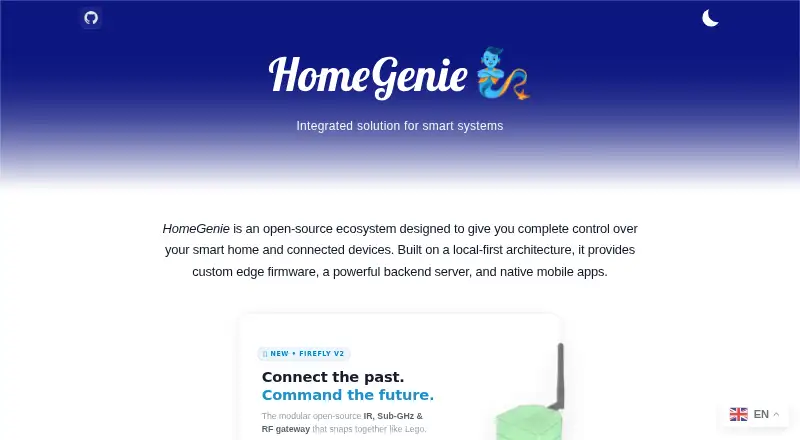
What HomeGenie is
HomeGenie is a free, open-source ecosystem for controlling smart homes and connected devices with local-first software and hardware. HomeGenie Server runs on Windows, Mac, Linux, and ARM devices such as Raspberry Pi, providing automation, dashboards, a code editor, virtual modules, and historical logs with charts and filters. Its local Lailama AI turns natural-language commands into inspectable, editable API calls. Automation can use C#, JavaScript, or Python, with GPIO, I2C, SPI, and PWM access on supported hardware. Native integrations include ZigBee, Z-Wave, MQTT, KNX, and X10, plus Web APIs and physical devices. VisionCore handles video detections, recordings, and live monitoring with YOLO models. Mini firmware supports ESP32 and ESP8266 devices, while Panel turns Android devices into dashboards with Gemini voice control and UPnP discovery. The project began in 2009 and is primarily maintained by its original founder.
Good
- Free and open source
- Local automation and AI
- ZigBee and Z-Wave support
- Multiple scripting languages
- Runs across major desktop platforms
Watch out
- Setup spans multiple components
- Advanced functions require supported hardware
- Android is required for Panel
Who it suits
HomeGenie suits users who want open-source, local control of smart-home devices across varied operating systems and hardware. It also fits people comfortable with scripting, DIY gateways, and self-hosted automation.
Verdict
HomeGenie offers a broad local-control toolkit spanning server software, firmware, dashboards, and hardware integrations. Its open-source design and programming support suit technically inclined smart-home builders.
The facts
Each one read from HomeGenie's own pages, with the date it was checked.
What it does
- Analytics
- The server provides historical data logs, time-range navigation, interactive charts, and filters such as moving averages.checked 8 Oct 2026
- Automation
- The server includes customizable dashboards, an integrated code editor, virtual modules for prototyping, and historical sensor logs with charts and filters.checked 9 Oct 2026
- Automation and programming
- The server supports automation scripts in C#, JavaScript, and Python, plus hardware access through GPIO, I2C, SPI, and PWM on supported hardware.checked 8 Oct 2026
- Firefly
- Firefly is a DIY gateway that combines IR, 433/315 MHz RF, and X10 devices, with modular components that plug into its board without soldering.checked 8 Oct 2026
- HomeGenie Mini
- HomeGenie Mini is open-source firmware for ESP32 and ESP8266 devices, with local JavaScript automation and a built-in scheduler.checked 8 Oct 2026
- Integrations
- The server lists native support for ZigBee, Z-Wave, MQTT, KNX, and X10, plus GPIO, I2C, SPI, and PWM access on supported hardware.checked 9 Oct 2026
- Local AI
- The server’s Lailama AI runs language models locally and can generate API calls to orchestrate devices; users can inspect and edit the generated scripts.checked 9 Oct 2026
- Local control
- Yeschecked 24 Sep 2026
- Mini connectivity
- HomeGenie Mini supports HTTP, WebSocket, MQTT, and Serial, and can be discovered by SSDP/UPnP or connected to HomeGenie Panel and Server.checked 9 Oct 2026
- Mini firmware
- HomeGenie Mini is open-source firmware for ESP32 and ESP8266 devices, with local JavaScript automation and no internet requirement for setup or core functionality.checked 9 Oct 2026
- Open source and history
- The About page says the project began in 2009, is 100% open source, and is now primarily maintained by its original founder.checked 8 Oct 2026
- Panel integrations
- HomeGenie Panel integrates Google Gemini for conversational voice control and acts as a UPnP control point for discovering media servers and smart TVs.checked 9 Oct 2026
- Pricing
- The opened maker pages describe HomeGenie as open-source but do not state plan prices or trial terms.checked 9 Oct 2026
- Product
- HomeGenie describes itself as an open-source ecosystem for controlling smart homes and connected devices, with firmware, a backend server, and mobile apps.checked 8 Oct 2026
- Programming
- The maker documents C#, JavaScript, and Python support through a unified API bus.checked 9 Oct 2026
- Project history
- The maker says HomeGenie began in 2009 as a personal project and is now primarily maintained by its original founder.checked 9 Oct 2026
- Purpose
- HomeGenie describes itself as an open-source ecosystem for controlling smart homes and connected devices, built around local-first software and hardware.checked 9 Oct 2026
- Security
- The maker says HomeGenie communications use end-to-end encryption and that Panel encryption keys are exchanged within the private home network rather than over the internet.checked 9 Oct 2026
- Server
- HomeGenie Server is a self-hosted automation engine that the maker says runs on Windows, Mac, Linux, and ARM devices such as Raspberry Pi.checked 9 Oct 2026
- Support
- The About page links to a Q&A discussion forum and says user and developer involvement is welcome.checked 9 Oct 2026
- VisionCore
- VisionCore processes video feeds for AI detections, event-based MP4 recording, and live stream monitoring, with visual metadata available to automation and local AI.checked 9 Oct 2026
- Zigbee support
- Yeschecked 24 Sep 2026
Money
- Free plan
- Yeschecked 24 Sep 2026
Where it runs
- Panel platform
- HomeGenie Panel turns an Android device into a dashboard and control hub with a built-in automation engine and customizable interface.checked 9 Oct 2026
Alternatives to HomeGenie
- 1
Google Home
Free planAndroidiOSWebAPI8.1From $10 a month - 2
eWeLink
Free planAndroidiOSWebAPI8.0From $9.90 a year - 3
Homey
Free planAndroidiOSWeb8.0From $2.99 a month - 4
HomeSeer HS4
Free planAndroidiOSWebLinux7.8From $39.95 a year - 5
Amazon Alexa
Free planAndroidiOSWeb7.5Free plan - 6
Loxone
Free planAndroidiOSLinuxmacOS7.5From $70 a year