HiveMQ MQTT Broker
HiveMQ MQTT Broker handles event-driven messaging between connected devices and enterprise systems.
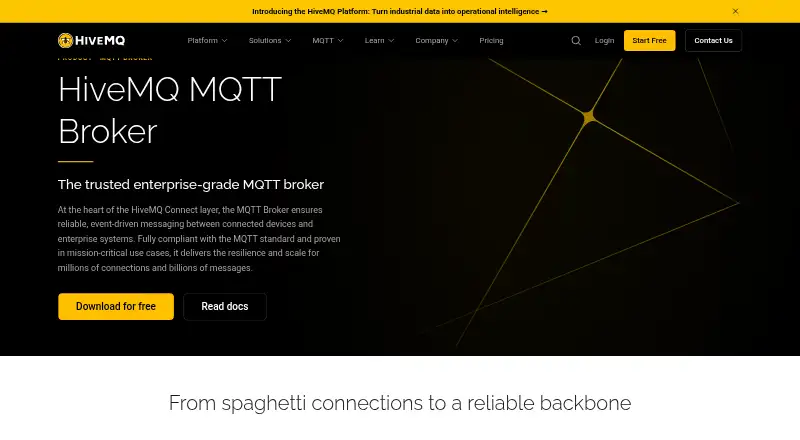
What HiveMQ MQTT Broker is
HiveMQ MQTT Broker handles event-driven messaging between connected devices and enterprise systems. It supports MQTT 3.1.1 and MQTT 5.0, with persistent messages stored to disk, offline queuing, and quality-of-service options. Operators can add or remove broker nodes while a cluster is running. Extensions connect the broker to streaming services, databases, data warehouses, and security services; listed examples include Kafka, Amazon Kinesis, and Google Pub/Sub. Security features include TLS 1.2/1.3, mutual TLS, access controls, pluggable authentication such as OAuth 2.0 and LDAP, and audit logging. The self-managed broker runs on private, hybrid, or public clouds, with images for Kubernetes, OpenShift, and DC/OS. HiveMQ lists a free plan and paid plans including Launch at $299 a month and Run at $499 a month. In evaluation mode without a valid license, a self-managed broker is limited to 25 client connections. The maker positions the product for large-scale IoT deployments and enterprise operations.
Good
- Supports MQTT 3.1.1 and MQTT 5.0.
- Persistent messaging and offline queues are included.
- Clusters can grow or shrink at runtime.
- Extensions connect to listed data and streaming services.
- Security options include mutual TLS and audit logging.
Watch out
- Evaluation mode is limited to 25 client connections.
- Launch costs $299 a month.
- Run costs $499 a month.
Who it suits
It suits teams building connected-device messaging systems, particularly those planning enterprise or large-scale IoT deployments. Self-managed deployments can be run across private, hybrid, and public clouds.
Verdict
HiveMQ offers MQTT messaging, clustering, integrations, and a broad set of security controls. Teams evaluating the self-managed broker should account for its 25-connection evaluation limit and compare plan capacity and support options.
Plans and prices
From HiveMQ MQTT Broker's own pricing page, checked 4 Oct 2026.
| Plan | Price | What it gives you |
|---|---|---|
| Launch | $299 a month | 1 broker deployment · 10,000 connections · 500 msgs/sec (normalized message size 5 KB) · Community support · $299/month |
| Run | $499 a month | 1 broker deployment · 10,000 connections · 1,000 msgs/sec (normalized message size 5 KB) · Silver support · $499/month |
| Serverless | Priced on request | 100 connections · 10 GB/month traffic |
| Starter | — | 10,000 connections · 1 MB/sec · 99.95% Uptime SLA · Silver support · From $0.34/hour+ $0.80/million messages |
| Lab | Free | 1 broker deployment · 25 connections · 25 msgs/sec (normalized message size 5 KB) · Community support · Free software license; valid for 30 days and renewable manually at no charge |
| Fully-managed Enterprise | Priced on request | Custom connections + throughput · Up to 99.99% uptime · Silver, Gold, or Platinum support · Priced by capacity |
| Self-managed Enterprise | Priced on request | Multi-broker / multi-site · Custom connection and throughput limits · Silver, Gold, or Platinum support · Priced by capacity |
The facts
Each one read from HiveMQ MQTT Broker's own pages, with the date it was checked.
What it does
- Clustering
- Dynamic clustering supports adding or removing broker nodes without downtime, and the cluster can grow or shrink at runtime.checked 4 Oct 2026
- Compliance
- HiveMQ states that it is ISO/IEC 27001:2022 certified and SOC 2 Type II compliant.checked 4 Oct 2026
- Deployment
- The self-managed broker can run on private, hybrid, and public clouds, with pre-built images for Kubernetes, OpenShift, and DC/OS.checked 4 Oct 2026
- Evaluation limit
- The self-managed broker starts in evaluation mode without a valid license and supports up to 25 client connections in that mode.checked 4 Oct 2026
- Integrations
- HiveMQ extensions integrate with streaming services, databases, data warehouses, and security services; the maker lists Kafka, Amazon Kinesis, and Google Pub/Sub extensions.checked 4 Oct 2026
- Intended users
- HiveMQ describes the broker as built for mission-critical enterprise operations and large-scale IoT deployments.checked 4 Oct 2026
- MQTT support
- The broker supports MQTT 3.1.1 and MQTT 5.0.checked 4 Oct 2026
- Purpose
- HiveMQ Broker provides reliable, event-driven MQTT messaging between connected devices and enterprise systems.checked 4 Oct 2026
- Reliability
- Features include persistent messaging stored to disk, offline message queuing, and QoS support.checked 4 Oct 2026
- Scale
- The maker describes the broker as scaling to millions of connections and billions of messages.checked 4 Oct 2026
- Security
- The broker page lists TLS 1.2/1.3, mutual TLS, fine-grained access control, pluggable authentication such as OAuth 2.0 and LDAP, and audit logging.checked 4 Oct 2026
- Support
- The maker offers Community, Silver, Gold, and Platinum support options; Gold and Platinum support are available up to 24×7.checked 4 Oct 2026
The company
- Founded
- 2012checked 28 Sep 2026
- Headquarters
- Landshut, Germanychecked 28 Sep 2026
The full review of HiveMQ MQTT Broker
Overview
HiveMQ MQTT Broker is an MQTT messaging broker for moving events between connected devices and enterprise systems. It is best suited to teams building large IoT deployments or mission-critical services that need scale, security controls, and runtime cluster changes. Its strengths are substantial, but smaller projects should weigh the capacity tiers and the self-managed evaluation limit.
Key features
The broker supports MQTT 3.1, 3.1.1, and 5.0, as well as TCP, TLS, and WebSocket. Persistent messages stored to disk, offline message queues, configurable delivery guarantees, QoS support, and dead-letter queues give operators several ways to handle message delivery and failure. A 256 MB maximum message size allows large payloads, though the right fit depends on the application’s message patterns.
Dynamic clustering lets teams add or remove nodes without downtime and change cluster size while the system is running. That is useful when capacity needs shift, particularly in large deployments. HiveMQ says the broker can scale to millions of connections and billions of messages; those are maker claims, not a substitute for matching a plan’s stated capacity to expected load.
Extensions connect the broker with streaming services, databases, data warehouses, and security services, including Kafka, Amazon Kinesis, and Google Pub/Sub. Security controls include TLS 1.2/1.3, mutual TLS, fine-grained access control, pluggable authentication such as OAuth 2.0 and LDAP, and audit logging. HiveMQ states that it is ISO/IEC 27001:2022 certified and SOC 2 Type II compliant, relevant credentials for organizations with formal security requirements.
The self-managed broker can run in private, hybrid, or public clouds, with pre-built images for Kubernetes, OpenShift, and DC/OS. Without a valid license, it starts in evaluation mode with a 25-client connection ceiling. That is enough to assess basic integration, but not to validate a larger deployment under representative connection load.
Pricing
HiveMQ’s pricing model is freemium, with a free plan, a 15-day trial, and paid options. The stated starting price is $0.34; the Starter plan is billed From $0.34/hour+ $0.80/million messages, so usage can add to the hourly charge.
| Plan | Price and capacity | What it means |
|---|---|---|
| Lab | Custom pricing; 100 connections and 100 msgs/sec, based on a normalized 5 KB message size | A small capacity ceiling makes it a fit for limited workloads, not a growing production fleet. |
| Launch | $299 a month; 1 broker deployment, 10,000 connections, 500 msgs/sec at normalized 5 KB, Community support | A single deployment with a defined throughput cap suits teams that can work with community support. |
| Run | $499 a month; 1 broker deployment, 10,000 connections, 1,000 msgs/sec at normalized 5 KB, Silver support | It doubles Launch’s stated throughput and adds Silver support, while keeping the same connection and deployment counts. |
| Self-Managed Enterprise | Custom pricing; multi-broker and multi-site deployments, custom capacity | For organizations that need to manage their own deployment across sites and set capacity to their requirements. |
| Serverless | Custom pricing; 100 connections and 10 GB/month traffic | The traffic allowance is a key constraint for teams considering this option. |
| Starter | Custom pricing; billed From $0.34/hour+ $0.80/million messages; 10,000 connections, 1 MB/sec, 99.95% Uptime SLA, Silver support | Usage-based billing and a stated uptime SLA may suit a team preferring this capacity and support combination. |
| Fully-Managed Enterprise | Custom pricing; up to 99.99% uptime | The stated uptime ceiling distinguishes it for teams prioritizing managed service availability. |
Launch costs less than Run but provides half its stated message rate and Community rather than Silver support. Both cap the deployment count at one and allow 10,000 connections. Teams needing multiple brokers or sites should consider Self-Managed Enterprise; teams considering Starter should account for both hourly and per-message charges. The free-plan and trial details do not establish additional capacity or terms beyond those stated above.
HiveMQ offers Community, Silver, Gold, and Platinum support options; Gold and Platinum support are available up to 24×7. Support availability is an important distinction for teams that need round-the-clock escalation.
Platforms
HiveMQ supports API, Linux, Windows, and self-hosted use. Its hybrid deployment model and cloud options give operators flexibility over where to run the broker, while Kubernetes, OpenShift, and DC/OS images align with teams already using those environments.
Who it's for
HiveMQ is a strong candidate for enterprise IoT teams that need MQTT messaging, runtime clustering, integration extensions, and a broad set of security controls. Its plan capacities and enterprise support options make it more appropriate for organizations planning around defined connection and throughput needs than for casual or very small deployments. A 25-connection evaluation limit also makes the self-managed version a poor way to assess full-scale load before licensing.
Pros and cons
- Pros: Dynamic clustering changes capacity without downtime, useful for services that cannot schedule broker outages.
- Pros: Persistent messaging, offline queuing, configurable delivery guarantees, and dead-letter queues provide several delivery and failure-handling options.
- Pros: MQTT protocol coverage, extensions, and security controls make it adaptable to enterprise IoT architectures.
- Cons: The self-managed evaluation mode is limited to 25 client connections, restricting realistic scale evaluation.
- Cons: Launch and Run are single-deployment plans, and Run’s higher throughput costs more while retaining the same connection ceiling.
- Cons: Starter combines hourly and per-million-message charges, so usage contributes to cost beyond the base hourly rate.
Alternatives
For a self-managed broker without a paid plan, RabbitMQ offers a free, community-supported server under the Mozilla Public License 2.0. Apache Artemis is another free self-hosted option under Apache License 2.0, with Java 17+ required. If core MQTT features and on-premises deployment are the priority, Eclipse Mosquitto is a free alternative.
For a managed notification service with a monthly free allowance, Amazon SNS offers 1 million requests, 100,000 HTTP notifications, and 1,000 email notifications in its Free Tier. Teams comparing queue-oriented services can also consider Amazon SQS, CloudAMQP, Google Cloud Pub/Sub, or browse Message Broker Software and Message Queue (MQ) Software.
Verdict
Choose HiveMQ when a large IoT or enterprise deployment needs MQTT, runtime clustering, integration options, and mature security controls. Its defined Launch and Run capacities, broader enterprise paths, and support tiers give teams choices as requirements grow. Look elsewhere if a free self-managed broker is the priority, if a 25-connection evaluation cap is too restrictive, or if a single-deployment paid plan cannot meet the needed topology.
Getting started
- Visit HiveMQ's MQTT Broker website at https://www.hivemq.com/products/mqtt-broker/.
- Choose a free option, a paid plan, or a self-managed deployment.
- For self-managed use, deploy on a private, hybrid, or public cloud, or use an available Kubernetes, OpenShift, or DC/OS image.
- If using a self-managed instance without a valid license, account for evaluation mode's 25-connection limit.
- Select a support option: Community, Silver, Gold, or Platinum.
Limits worth knowing
A self-managed broker without a valid license starts in evaluation mode and supports up to 25 client connections. Launch costs $299 a month and includes one broker deployment, up to 10,000 connections, and 500 messages per second at a normalized message size of 5 KB; Run costs $499 a month and includes one deployment, up to 10,000 connections, and 1,000 messages per second at that message size.
Questions
Does HiveMQ MQTT Broker have a free plan?
Yes. The pricing information includes a free plan, and the Lab plan lists 100 connections and 100 messages per second based on a normalized 5 KB message size.
How much do Launch and Run cost?
Launch costs $299 a month. Run costs $499 a month.
Which MQTT versions does it support?
It supports MQTT 3.1.1 and MQTT 5.0. The supported protocol list also includes MQTT 3.1, TCP, TLS, and WebSocket.
Can the broker be self-managed?
Yes. The self-managed broker can run on private, hybrid, and public clouds, with pre-built images for Kubernetes, OpenShift, and DC/OS.
What happens in evaluation mode?
A self-managed broker without a valid license starts in evaluation mode and supports up to 25 client connections.
Which support options are available?
HiveMQ offers Community, Silver, Gold, and Platinum support. Gold and Platinum support are available up to 24×7.
Alternatives to HiveMQ MQTT Broker
- 1

EMQX
Free planOpen sourceWebAPILinuxmacOS8.1From $234 a month - 2

RabbitMQ
Free planOpen sourceWebAPILinuxmacOS7.8Free plan - 3

CloudAMQP
Free planWebAPILinuxmacOS7.6From $19 a month - 4

Apache ActiveMQ
Free planOpen sourceWebAPILinuxmacOS7.5Free plan - 5
Apache RocketMQ
Free planOpen sourceAPILinuxmacOSSelf-hosted7.5Free plan - 6
Faye
Free planOpen sourceWebAPILinuxmacOS7.5Free plan