
Amazon SQS
Amazon SQS is a managed cloud message queuing service for microservices, distributed systems, and serverless applications.
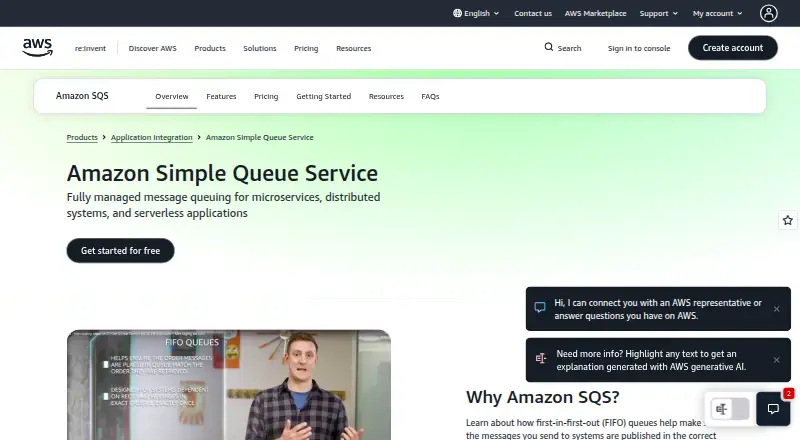
What Amazon SQS is
Amazon SQS is a managed cloud message queuing service for microservices, distributed systems, and serverless applications. It lets software components send, store, and receive messages so applications can operate independently and respond to events. Standard queues offer at-least-once delivery with best-effort ordering; FIFO queues preserve message order without introducing duplicates. Standard queues support nearly unlimited transactions per second per API action, while FIFO high throughput mode supports up to 70,000 messages per second without batching. Payloads can be up to 256 KB, and larger messages can use the Java Extended Client Library with Amazon S3. SQS accepts batches of up to 10 messages and retains messages for up to 14 days. Dead Letter Queues can receive messages after their maximum receive count is exceeded and must match the source queue type. AWS lists integrations with Redshift, DynamoDB, RDS, EC2, ECS, Lambda, and S3, and describes fanout with SNS. Server-side encryption uses AWS KMS keys. The Free Tier is listed as free for 1 million requests; S3 storage, KMS calls, and some data transfers may cost extra.
Good
- Standard and FIFO queue options
- Batches of up to 10 messages
- Message retention up to 14 days
- Dead Letter Queue support
- Free Tier includes 1 million requests
Watch out
- Payload limit is 256 KB without the S3 extension
- S3 storage and KMS calls may incur extra charges
- Some data transfers may incur separate charges
Who it suits
SQS suits teams building microservices, distributed systems, or serverless applications that need components to exchange messages. AWS describes its audience as including startups, enterprises, nonprofits, and governments.
Verdict
Amazon SQS provides queue choices, message batching, retention, and integrations for distributed application architectures. Consider the payload limit and possible charges for related storage, encryption, and data transfer.
Plans and prices
From Amazon SQS's own pricing page, checked 15 Oct 2026.
| Plan | Price | What it gives you |
|---|---|---|
| Free Tier | Free | 1 million Amazon SQS requests per month · unused usage does not roll over · monthly |
| Standard queues | Priced on request | Usage-based pricing · At-least-once delivery · Best-effort ordering |
| FIFO queues | Priced on request | Usage-based pricing · Exactly-once processing · Ordered message groups |
| Amazon SQS Free Tier | Free | Free usage calculated monthly across Regions except GovCloud · Unused free usage does not roll over · 1 million requests per month |
| Pay-as-you-go | — | standard, FIFO and fair-queue request charges · 64 KB payload chunks count as requests · data-transfer charges may apply · per request; no minimum fee |
The facts
Each one read from Amazon SQS's own pages, with the date it was checked.
What it does
- Additional charges
- S3 storage, AWS KMS calls, and cross-Region or internet data transfer may incur separate charges.checked 30 Sep 2026
- API and CLI
- AWS publishes a web-services API reference, developer guide and AWS CLI reference for SQS.checked 15 Oct 2026
- AWS integrations
- AWS documents integrations with Redshift, DynamoDB, RDS, EC2, ECS, Lambda and S3, plus SNS fan-out patterns.checked 15 Oct 2026
- Batching
- Send, receive and delete operations can handle batches of up to 10 messages, reducing API-call overhead.checked 15 Oct 2026
- Batching and retention
- SQS supports batches of up to 10 messages and retains messages for up to 14 days.checked 30 Sep 2026
- Compliance
- AWS says its compliance program supports 143 security standards and certifications, including PCI-DSS, HIPAA/HITECH, FedRAMP, GDPR, FIPS 140-3 and NIST 800-171.checked 15 Oct 2026
- Dead-letter queues
- Dead-letter queues receive messages that exceed a configured receive count and support inspection and redrive to source queues.checked 15 Oct 2026
- Delivery delay limit
- Message timers support delays from zero to a maximum of 15 minutes.checked 15 Oct 2026
- Encryption
- Server-side encryption uses AWS Key Management Service keys to encrypt message bodies at rest and decrypt them for authorized consumers.checked 15 Oct 2026
- Failure handling
- Dead Letter Queues can receive messages after their maximum receive count is exceeded, and must match the source queue type.checked 30 Sep 2026
- FIFO queues
- FIFO queues preserve message order and provide exactly-once processing, with default throughput up to 3,000 messages per second when batching is used.checked 15 Oct 2026
- Integrations
- AWS lists integrations with Redshift, DynamoDB, RDS, EC2, ECS, Lambda, and S3, and describes fanout with SNS.checked 30 Sep 2026
- Intended users
- AWS describes SQS use for organizations building microservices, distributed systems, and serverless applications, including startups, enterprises, nonprofits, and governments.checked 30 Sep 2026
- Licence
- Amazon SQS is proprietary software rather than an open-source product.checked 15 Oct 2026
- Limit: AWS ecosystem dependence
- TrustRadius reviewers caution that SQS is less attractive for mixed environments because complete solutions tend to depend on the broader AWS stack.checked 15 Oct 2026
- Limit: complexity and configuration
- Gartner reviewers describe initial AWS implementation as complicated and slow, with rigid configuration and data limitations.checked 15 Oct 2026
- Limit: console monitoring
- G2 reviewers mention difficult console navigation, inaccurate message counts and limited monitoring or dead-letter handling.checked 15 Oct 2026
- Limit: debugging and FIFO throughput
- G2 reviewers report that distributed-message debugging is difficult and FIFO queues have lower throughput than standard queues.checked 15 Oct 2026
The company
- Company founded
- LinkedIn describes Amazon Web Services as launched in 2006.checked 15 Oct 2026
- Company headquarters
- Amazon Web Services, Inc. lists 410 Terry Avenue North, Seattle, Washington 98109-5210, United States.checked 15 Oct 2026
- Company legal name
- AWS identifies the U.S. contracting entity as Amazon Web Services, Inc.checked 15 Oct 2026
- Company ownership and funding
- Crunchbase lists Amazon Web Services, Inc. as a private Seattle company with 10001+ employees and one grant round funded by the BIRD Foundation.checked 15 Oct 2026
- Company size
- LinkedIn lists 146,958 employees associated with Amazon Web Services.checked 15 Oct 2026
- Founded
- 2006checked 28 Sep 2026
Alternatives to Amazon SQS
- 1

EMQX
Free planOpen sourceWebAPILinuxmacOS8.1From $234 a month - 2

RabbitMQ
Free planOpen sourceWebAPILinuxmacOS7.8Free plan - 3

CloudAMQP
Free planWebAPILinuxmacOS7.6From $19 a month - 4

Apache ActiveMQ
Free planOpen sourceWebAPILinuxmacOS7.5Free plan - 5
Apache RocketMQ
Free planOpen sourceAPILinuxmacOSSelf-hosted7.5Free plan - 6
Faye
Free planOpen sourceWebAPILinuxmacOS7.5Free plan