HarmBench
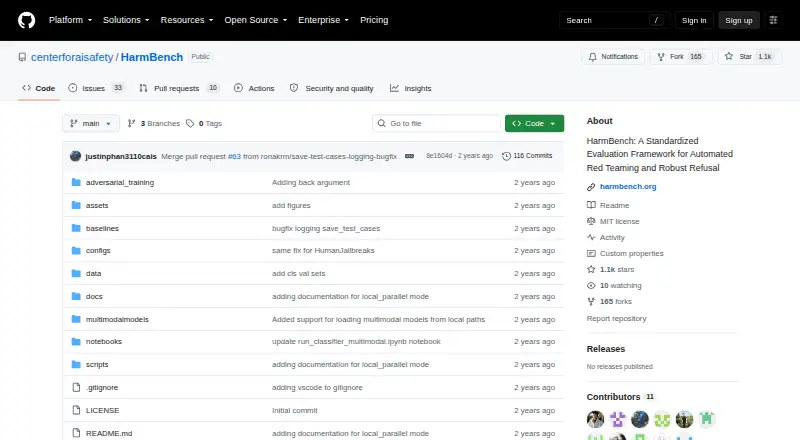
The facts below are what the maker publishes about HarmBench, checked and dated. Our editors have not written about it yet.
The facts
Each one read from HarmBench's own pages, with the date it was checked.
What it does
- Classifiers
- The project provides three classifier models for standard, contextual, and multimodal behaviors, including a validation classifier.checked 8 Oct 2026
- Compute requirements
- The documentation says evaluation requires enough GPUs for the target model, attack, and classifier, and its default GPU settings were chosen for 80GB A100s.checked 8 Oct 2026
- Customization
- Users can add Hugging Face Transformers models through the model configuration and add red-teaming methods in the baselines directory.checked 8 Oct 2026
- Custom methods
- Users can add red teaming methods by creating a subfolder in the baselines directory and implementing the RedTeamingMethod class.checked 8 Oct 2026
- Custom models
- Users can add Hugging Face Transformers models through the model configuration file, though AutoDAN, PAIR, and TAP require manual experiment configuration for new models.checked 8 Oct 2026
- Evaluation uses
- The framework supports evaluating red teaming methods against LLMs and evaluating LLMs against red teaming methods.checked 8 Oct 2026
- Evaluation workflow
- Its pipeline generates red-team test cases, prompts target models to generate completions, and classifies those completions to calculate attack success rate.checked 8 Oct 2026
- Execution
- The pipeline can run sequentially on the current machine, in parallel across GPUs on one machine with Ray, or with SLURM across machines.checked 8 Oct 2026
- Installation
- The README instructs users to clone the repository, install requirements with pip, and download the en_core_web_sm spaCy model.checked 8 Oct 2026
- License
- The public GitHub repository lists an MIT license.checked 8 Oct 2026
- Model support
- HarmBench supports Transformers-compatible LLMs, numerous closed-source APIs, and several multimodal models out of the box.checked 8 Oct 2026
- Pipeline
- Its evaluation pipeline generates test cases, generates model completions, and evaluates completions, with an optional test-case merging step.checked 8 Oct 2026
- Pipeline execution
- The pipeline can run locally, in parallel across GPUs on one machine with Ray, or through SLURM jobs.checked 8 Oct 2026
- Purpose
- HarmBench is an open-source framework for evaluating automated red teaming methods and LLM attacks and defenses.checked 8 Oct 2026
- Security and compliance
- The repository README and linked HarmBench website page provide no security or compliance claims; the website page opened here only says JavaScript must be enabled.checked 8 Oct 2026
- Support
- The README links to evaluation pipeline and codebase documentation for further details.checked 8 Oct 2026
- Usage caveat
- The documentation says its text and multimodal classifier models are test classifiers intended only for evaluation.checked 8 Oct 2026
- Who it serves
- The project describes uses for evaluating red-teaming methods against LLMs and evaluating LLMs against red-teaming methods.checked 8 Oct 2026
Alternatives to HarmBench
- 1
OpenSecureAI Scanner
Free planOpen sourceWebAPILinuxmacOS8.1From $49 a month - 2

PromptGuard
Free planWebAPIExtensionLinux7.9From $19 a month - 3

Promptfoo
Free planOpen sourceWebAPILinuxmacOS7.8Free plan - 4

Giskard
Free planOpen sourceWebAPILinuxSelf-hosted7.6Free plan - 5

AIRTA Red Team
Free planOpen sourceWebAPILinuxmacOS7.5Free plan - 6
CyberSecEval
Free planOpen sourceWebAPILinuxmacOS7.5Free plan