Grendel
Grendel is a bare-metal provisioning system for Linux clusters used in high-performance computing.
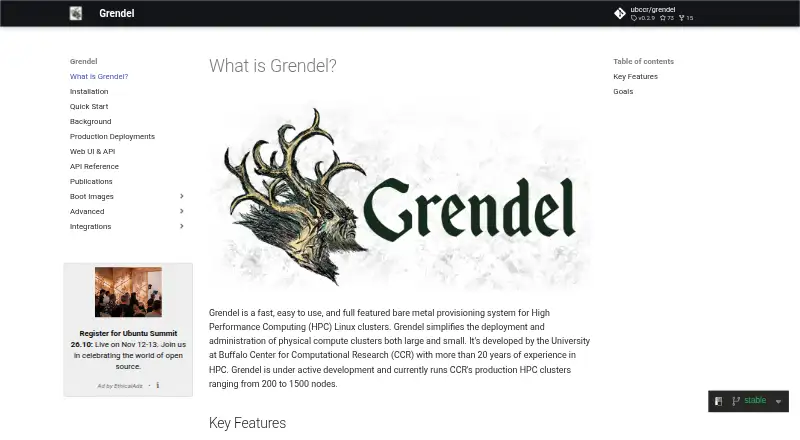
What Grendel is
Grendel is a bare-metal provisioning system for Linux clusters used in high-performance computing. It provides DHCP, PXE, TFTP, DNS, and HTTP services for network-based Linux provisioning, with diskful and stateless live-image options. It can boot kernel and initrd images, including LiveOS images, and find hosts through switch queries, DHCP packet snooping, a dhcpd.leases file, or tab-delimited imports. For hardware management, it supports BMC and iDRAC control through RedFish and IPMI. An HTTP API powers its command-line client and built-in Web UI. The TCP API listener uses token authentication and role-based access control, with admin, user, and read-only roles; HTTPS can be configured. Grendel can supply tagged node groups to ClusterShell clush. Installation options include Linux tar.gz, deb, and rpm packages, plus a container image. It is free and open source. The University at Buffalo Center for Computational Research develops it, and its documentation describes production use on clusters ranging from 200 to 1500 nodes. Its database is in memory by default except for rpm or deb installations, unless disk persistence is configured.
Good
- Supports diskful and stateless live-image provisioning.
- Discovers hosts through several listed methods.
- Controls BMC and iDRAC through RedFish and IPMI.
- HTTP API powers both the CLI and Web UI.
Watch out
- Database changes can be lost on restart without persistence configured.
- It is not a recursive DNS resolver.
- Documentation assumes basic HPC, Linux, and networking knowledge.
Who it suits
Grendel suits organizations provisioning server racks over a network, particularly those working with HPC Linux clusters. Its documentation assumes basic HPC, Linux, and networking knowledge.
Verdict
Grendel brings network provisioning, host discovery, and out-of-band hardware control together for Linux clusters. Plan for database persistence and a separate stub resolver in production deployments.
The facts
Each one read from Grendel's own pages, with the date it was checked.
What it does
- Access controls
- The TCP listener uses token authentication and role-based access control, with built-in admin, user, and read-only roles.checked 3 Oct 2026
- API and interface
- An HTTP API powers both the Grendel CLI and built-in Web UI.checked 3 Oct 2026
- Boot images
- Grendel supports booting Linux kernel and initrd images, including LiveOS images.checked 3 Oct 2026
- Database persistence
- Unless installed with an rpm or deb package, the database is in memory by default and changes are lost on restart unless disk persistence is configured.checked 2 Oct 2026
- Deployment
- The project provides precompiled Linux tar.gz, deb, and rpm packages, plus a container image.checked 3 Oct 2026
- DNS limit
- Grendel is not a recursive DNS resolver; the production deployment guide recommends running it behind a stub resolver such as unbound.checked 3 Oct 2026
- DNS limitation
- Grendel is not a recursive DNS resolver; production deployments are recommended to run it behind a stub resolver such as unbound.checked 2 Oct 2026
- Hardware control
- It supports BMC/iDRAC control via RedFish and IPMI.checked 2 Oct 2026
- Hardware management
- It supports BMC and iDRAC control through RedFish and IPMI.checked 3 Oct 2026
- Host discovery
- It can discover hosts by querying a switch, snooping DHCP packets, reading a dhcpd.leases file, or importing a tab-delimited file.checked 3 Oct 2026
- HTTPS
- The API can use HTTPS when a key and certificate are configured, and provisioning over HTTPS and signed boot images are also documented.checked 3 Oct 2026
- Installation
- The documentation provides Linux tar.gz, deb and rpm packages, plus a container image.checked 2 Oct 2026
- Integration
- Grendel can serve as a group source for ClusterShell clush, using tags to filter nodes.checked 3 Oct 2026
- Intended users
- The documentation assumes HPC, Linux, and networking knowledge and describes administrators using Grendel to deploy physical compute clusters.checked 3 Oct 2026
- Persistence limit
- Unless installed from an rpm or deb package, its database is in memory by default and changes are lost on restart unless persistence is configured.checked 3 Oct 2026
- Provisioning
- It provides DHCP, PXE, TFTP, DNS, and HTTP services for provisioning Linux systems over a network.checked 3 Oct 2026
- Provisioning modes
- It supports diskful and stateless live-image provisioning.checked 2 Oct 2026
- Purpose
- Grendel is a bare-metal provisioning system for High Performance Computing Linux clusters.checked 3 Oct 2026
- Security
- The TCP API listener uses token authentication with role-based access control; HTTPS is recommended for remote access.checked 2 Oct 2026
The company
- Headquarters
- Buffalo, NYchecked 28 Sep 2026
- Maker and use
- Grendel is developed by the University at Buffalo Center for Computational Research and the docs say it runs CCR production clusters ranging from 200 to 1500 nodes.checked 3 Oct 2026
Alternatives to Grendel
- 1

Canonical MAAS
Free planOpen sourceWebAPILinuxSelf-hosted8.1From $30 a year - 2

FOG Project
Free planOpen sourceWebAPILinuxmacOS7.7Free plan - 3

Foreman
Free planWebAPILinuxSelf-hosted6.9Free plan - 4
Supermicro SuperDoctor 5
Free planLinuxWindows6.8Free plan - 5

Clonezilla
Free planLinuxmacOSSelf-hostedWindows6.7Free plan - 6
iVentoy
Free planLinuxSelf-hostedWindows6.7$49 one-time