
Gratona Donor Intelligence
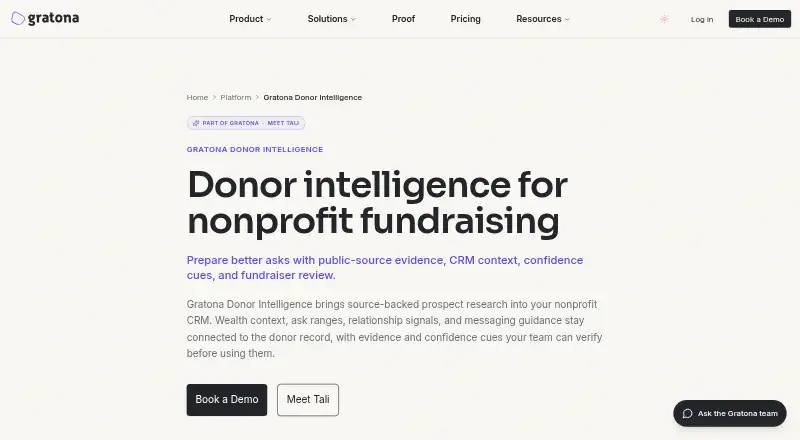
Gratona Donor Intelligence adds prospect research to a nonprofit CRM, attaching wealth context, suggested ask ranges, relationship signals, and messaging gui…
What Gratona Donor Intelligence is
Gratona Donor Intelligence adds prospect research to a nonprofit CRM, attaching wealth context, suggested ask ranges, relationship signals, and messaging guidance to donor records. Profiles may include public-source evidence and confidence labels; unclear identities or weak evidence are flagged for fundraiser review. Profiles older than 90 days are marked so staff can decide whether to refresh them. Research is intended to inform, not replace, fundraiser judgment: results should be reviewed and adjusted before outreach. Related CRM tools include unified donor profiles, dashboards, advanced filtering, custom reports, and household management. Integrations listed include Stripe, PayPal, Authorize.net, Flutterwave, QPayPro, QuickBooks, Salesforce, Zapier, Mailgun, Box, OpenAI, and a REST API. The product is available on Android, iOS, and web, with API access. The product is described for major gifts officers, development directors, and fundraising coordinators.
Good
- Shows public-source evidence and confidence labels.
- Flags profiles older than 90 days.
- Includes wealth context, ask ranges, and relationship signals.
- Offers donor dashboards, filtering, reports, and household management.
- Lists Salesforce and payment integrations.
Watch out
- No free plan is listed.
- Launch costs $750 a month.
- Research requires fundraiser review before outreach.
Who it suits
It suits nonprofit major gifts officers, development directors, and fundraising coordinators who want research and wealth context attached to donor records. Fundraisers should be prepared to review and adjust research before using it for outreach.
Verdict
Gratona combines donor research with CRM records and flags uncertain or aging profiles for human review. Its listed entry plan is paid, and the product expects fundraisers to assess results before acting on them.
Plans and prices
From Gratona Donor Intelligence's own pricing page, checked 14 Oct 2026.
| Plan | Price | What it gives you |
|---|---|---|
| Launch | $750 a month | 1,000 AI credits/month · one team/entity · one primary workflow · standard onboarding · no read API · $750/month; $9,000/year billed annually |
| Growth | $1,500 a month | 3,000 AI credits/month · donor intelligence · mission trips · read API · priority support · $1,500/month; $18,000/year billed annually |
| Scale | $3,000 a month | 7,500 AI credits/month · API writes · webhooks · advanced donor intelligence · implementation support · $3,000/month; $36,000/year billed annually |
| Network | Priced on request | Multi-entity hierarchy · SSO · partner workspaces · custom integrations · dedicated infrastructure · custom SLA · Custom |
The facts
Each one read from Gratona Donor Intelligence's own pages, with the date it was checked.
What it does
- AI data permissions
- Tali and connected AI tools use Gratona records available to the connected user and enabled workflow, bounded by authentication, permissions, connector scopes, and enabled tools.checked 2 Oct 2026
- AI privacy
- Gratona says it does not sell personal information or share it for third-party marketing, and its public privacy policy says Google user data is not used to train generalized AI models.checked 2 Oct 2026
- API documentation
- The public API documentation covers API-key authentication, donor and sponsorship management, donation tracking, sample code and standard response codes.checked 14 Oct 2026
- Ask calculator
- It provides tiered ask-range calculations alongside donor giving history and evidence.checked 14 Oct 2026
- Communication features
- Communication modules include email campaigns, automated email and SMS, newsletters, templates, translation assistance and moderated messaging.checked 14 Oct 2026
- Confidence cues
- Profiles show confidence labels and surface ambiguous identities or weak evidence for verification.checked 14 Oct 2026
- Core CRM
- Gratona combines donor, household and organization records with gifts, pledges, campaigns, communications, tasks, documents and reports.checked 14 Oct 2026
- Evidence and review
- Profiles can show public-source evidence and confidence labels, and ambiguous identities or weak evidence are surfaced for review.checked 2 Oct 2026
- Freshness
- Gratona flags donor profiles older than 90 days so a fundraiser can decide whether to refresh the research.checked 2 Oct 2026
- Freshness control
- Profiles older than 90 days are flagged so users can request refreshed research.checked 14 Oct 2026
- Google Play data safety
- Google Play says the app may share location and personal data, encrypts data in transit and lets users request deletion.checked 14 Oct 2026
- Human oversight
- Research results are a starting point for fundraiser review, and the fundraiser reviews and adjusts output before it informs outreach.checked 2 Oct 2026
- Human review
- The workflow requires fundraiser review before donor outreach or other external action.checked 14 Oct 2026
- Integrations
- Listed integrations include Authorize.net, Flutterwave, PayPal, QPayPro, Stripe, QuickBooks, Salesforce, Zapier, Mailgun, Box and OpenAI.checked 14 Oct 2026
- Intended users
- The product page describes use by major gifts officers, development directors, and fundraising coordinators.checked 2 Oct 2026
- Legal developer name
- The mobile-store listings identify REEVE GROUP LLC as the developer or seller.checked 14 Oct 2026
- MCP and connectors
- A production MCP endpoint is read-only by default; the ChatGPT connector is a private draft and other MCP clients can connect with deliberate configuration.checked 14 Oct 2026
Money
- API plan gates
- Read API access starts with Growth, while API writes and webhooks start with Scale; Network covers custom multi-entity integration scope.checked 14 Oct 2026
Where it runs
- Apple system requirements
- The iOS listing requires iOS/iPadOS 15.6 or later; Mac use requires macOS 12.5 or later with an Apple M1 chip or newer.checked 14 Oct 2026
- GetApp support listing
- GetApp lists web, Android and iPhone/iPad platforms plus email/help desk, knowledge base, FAQ/forum and chat support.checked 14 Oct 2026
The company
- Company
- Gratona describes itself as an AI-native fundraising CRM for nonprofits that grew out of a live sponsorship platform; the opened About page does not state headquarters or a founding year.checked 2 Oct 2026
- Company headquarters
- LinkedIn lists headquarters in San Francisco, California.checked 14 Oct 2026
- Company size
- LinkedIn lists Gratona as a privately held embedded-software company with 2–10 employees.checked 14 Oct 2026
- Founded year
- LinkedIn lists Gratona as founded in 2011.checked 14 Oct 2026
The full review of Gratona Donor Intelligence
Gratona Donor Intelligence is a prospect-research layer inside a nonprofit fundraising CRM. It fits major-gifts officers, development directors, and fundraising coordinators who want wealth and relationship context attached to working donor records. The $750-per-month entry point makes it a serious commitment, but the evidence indicators and review workflow give larger teams a more disciplined way to use research.
Overview
Gratona combines wealth context, ask ranges, relationship signals, and messaging guidance with donor records. Wealth screening, prospect scoring, engagement signals, and CRM integration cover the core needs of teams qualifying and prioritizing prospects. Because the intelligence sits alongside CRM data, teams can work from unified records instead of moving research between separate tools.
Profiles may include public-source evidence and confidence labels. Ambiguous identities and weak evidence are surfaced for review, and profiles older than 90 days are flagged for a refresh decision. These controls make the product a decision aid rather than an automatic outreach engine: fundraisers are expected to check and adjust results before acting on them.
Key features
Research and record management
Unified donor profiles, dashboards, advanced filtering, custom reports, and household management extend the product beyond a single screening search. That broader CRM scope suits teams consolidating fundraising operations, while organizations that only need occasional prospect lookups may find the surrounding system excessive.
Integrations and AI controls
Payment connections include Stripe, PayPal, Authorize.net, Flutterwave, and QPayPro. Other listed connections include QuickBooks, Salesforce, Zapier, Mailgun, Box, OpenAI, and a REST API. Tali and connected AI tools can use records available to the authenticated user through enabled workflows, with access bounded by permissions, connector scopes, and enabled tools. Gratona says it does not sell personal information or share it for third-party marketing, and its public privacy policy says Google user data is not used to train generalized AI models. It also reviews transport, storage, secrets, and backup controls with current evidence during security diligence.
Planned capabilities
Conversational briefings, portfolio-level capacity planning, giving-trigger alerts, and affinity clustering are described as in development. Buyers should choose a plan for its current capabilities rather than treating these projects as included functionality.
Pricing
There is no free plan. Launch costs $750 a month, billed at $9,000/year annually, and includes 1,000 AI credits per month, Donor Intelligence, one primary workflow, and email and chat support. It is the practical starting point for a single core workflow, but the annual billing commitment and credit ceiling matter for smaller organizations.
Growth is $1,500 a month, billed at $18,000/year annually. It raises the allowance to 3,000 AI credits per month, keeps Donor Intelligence, and adds read API access and priority support. This fits teams connecting reporting or other systems that need data access without writing back to Gratona.
Scale costs $3,000 a month, billed at $36,000/year annually. It provides 7,500 AI credits monthly, advanced Donor Intelligence workflows, API writes and webhooks, implementation, and priority support. The higher price is justified for organizations automating two-way integrations and needing a more involved rollout.
Network uses custom pricing and offers a custom AI allowance, Donor Intelligence, multi-entity scope, custom integrations, dedicated infrastructure, and a custom SLA. It is aimed at organizations with several entities or infrastructure requirements rather than a typical standalone nonprofit.
Platforms
Gratona supports Android, iOS, web, and API access. That combination covers mobile and browser work while allowing system-to-system integration.
Who it's for
Major-gifts officers can use wealth, relationship, and ask-range context while reviewing individual records. Development directors gain dashboards, filtering, reports, and portfolio-oriented CRM data. Fundraising coordinators benefit from household management and workflow support when maintaining shared records. Smaller teams seeking an inexpensive enrichment utility, or buyers unwilling to review AI-assisted research, should look elsewhere.
Pros and cons
- Pros: Source evidence and confidence labels make profile claims easier to assess.
- Pros: Flags for ambiguous matches, weak evidence, and profiles older than 90 days focus human review where it matters.
- Pros: CRM features and integrations keep intelligence connected to fundraising operations.
- Pros: Growth and Scale add API access, writes, webhooks, and implementation support for connected teams.
- Cons: The $750-per-month starting price and annual billing exclude many small or occasional users.
- Cons: Launch has one primary workflow and 1,000 monthly AI credits, limiting lower-tier scale.
- Cons: Results still require fundraiser verification and adjustment before outreach.
Alternatives
Nonprofit Donor Prospecting Software is the broader category to compare when you want multiple prospecting approaches.
Hatch is the better starting point for budget-conscious users who want a free plan with 50 enrichment profiles, one seat, and limited monthly drafts through its API and web platform.
Choose Blackbaud Financial Edge NXT when you prefer a custom-quoted Blackbaud product with implementation, training, and ongoing support potentially included.
NPOAuthority suits teams wanting an annual contract with unlimited one-off searches, seats, and training, plus a free trial.
DonorAtlas is an enterprise alternative with unlimited searches and profile views, SSO, SCIM, role-based access, and an MCP server.
Windfall Wealth Screening is worth considering when you want wealth screening priced around organizational needs through a demo.
Code-fi offers an annual, team-size-based subscription with unlimited access to its tools, data, and knowledge support services.
DonorScope is a lower-cost freemium option with a $998 annual subscription and per-record enrichment charges.
DonorTrends is another paid web option for fundraising reports, analysis, and advice.
Verdict
Choose Gratona Donor Intelligence if your nonprofit wants prospect research, CRM records, and human-review safeguards in one system, and can support at least $9,000 in annual spend. Its strongest reason to buy is the combination of evidence, confidence signals, aging flags, and integration depth. Look elsewhere if you need a free or lightweight prospecting tool, predictable low-volume pricing, or research that requires no fundraiser validation.
Alternatives to Gratona Donor Intelligence
- 1
NPOAuthority
AndroidiOSWeb7.5From $1,695 a year - 2

Hatch
Free planWebAPI7.3From $150 a month - 3
EverTrue
AndroidiOSWebAPI6.9 - 4
DonorScope
Web6.4From $998 a year - 5
CharityCAN
WebAPI6.3From $3,400 a year - 6

DonorAtlas
WebAPI6.0