Grace
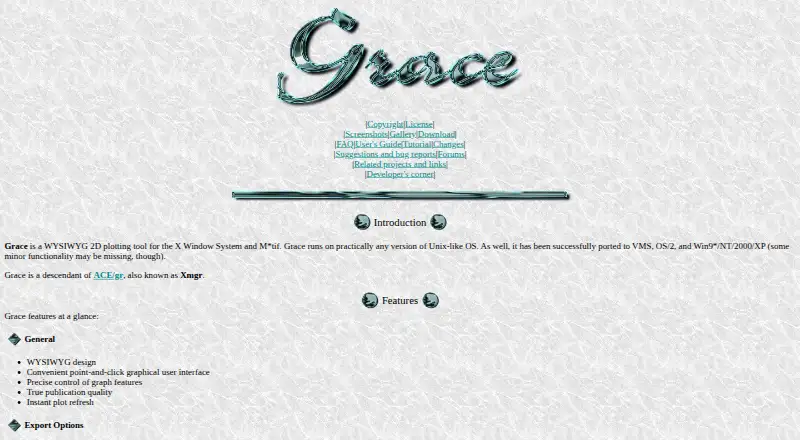
The facts below are what the maker publishes about Grace, checked and dated. Our editors have not written about it yet.
Plans and prices
From Grace's own pricing page, checked 12 Oct 2026.
| Plan | Price | What it gives you |
|---|---|---|
| Grace (GPL-licensed software) | Free | No paid plans stated |
The facts
Each one read from Grace's own pages, with the date it was checked.
What it does
- Analysis
- Its listed analysis functions include FFT, integration, differentiation, histograms, interpolation, smoothing, convolution, correlation, and sorting.checked 12 Oct 2026
- Automation
- Grace has a built-in programming language, supports loadable user-defined functions, and can be controlled by external programs.checked 11 Oct 2026
- Curve fitting
- Grace supports linear and nonlinear least-squares fitting, constraints, region restrictions, arbitrary weight functions, and user-defined fitting functions.checked 12 Oct 2026
- Customization
- Users can dynamically load modules and supply their own colors, fonts, and encodings.checked 11 Oct 2026
- Data input
- The feature list says Grace reads text data files and 1D netCDF files.checked 12 Oct 2026
- Data sources
- Text data files,1D NetCDF files,disk files,and data pipeschecked 21 Sep 2026
- Export
- It exports vector graphics to EPS, PDF, MIF, and SVG, and supports PNG, PNM, and JPEG.checked 11 Oct 2026
- Exports
- It exports vector graphics to EPS, PDF, MIF, and SVG, and supports PNG, PNM, and JPEG.checked 12 Oct 2026
- Extensibility
- Grace includes a built-in programming language, can be controlled by external programs, and supports dynamically loadable C or Fortran modules.checked 12 Oct 2026
- Graph editing
- The official feature list describes point-and-click editing, precise graph controls, publication-quality output, and instant plot refresh.checked 12 Oct 2026
- Graphing
- It supports unlimited graphs and curves per graph, up to 256 customizable colors, and text annotations with subscripts and superscripts.checked 11 Oct 2026
- Import and data size
- Grace reads text data and 1D netCDF files, and the site describes its data size as unlimited, with up to six dimensions plus an optional string array.checked 11 Oct 2026
- Installation
- The FAQ recommends compiling from source; volunteer-contributed binary packages are not officially supported.checked 12 Oct 2026
- Installation limits
- The FAQ says binary packages are not officially supported; contributed volunteer binaries are also unsupported, and compiling from source is the preferred installation method.checked 11 Oct 2026
- Interface
- It combines a graphical user interface with a scripting language for calculations and automated tasks.checked 12 Oct 2026
- License
- Grace is free under the GNU General Public License, version 2 or any later version.checked 12 Oct 2026
- Limitations
- The FAQ says Grace does not yet plot 3D graphs and does not have an undo function.checked 12 Oct 2026
- Operating systems
- The site says Grace runs on practically any Unix-like operating system and reports ports to VMS, OS/2, and Windows 9x/NT/2000/XP, with some minor functionality possibly missing.checked 11 Oct 2026
- Purpose
- Grace is a WYSIWYG tool for making two-dimensional plots of numerical data.checked 12 Oct 2026
- Security
- The changes list says safe mode is enabled by default and disables command-language statements that may modify files, to guard against malicious project files.checked 12 Oct 2026
- Support
- The FAQ points users to its guide, home page, and user forums, and cautions that forum participants help in their spare time so replies may not be quick.checked 12 Oct 2026
Money
- Free plan
- Yeschecked 21 Sep 2026
Where it runs
- Platform
- desktopchecked 21 Sep 2026
- Platform support
- The home page says Grace runs on practically any Unix-like OS and has been ported to VMS, OS/2, and older Windows versions; the Windows and OS/2 ports require an X server and may lack functionality.checked 12 Oct 2026