
Gnocchi
The facts below are what the maker publishes about Gnocchi, checked and dated. Our editors have not written about it yet.
The facts
Each one read from Gnocchi's own pages, with the date it was checked.
What it does
- Aggregation
- Gnocchi computes metric aggregations when data is ingested and stores the results for fast retrieval.checked 11 Oct 2026
- Aggregation policies
- Archive policies configure which aggregations to compute and how many aggregates to retain; supported methods include minimum, maximum, average, percentile, and standard deviation.checked 11 Oct 2026
- Architecture
- Its API and metric processing services are stateless and can be scaled horizontally by running additional daemons or API endpoints.checked 11 Oct 2026
- Authentication
- The API supports basic authentication, OpenStack Keystone authentication, and remote-user authentication.checked 11 Oct 2026
- Deployment
- Gnocchi can be installed with pip, from source, using Docker, or using OpenShift.checked 11 Oct 2026
- Features
- Its listed features include an HTTP REST interface, horizontal scalability, metric aggregation, measures batching, archiving policies, metric value search, structured resources, and resource history.checked 11 Oct 2026
- Grafana
- Gnocchi supports Grafana.checked 11 Oct 2026
- Indexer
- The documented indexer drivers are PostgreSQL, which is preferred, and MySQL version 5.6.4 or later.checked 11 Oct 2026
- Indexer backends
- The supported indexer database drivers are PostgreSQL and MySQL, with PostgreSQL marked preferred.checked 11 Oct 2026
- Installation
- Gnocchi can be installed using pip, from source, or using Docker; the documentation also describes an OpenShift installation option.checked 11 Oct 2026
- Integrations
- The documentation lists support for Grafana, Prometheus Remote Write, Nagios/Icinga, StatsD, Collectd, InfluxDB line protocol, and AMQP 1.0.checked 11 Oct 2026
- Multi-tenancy
- Gnocchi lists multi-tenant support as a main feature.checked 11 Oct 2026
- Other integrations
- The feature list includes Nagios/Icinga, StatsD, Collectd, InfluxDB line protocol ingestion, and AMQP 1.0 support.checked 11 Oct 2026
- Product
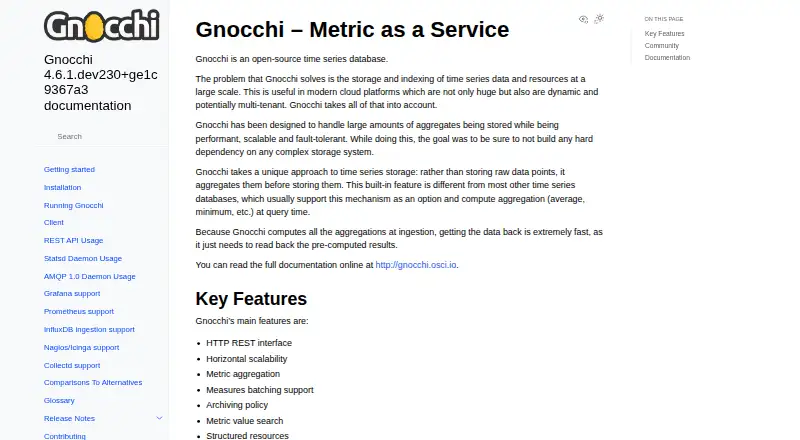
- Gnocchi is an open-source time series database for storing and indexing time series data and resources at large scale.checked 11 Oct 2026
- Prometheus
- Gnocchi supports Prometheus Remote Write.checked 11 Oct 2026
- Purpose
- Gnocchi is an open-source time series database for storing and indexing time series data and resources at large scale.checked 11 Oct 2026
- Scalability
- Gnocchi services are stateless and can be scaled horizontally by running additional daemons or API endpoints.checked 11 Oct 2026
- Storage
- Documented storage options include file, Ceph, OpenStack Swift, Amazon S3, and Redis; Ceph is described as the recommended driver.checked 11 Oct 2026
- Storage backends
- Incoming and aggregated metric storage can use File, Ceph, OpenStack Swift, Amazon S3, or Redis drivers.checked 11 Oct 2026
- Support
- The project documentation points users to its source code, GitHub bug tracker, and the #gnocchi IRC channel on OFTC.checked 11 Oct 2026
- Tenancy
- Gnocchi supports multi-tenant use.checked 11 Oct 2026
- Upgrade limit
- Upgrades are supported between major versions one step at a time or between minor versions; upgrading directly from version 2 to version 4 is unsupported.checked 11 Oct 2026
- Upgrade limitation
- The documentation says upgrades are supported between major versions one step apart or between minor versions, and warns that backlog data is not migrated between versions.checked 11 Oct 2026
Alternatives to Gnocchi
- 1

TDengine
Free planOpen sourceWebAPILinuxmacOS8.3Free plan - 2

Amazon Timestream
Free planWebAPILinuxmacOS7.9Free plan - 3

Apache IoTDB
Free planOpen sourceWebAPILinuxmacOS7.7Free plan - 4

InfluxDB
Free planWebAPILinuxmacOS7.4$0.01 usage-based - 5

VictoriaMetrics
Free planWebAPILinuxmacOS7.4From $200 a month - 6

LinDB
Free planWebAPILinuxmacOS6.9Free plan