Gantry
Gantry is a free, open-source internal developer platform for engineering teams, combining a service catalog, self-service actions, GitOps configuration, and…
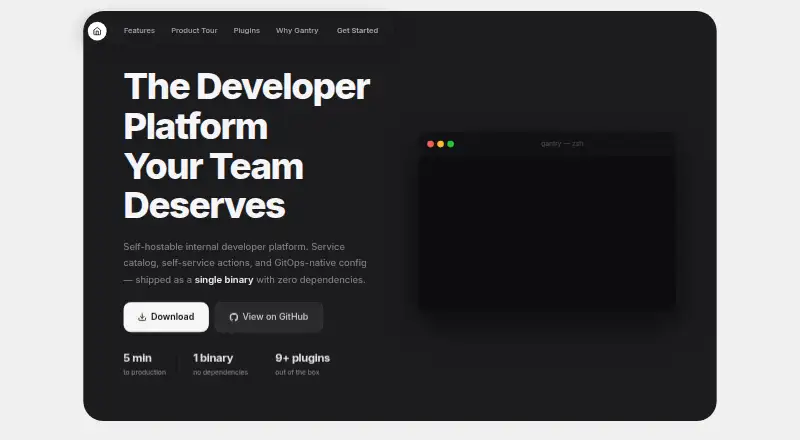
What Gantry is
Gantry is a free, open-source internal developer platform for engineering teams, combining a service catalog, self-service actions, GitOps configuration, and plugins. Its catalog connects services, APIs, teams, infrastructure components, and environments with ownership and dependency relationships. Teams can create executable runbooks and workflows, presenting tasks such as deployments and environment provisioning through schema-driven forms. Catalog entities can be written in YAML and applied with `gantry apply` for version control, review, diffing, and rollback. Search uses SQLite FTS5, without requiring Elasticsearch. Official integrations include Kubernetes, GitHub, and ArgoCD; PagerDuty, Datadog, Grafana, and Flux are listed as planned. Gantry is packaged as a single Go binary with embedded SQLite and no external runtime dependencies. It can be installed from a binary, run with Docker or Docker Compose, or built from source, and is intended for self-hosting. Licensed under Apache 2.0, Gantry is in active development and approaching its first stable release; its documentation warns that APIs and schemas may change between releases.
Good
- Open-source under the Apache 2.0 license.
- Catalog tracks owners and dependency relationships.
- GitOps supports review, diffs, and rollback.
- Official integrations include Kubernetes, GitHub, and ArgoCD.
Watch out
- APIs and schemas may change between releases.
- Several listed integrations are only planned.
- The project is approaching its first stable release.
Who it suits
Gantry is aimed at engineering teams that want an internal developer platform without dedicated platform engineering staff to maintain it. It may suit teams seeking a self-hosted catalog and workflow tools with GitOps configuration.
Verdict
Gantry brings cataloging, self-service workflows, and GitOps configuration into a self-hosted platform. Its active-development status and possible API or schema changes are worth considering before adoption.
Plans and prices
From Gantry's own pricing page, checked 8 Oct 2026.
| Plan | Price | What it gives you |
|---|---|---|
| Gantry | Free | Open source · Apache 2.0 · Self-hosted |
The facts
Each one read from Gantry's own pages, with the date it was checked.
What it does
- Architecture
- It ships as a single Go binary with embedded SQLite and no external runtime dependencies.checked 8 Oct 2026
- Audience
- Gantry is aimed at engineering teams seeking an internal developer platform without dedicated platform engineering staff to maintain it.checked 8 Oct 2026
- Catalog
- The catalog organizes services, APIs, teams, infrastructure components, and environments with ownership and dependency relationships.checked 8 Oct 2026
- Deployment
- Gantry can be installed from a binary, run with Docker or Docker Compose, or built from source.checked 8 Oct 2026
- GitOps
- Catalog entities can be defined in YAML and applied with `gantry apply` for version control, review, diffing, and rollback.checked 8 Oct 2026
- Integrations
- Official integrations include Kubernetes, GitHub, and ArgoCD; the site lists PagerDuty, Datadog, Grafana, and Flux as planned.checked 8 Oct 2026
- License
- Gantry is licensed under Apache 2.0.checked 8 Oct 2026
- Product
- Gantry is an open-source internal developer platform that provides a service catalog, self-service actions, GitOps configuration, and plugins.checked 8 Oct 2026
- Project status
- The documentation says Gantry is in active development and approaching its first stable release, and warns that APIs and schemas may change between releases.checked 8 Oct 2026
- Search
- Full-text search uses SQLite FTS5 and does not require Elasticsearch.checked 8 Oct 2026
- Security
- The documentation describes JWT authentication and instructs installers to set an admin password; the installer verifies downloads with SHA-256 checksums.checked 8 Oct 2026
- Self-service
- Teams can define executable runbooks and workflows with schema-driven forms for tasks such as deployments and environment provisioning.checked 8 Oct 2026
Where it runs
- Platforms
- The download page lists binaries for Linux amd64 and arm64, macOS amd64 and arm64, and Windows amd64.checked 8 Oct 2026
The full review of Gantry
Overview
Gantry is a self-hosted internal developer platform for engineering teams that want a service catalog and repeatable self-service operations without a dedicated platform staff. It is most compelling for teams that value a compact deployment and Git-managed configuration; the caveat is that the project has not yet reached its first stable release.
The catalog brings services, APIs, teams, infrastructure components, and environments together with ownership and dependency relationships. That makes it easier to see who is responsible for a component and what it connects to, rather than treating the catalog as a simple inventory.
Deployment is deliberately contained: Gantry runs as a single Go binary with embedded SQLite and no external runtime dependencies. Teams can install the binary, use Docker or Docker Compose, or build from source. This avoids the overhead of assembling a larger platform stack, though self-hosting still means the team owns its deployment and administration.
Key features
Teams can define executable runbooks and workflows, then expose them through schema-driven forms for jobs such as deployments and environment provisioning. That is a practical way to make recurring operations available to developers without routing every request through platform specialists. It suits teams with clear procedures to encode; it is not a substitute for deciding how those procedures should work.
Catalog entities can be authored in YAML and applied with gantry apply. Version control, review, diffing, and rollback make configuration changes easier to track and govern as code. Search uses SQLite FTS5, so full-text catalog search does not require a separate Elasticsearch service.
Official integrations cover Kubernetes, GitHub, and ArgoCD. Those are useful foundations for teams already working with that toolchain, but the integration set is relatively focused: PagerDuty, Datadog, Grafana, and Flux are planned rather than current integrations.
The documentation describes JWT authentication and directs installers to set an admin password; the installer also verifies downloads with SHA-256 checksums. These are relevant safeguards, but teams should assess the documented security controls against their own requirements before adopting the platform.
Pricing
Gantry is free: the Gantry plan costs nothing and is open source under Apache 2.0. It is self-hosted and includes the software catalog, self-service workflows, Kubernetes support, and ownership documentation. There is no paid tier to unlock those core capabilities, making it a straightforward fit for teams able to operate their own instance.
Platforms
Gantry supports Linux, macOS, and Windows, and is available for web and self-hosted use. The self-hosted deployment options give teams control over where it runs, while the single-binary architecture keeps its runtime requirements modest.
Who it's for
Gantry is aimed at engineering teams that want internal-platform capabilities but lack dedicated platform engineering staff. It fits best when a shared catalog, ownership records, GitOps-managed configuration, and reusable operational workflows would reduce friction across teams. Organizations that require a mature, stable API and schema contract should be cautious while the project remains in active development and warns that those interfaces may change between releases.
Pros and cons
- Compact self-hosting: A single Go binary, embedded SQLite, and no external runtime dependencies avoid a sprawling deployment footprint.
- Configuration as code: YAML entities and gantry apply support reviewable changes, diffs, and rollback.
- Operational self-service: Schema-driven workflows can put repeatable deployments and environment provisioning in developers’ hands.
- Focused integrations: Kubernetes, GitHub, and ArgoCD are official integrations, but several commonly relevant tools remain planned.
- Early maturity: Active development and possible API or schema changes create maintenance and compatibility risk for teams seeking a stable platform foundation.
Alternatives
Internal Developer Portals is the broader category directory for comparing options.
- Northflank is worth considering if you want a freemium option with always-on compute and free allowances of two services, one database, and two cron jobs.
- Backstage is another free, open-source framework for teams that prefer a portal framework and want an alternative without stated plan limits.
- Skyhook may suit a team looking for a freemium service with a free allowance of three Git-connected users, three services, and one cluster.
- OpenChoreo is a free, self-hosted, open-source Kubernetes platform for teams seeking that platform model instead.
- configure8 is a freemium option with a free plan and free trial for teams considering a catalog-oriented alternative.
- Cycloid offers a free SaaS plan for up to five users and one workspace, making it an option for teams that prefer a hosted service.
- Port is a freemium alternative whose free plan has limits of 15 seats, 10,000 entities, and 400 runs.
- Ravion is another freemium alternative with a free plan for individuals.
Verdict
Choose Gantry if your engineering team wants a no-cost, self-hosted catalog tied to GitOps configuration and executable self-service workflows, without taking on a large runtime stack. Its strongest reason to choose it is that combination of useful internal-platform functions and compact architecture. Look elsewhere if your organization needs a mature interface contract or a broader current integration set: active development and possible API or schema changes are meaningful adoption risks.
Getting started
- Open the Gantry website
- Choose a binary installation, Docker, Docker Compose, or source build
- Deploy Gantry on Linux, macOS, Windows, or your web environment
- Set the administrator password as directed
- Configure JWT authentication and define catalog entities in YAML
- Apply catalog configuration with `gantry apply`
Questions
How much does Gantry cost?
Gantry is free and open source under the Apache 2.0 license.
Is Gantry self-hosted?
Yes. Its deployment model is self-hosted, with binary, Docker, Docker Compose, and source installation routes.
Which integrations are official?
Official integrations include Kubernetes, GitHub, and ArgoCD. PagerDuty, Datadog, Grafana, and Flux are listed as planned.
What does the catalog contain?
It organizes services, APIs, teams, infrastructure components, and environments, including ownership and dependency relationships.
Does Gantry support workflows?
Teams can define executable runbooks and workflows with schema-driven forms for deployments and environment provisioning.
How is search implemented?
Full-text search uses SQLite FTS5 and does not require Elasticsearch.
Alternatives to Gantry
- 1

Northflank
Free planWebAPILinuxmacOS8.0From $2.70 a month - 2
Wayfinder
Free planWebAPISelf-hosted7.5From £399 a month - 3

Qovery
WebAPILinuxmacOS7.1From $299 a month - 4
Skyhook
Free planWebAPILinuxmacOS7.1From $1 a month - 5

Cycloid
Free planWebAPILinuxSelf-hosted6.9From $45 a month - 6

Port
Free planWebAPIExtension6.9From $30 a month