
FuzzForge
FuzzForge is FuzzingLabs’ platform for fuzzing, emulation, and reverse-engineering campaigns against embedded and connected products.
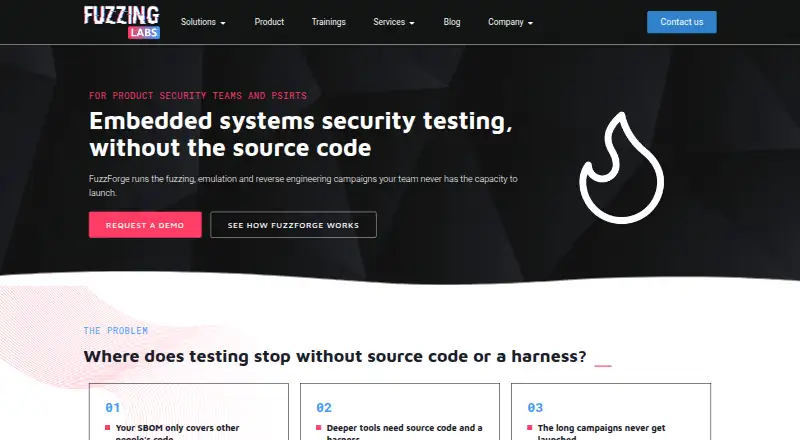
What FuzzForge is
FuzzForge is FuzzingLabs’ platform for fuzzing, emulation, and reverse-engineering campaigns against embedded and connected products. It accepts binaries, complete firmware images, or source code, including components supplied without source. The platform maps targets, can build an SBOM from a binary, and produces triaged crashes with replayable test cases. It can write the fuzzing harness for targets without source code. Specialized agents run campaigns while engineers can take over with familiar industry tools. Campaigns are scheduled on available compute and may run overnight or for days. Deployment options include a hosted instance, a dedicated customer-cloud instance, Kubernetes on-premise, and air-gapped installation. Air-gapped use relies on local open-weight models, has no network egress, and costs more than standard on-premise licensing. FuzzForge logs model requests and reasoning chains. Customers retain campaign outputs and knowledge graph. It has a free plan and supports web and self-hosted deployment.
Good
- Tests binaries and firmware without source
- Produces replayable triaged crashes
- Builds SBOMs from binaries
- Hybrid agent and engineer operation
- Hosted, on-premise, or air-gapped deployment
Watch out
- Does not replace security researchers
- Not a source-code scanner
- Air-gapped deployment costs more
Who it suits
It is aimed at product security teams and PSIRTs, including embedded vendors, OEMs, government and defense, MSSPs, integrators, consultants, auditors, and certification bodies.
Verdict
FuzzForge focuses on continuous offensive validation for embedded and connected products, with multiple deployment models and human oversight. Its scope is campaign execution rather than replacing researchers or serving as a source-code scanner.
The facts
Each one read from FuzzForge's own pages, with the date it was checked.
Where it runs
- Air-gapped limit
- Air-gapped deployment uses local open-weight models only, has no router or network egress, and is priced above the standard on-premise licence.checked 7 Oct 2026
- Air-gapped limits
- Air-gapped deployment uses local open-weight models, has no network egress, and is priced above the standard on-premise licence.checked 5 Oct 2026
What it does
- Audience
- The page identifies product security teams and PSIRTs as its audience, including embedded product vendors, OEMs, government and defense teams, and security service firms.checked 7 Oct 2026
- Audit logs
- The platform logs every model request and reasoning chain for auditing.checked 7 Oct 2026
- Automation
- Specialized agents drive campaigns, while engineers can take over using industry tools they already know.checked 5 Oct 2026
- Campaign results
- Campaigns produce triaged crashes with replayable test cases and validated findings; the platform can also build an SBOM from a binary.checked 7 Oct 2026
- Deployment
- Deployment options include hosted SaaS, a dedicated instance in the customer’s cloud tenancy, Kubernetes on-premise, and air-gapped deployment.checked 7 Oct 2026
- Human oversight
- Agents drive campaigns, while engineers can take over using industry tools they already know.checked 7 Oct 2026
- Input targets
- It accepts binaries, full firmware images or source code and can map targets and build an SBOM.checked 7 Oct 2026
- Integrations
- FuzzingLabs describes workflows that combine tools such as Semgrep, CodeQL, AFL, LibFuzzer, Ghidra, angr and QEMU.checked 7 Oct 2026
- Licensing unit
- For public sector procurement, the maker describes an annual licence per instance, with tiers based on target count and no per-seat or per-test billing.checked 5 Oct 2026
- No source required
- FuzzForge works on binaries and firmware images without source code and writes the fuzzing harness itself.checked 7 Oct 2026
- Not a source-code scanner
- The maker says FuzzForge does not replace researchers and is not a source-code scanner.checked 5 Oct 2026
- Operations
- The execution layer schedules campaigns on available compute, and campaigns can run overnight or for days.checked 7 Oct 2026
- Purpose
- FuzzForge runs fuzzing, emulation and reverse engineering campaigns for embedded and connected product security testing.checked 7 Oct 2026
- Scope limit
- FuzzForge does not replace security researchers and is not a source-code scanner.checked 7 Oct 2026
- Support
- The product page offers a demo request and describes campaign findings as work engineers can pick up and verify.checked 7 Oct 2026
- Targets
- It can test binaries, firmware images and source code, including third-party components supplied without source code.checked 5 Oct 2026
- What it does
- FuzzForge runs fuzzing, emulation and reverse engineering campaigns for embedded and connected products.checked 5 Oct 2026
- Who it is for
- The maker lists embedded product vendors, OEMs, government and defense, MSSPs, integrators, consulting and audit firms, and certification bodies as intended users.checked 5 Oct 2026
The company
- Data ownership
- Customers keep campaign test cases, reports, configurations and their knowledge graph; FuzzingLabs keeps the platform itself.checked 7 Oct 2026
- Founded
- 2021checked 28 Sep 2026
- Headquarters
- Near Parischecked 28 Sep 2026
- Maker
- FuzzingLabs describes FuzzForge as its flagship AI agent orchestration platform for continuous offensive validation on firmware, binaries and embedded systems.checked 7 Oct 2026
Alternatives to FuzzForge
- 1
Jazzer
Free planOpen sourceAPILinuxmacOSSelf-hosted7.3Free plan - 2
AFL++
Free planAndroidLinuxmacOSSelf-hosted7.2From €20,000 a year - 3

Mayhem
Free planWebAPILinuxmacOS7.0From $236 a month - 4

ClusterFuzz
Free planWebLinuxmacOSSelf-hosted6.8Free plan - 5
cargo-fuzz
Free planLinuxmacOSWindows6.7Free plan - 6
boofuzz
Free planAPILinuxSelf-hostedWindows6.4Free plan