
Fortinet Unified SASE
Fortinet Unified SASE brings secure SD-WAN, zero trust and security service edge capabilities under a shared operating system, policy engine and management p…
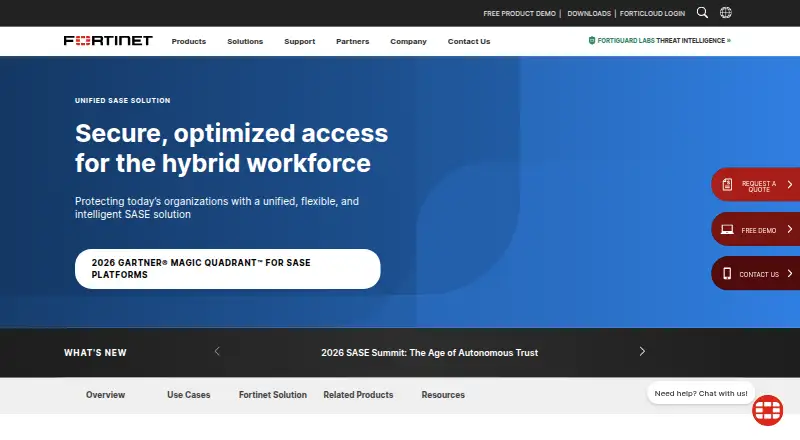
What Fortinet Unified SASE is
Fortinet Unified SASE brings secure SD-WAN, zero trust and security service edge capabilities under a shared operating system, policy engine and management plane. Its security functions include firewall as a service, secure web gateway, CASB, ZTNA and data loss prevention. The service is positioned for hybrid workforces, branch connectivity, cloud access protection and policy enforcement across dispersed users and locations. Integrated ZTNA verifies user and device identity continuously and applies application-aware controls before access sessions. AI and machine learning analyze traffic patterns and anomalies to support threat detection, automated response and network performance. FortiSASE connects through more than 200 global points of presence and integrates with AWS, Google Cloud and Oracle Cloud. It also integrates with Fortinet products, supports SAML single sign-on with Okta, and includes cloud management and a REST API. FortiSASE Sovereign can be deployed by end users in their own data centers for regional data residency and sovereignty needs. Pricing is on request, and user-based licensing has a minimum orderable quantity of 50 users.
Good
- Combines SD-WAN, zero trust and security service edge functions.
- Includes FWaaS, secure web gateway, CASB, ZTNA and DLP.
- Connects through more than 200 global points of presence.
- Integrates with AWS, Google Cloud and Oracle Cloud.
- Supports Windows, macOS, Linux, Android and iOS clients.
Watch out
- Pricing is available on request.
- Licensing requires a minimum order of 50 users.
Who it suits
It suits organizations supporting hybrid workforces, branch networks and cloud access across distributed users and locations. FortiSASE Sovereign may suit organizations needing deployment in their own data centers for regional data residency requirements.
Verdict
Fortinet Unified SASE combines network access and security functions with cloud and Fortinet integrations. The 50-user minimum and request-based pricing are important considerations for prospective buyers.
Plans and prices
From Fortinet Unified SASE's own pricing page, checked 30 Sep 2026.
| Plan | Price | What it gives you |
|---|---|---|
| Advanced | Priced on request | up to 3 devices per user · Fortinet and public cloud locations · agentless ZTNA · assisted onboarding · 24x7 premium support |
| Comprehensive | Priced on request | up to 3 devices per user · Fortinet and public cloud locations · global security PoP add-on · comprehensive SASE features · 24x7 premium support |
| Standard | Priced on request | up to 3 devices per user · Fortinet cloud locations · 24x7 premium support · REST API |
The facts
Each one read from Fortinet Unified SASE's own pages, with the date it was checked.
What it does
- AI protection
- AI and machine learning analyze traffic patterns and anomalies to enhance threat detection, automate response and improve network performance.checked 30 Sep 2026
- API and management
- The subscriptions include SASE cloud management and a REST API.checked 30 Sep 2026
- Cloud integrations
- FortiSASE integrates coverage with AWS, Google Cloud and Oracle Cloud.checked 30 Sep 2026
- Compliance
- FortiSASE has an available SOC 2 report covering security, availability, processing integrity, confidentiality and privacy controls.checked 30 Sep 2026
- Deployment sovereignty
- FortiSASE Sovereign can be deployed by end users in their own data centers to meet regional data residency and sovereignty requirements.checked 30 Sep 2026
- Fortinet integrations
- The service integrates with FortiGate Secure SD-WAN, FortiAP, FortiExtender and FortiBranch SASE thin-edge devices.checked 30 Sep 2026
- Global network
- FortiSASE provides low-latency connectivity through a global network of more than 200 points of presence.checked 30 Sep 2026
- Hybrid workforce
- Fortinet positions Unified SASE for hybrid workforces, secure branch connectivity, cloud access protection and policy enforcement across dispersed users and locations.checked 30 Sep 2026
- Identity integration
- FortiSASE supports SAML single sign-on with Okta as an identity provider.checked 30 Sep 2026
- Licensing minimum
- FortiSASE uses user-based licensing with a minimum orderable quantity of 50 users.checked 30 Sep 2026
- Purpose
- Fortinet Unified SASE converges secure SD-WAN, zero trust and security service edge functions on one operating system, policy engine and management plane.checked 30 Sep 2026
- Security functions
- The platform provides FWaaS, secure web gateway, CASB, ZTNA and DLP capabilities.checked 30 Sep 2026
- Supported operating systems
- FortiSASE supports FortiClient on Windows, macOS, Linux, Android and iOS.checked 30 Sep 2026
- Zero trust
- Integrated ZTNA continuously verifies user and device identity and applies application-aware controls before access sessions.checked 30 Sep 2026
The company
- Founded
- 2000checked 28 Sep 2026
- Headquarters
- Sunnyvale, California, United Stateschecked 28 Sep 2026
The full review of Fortinet Unified SASE
Overview
Fortinet Unified SASE brings network access and security controls together for organizations managing hybrid users and branch locations. It is best suited to teams that can meet a 50-user minimum and want Fortinet’s security and networking tools managed through a shared policy plane. Its breadth is a strength; the minimum commitment and custom pricing make it difficult to justify for smaller teams.
Key features
The platform unifies secure SD-WAN, zero trust and security service edge functions under one operating system, policy engine and management plane. FWaaS, secure web gateway, CASB, ZTNA and DLP cover a wide range of network and data controls, which can simplify policy enforcement across dispersed users compared with managing each function separately.
Integrated ZTNA continually verifies user and device identity and applies application-aware controls before access sessions. That is useful for organizations that need access decisions tied to both identity and device, not simply network location. AI and machine learning analyze traffic patterns and anomalies to support threat detection, automate response and improve network performance.
FortiSASE connects through more than 200 global points of presence and integrates with AWS, Google Cloud and Oracle Cloud. Fortinet customers can connect FortiGate Secure SD-WAN, FortiAP, FortiExtender and FortiBranch SASE thin-edge devices. SAML single sign-on with Okta is supported, and subscriptions include cloud management and a REST API. An available SOC 2 report covers security, availability, processing integrity, confidentiality and privacy controls. FortiSASE Sovereign can be deployed in an organization’s own data centers for regional data residency and sovereignty needs.
Pricing
Fortinet uses paid, user-based licensing with custom pricing and a minimum order of 50 users. That makes it a better match for established organizations planning a broader deployment than small teams that want to start with a handful of seats. Each plan supports up to three devices per user and includes 24x7 premium support.
- Standard: Includes Fortinet cloud locations and a REST API. It suits teams that need core SASE access and management but do not require public cloud locations or the higher-tier options.
- Advanced: Adds public cloud locations, agentless ZTNA and assisted onboarding. It is the more suitable tier for teams connecting public cloud workloads or seeking help with rollout.
- Comprehensive: Includes public cloud locations, a global security PoP add-on and comprehensive SASE features. It is aimed at organizations requiring the broadest feature set and global coverage options.
No plan has a published price, so buyers must request a quote; the 50-user floor remains relevant whichever tier they choose.
Platforms
FortiClient is supported on Windows, macOS, Linux, Android and iOS. The broader platform listing also includes API, web and self-hosted, while endpoint platform support includes ChromeOS. Hybrid delivery and branch connectivity make the service relevant to organizations securing both remote users and sites.
Who it's for
Fortinet Unified SASE is a strong fit for organizations with at least 50 users that want branch connectivity, cloud access protection and centralized policy enforcement across a hybrid workforce. Existing Fortinet environments have a practical integration path through Fortinet networking devices. Teams with fewer users, or those prioritizing a free entry tier and a known initial cost, should look elsewhere.
Pros and cons
- Pro: Combines FWaaS, web gateway, CASB, ZTNA and DLP under one management plane, reducing the need to coordinate separate security controls.
- Pro: More than 200 points of presence and AWS, Google Cloud and Oracle Cloud integrations support distributed users and cloud workloads.
- Pro: FortiSASE Sovereign supports deployment in an organization’s own data centers when regional data residency is a requirement.
- Con: The 50-user minimum rules out small deployments and limits low-commitment evaluation by small teams.
- Con: Custom pricing across all three tiers makes budget comparisons harder before contacting Fortinet.
Alternatives
Browse Secure Access Service Edge Software for more options. Cloudflare One is worth considering when a free plan for up to 50 users and a $0 forever starting point matter more than Fortinet’s paid, 50-user-minimum model. Pangolin is an alternative with a free plan for small deployments. Arista NG Firewall offers a free tier with basic security and connectivity features. Sangfor EasyConnect is another paid option for teams comparing access software across Windows, macOS, Linux, iOS and Android. Zscaler Private Access is a paid alternative with a limited private-access tier for 5% of users on its Essentials Platform. Cato SASE Platform also uses pricing by request. Skyhigh Private Access is another paid private-access option. Broadcom Symantec SASE is a paid alternative with cloud and on-premises options.
Verdict
Choose Fortinet Unified SASE if your organization has at least 50 users, needs broad security controls across branches and hybrid work, and can benefit from Fortinet integrations. Its unified management and extensive security coverage are the main reasons to choose it; the user minimum and quote-based pricing are the reasons smaller or budget-sensitive teams should compare alternatives first.
Getting started
- Visit the Fortinet Unified SASE website.
- Contact Fortinet for pricing and licensing details.
- Plan for the minimum orderable quantity of 50 users.
- Select a plan: Standard, Advanced or Comprehensive.
- Deploy with supported FortiClient platforms or use FortiSASE Sovereign in your own data center if regional sovereignty requirements call for it.
Limits worth knowing
Licensing has a minimum orderable quantity of 50 users. Standard, Advanced and Comprehensive each support up to three devices per user.
Questions
How much does Fortinet Unified SASE cost?
Pricing is on request.
What is the minimum order size?
FortiSASE uses user-based licensing with a minimum orderable quantity of 50 users.
What are the plan options?
The plans are Standard, Advanced and Comprehensive. Each supports up to three devices per user; their included locations and features differ.
Which cloud services does it integrate with?
FortiSASE integrates with AWS, Google Cloud and Oracle Cloud.
Which devices and operating systems does it support?
FortiClient is supported on Windows, macOS, Linux, Android and iOS. ChromeOS is also listed as an endpoint platform.
Can it be deployed in an organization's own data center?
Yes. FortiSASE Sovereign can be deployed by end users in their own data centers to meet regional data residency and sovereignty requirements.
Alternatives to Fortinet Unified SASE
- 1
Pangolin
Free planOpen sourceAndroidiOSWebAPI8.5From $4 a month - 2
Cato SASE Platform
AndroidiOSWebAPI7.5From $1 a year - 3

Cloudflare One
Free planAndroidiOSWebAPI7.5$7 usage-based - 4
WatchGuard FireCloud
AndroidiOSWebAPI7.5From $97.75 a year - 5

Check Point Harmony SASE
AndroidiOSWebLinux7.3 - 6

iboss Cloud
AndroidiOSWebAPI7.1