Cato SASE Platform
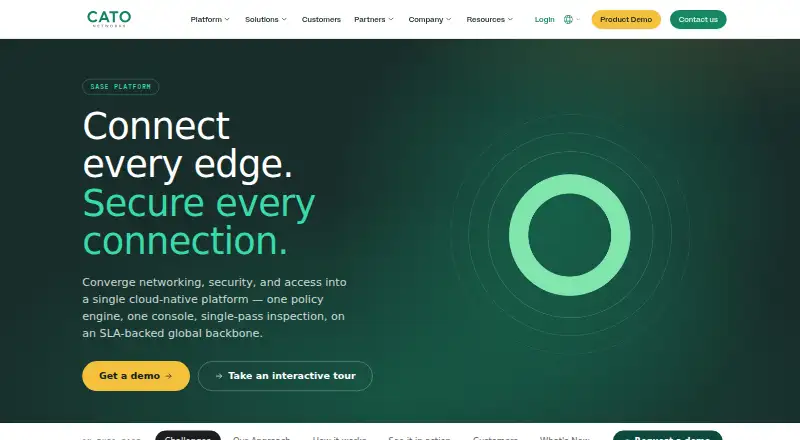
Cato SASE Platform combines networking, security, and access in a cloud-native service managed through a shared policy engine and console.
What Cato SASE Platform is
Cato SASE Platform combines networking, security, and access in a cloud-native service managed through a shared policy engine and console. Its backbone provides global connectivity, network segmentation, and multi-cloud access. The security stack uses single-pass inspection and shared policy, with features including firewall-as-a-service, secure web gateway, intrusion and malware prevention, DNS security, and remote browser isolation. Other listed capabilities include SD-WAN, CASB, DLP, XDR, endpoint protection, digital experience monitoring, and a platform API. Users can reach private applications through a ZTNA client, Enterprise Browser, or clientless portal. Browser-based access can also reach hosted applications and RDP or SSH resources without installing the client. The Cato Client is available for Windows, macOS, Linux, iOS, and Android, with support dependent on operating-system and client versions. Cato lists 100 integrations across areas such as authentication, asset management, EDR, ITSM, SaaS security, and SIEM; some require a separate license. Pricing is available on request. The company was founded in 2015 and is based in Tel Aviv, Israel.
Good
- Combines networking, security, and access
- Provides segmentation and multi-cloud access
- Offers clientless browser access to hosted apps and RDP or SSH
- Lists 100 integrations
Watch out
- Pricing is available only on request
- Some third-party integrations require a license
- Client support depends on operating-system and client versions
Who it suits
Cato SASE Platform suits organizations seeking cloud-delivered networking, security, and private application access under shared policies. Its client and browser access options address both managed endpoints and access without installing the client.
Verdict
Cato SASE Platform brings a broad set of network and security capabilities under one console and policy engine. Organizations should confirm pricing and integration licensing with Cato.
Plans and prices
From Cato SASE Platform's own pricing page, checked 21 Oct 2026.
| Plan | Price | What it gives you |
|---|---|---|
| Basic | $1 a year | Capterra listing · free version not included · Per User, Per Year |
| Cato SASE Platform | Priced on request | Pricing by request; contact sales for a tailored discussion |
| SASE Cloud Platform | Priced on request | Custom enterprise quote · platform modules and licenses vary · Contact Cato for pricing |
The facts
Each one read from Cato SASE Platform's own pages, with the date it was checked.
What it does
- Additional capabilities
- Other listed capabilities include SD-WAN, CASB, DLP, XDR, endpoint protection, digital experience monitoring, and a platform API.checked 30 Sep 2026
- AI security
- AI Security discovers and categorizes public AI usage, enforces intent-based policies and detects attacks such as prompt injection and jailbreaks against private AI.checked 21 Oct 2026
- API
- Cato exposes a public GraphQL API with schema introspection, permission-controlled queries and APIs marked as rollout, beta or early-access.checked 21 Oct 2026
- Automation
- The integration documentation lists an included Terraform provider for infrastructure-as-code and DevOps automation.checked 21 Oct 2026
- CASB and DLP
- CASB provides sanctioned and unsanctioned application visibility while DLP applies granular data policies across on-premises and cloud destinations.checked 21 Oct 2026
- Cloud on-ramps
- Cloud connectivity can use vSocket appliances, provider cross-connects or IPSec tunnels to AWS, Azure, GCP, Oracle and other environments.checked 21 Oct 2026
- Compliance
- Cato’s Trust Center lists SOC 2 Type II, PCI, ISO 27001:2022, ISO 27701, GDPR, HIPAA, and other compliance badges.checked 30 Sep 2026
- Digital experience monitoring
- Cato DEM uses synthetic probes and AI/ML monitoring for internet, SaaS and WAN applications without sensor deployment.checked 21 Oct 2026
- Documentation
- The vendor provides a searchable knowledge center with client installation, integrations, licensing and configuration articles.checked 21 Oct 2026
- Downloads
- Windows, macOS and Linux clients are distributed through a download portal, while iOS and Android clients come from their app stores.checked 21 Oct 2026
- Endpoint security
- The Cato Client includes endpoint protection and detection capabilities and forwards endpoint context into Cato XDR.checked 21 Oct 2026
- Firewall and segmentation
- FWaaS controls traffic across ports, protocols and directions and segments networks using identities, applications, services and VLANs.checked 21 Oct 2026
- Global backbone
- The platform uses an SLA-backed private backbone with more than 85 physical points of presence.checked 21 Oct 2026
- Integration licensing
- Cato’s support documentation says some third-party integrations are included with the default account license and others require a license.checked 30 Sep 2026
- Integrations
- Published integrations include Microsoft Entra ID, Okta, Google, CrowdStrike, Microsoft Defender, SentinelOne, Salesforce, Slack, Microsoft 365, Splunk, Sentinel, AWS S3 and Azure Blob.checked 21 Oct 2026
- Licence and hosting
- Cato’s master agreement assigns service, hardware, scripts and API-tool intellectual-property rights to Cato or its licensors, indicating proprietary software rather than open source, and the service is cloud delivered.checked 21 Oct 2026
- Limit: client reliability
- App Store reviewers report authentication or connection failures after an iPhone update and problems using an HTTP proxy while on VPN.checked 21 Oct 2026
Where it runs
- Browser access
- Browser-based remote access can reach hosted applications and RDP or SSH resources without installing the Cato Client.checked 30 Sep 2026
- Client platforms
- The Cato Client is available for Windows, macOS, Linux, iOS, and Android, with support depending on operating-system and client versions.checked 30 Sep 2026
The company
- Company
- Cato Networks says it was founded in 2015 and is based in Tel Aviv, Israel.checked 30 Sep 2026
- Company legal name
- Crunchbase identifies the company as Cato Networks Ltd., founded by Gur Shatz and Shlomo Kramer.checked 21 Oct 2026
- Company location and size
- Gartner lists headquarters in Tel Aviv, Israel, year founded 2015 and 1,001–5,000 employees.checked 21 Oct 2026
- Founded
- 2015checked 23 Sep 2026
- Headquarters
- Tel Aviv, Israelchecked 23 Sep 2026
The full review of Cato SASE Platform
Overview
Cato SASE Platform is a cloud-delivered service that combines network connectivity, security controls, and remote access. It is best suited to organizations looking to manage those capabilities through a common policy and console; its breadth is a strength, but the custom-quote model calls for a licensing conversation before committing.
Its cloud-native backbone supports global connectivity, segmentation, and multi-cloud access, with branch connectivity among its capabilities. The platform is made by Cato Networks, founded in 2015 and based in Tel Aviv.
Explore the Secure Access Service Edge Software category.
Key features
Shared network and security policy
Cato brings networking and security into a common platform with a single policy engine and console, and uses single-pass inspection. Its security services include firewall-as-a-service, secure web gateway, intrusion and malware prevention, DNS security, and remote browser isolation. The package also spans SD-WAN, CASB, data loss prevention, XDR, endpoint protection, digital experience monitoring, and an API. That range may reduce the need to manage separate controls, while the value of consolidating them depends on which capabilities an organization actually needs.
Remote access choices
Users can reach private applications through a ZTNA client, Enterprise Browser, or clientless portal. Browser access can reach hosted applications and RDP or SSH resources without installing the Cato Client, a useful option for access scenarios where deploying a client is undesirable. The Cato Client supports Windows, macOS, Linux, iOS, and Android, though support varies with operating-system and client versions.
Integrations and compliance
Cato’s Integration Hub covers 100 integrations across areas including authentication, asset management, EDR, ITSM, SaaS security, and SIEM. Some third-party integrations are included with the default account license, while others require a separate license, so organizations should confirm costs for the integrations they rely on. Cato’s Trust Center carries compliance badges including SOC 2 Type II, PCI, ISO 27001:2022, ISO 27701, GDPR, and HIPAA.
Pricing
Cato SASE Platform: custom pricing; contact sales for a tailored discussion. The paid, cloud-delivered plan combines the platform’s networking and security capabilities, including branch connectivity, secure web gateway, CASB, and data loss prevention. No seat count, quota, trial, or renewal terms are provided, so buyers should establish the full scope and licensing requirements in their quote, including charges for third-party integrations.
There is no stated lower-cost or free Cato tier to compare. Organizations should assess whether they need the breadth of the platform rather than assuming every capability is part of their intended deployment.
Platforms
The platform lists Android, iOS, Linux, macOS, web, Windows, and API support. The Cato Client is available for Windows, macOS, Linux, iOS, and Android, with version-dependent support. Browser-based remote access can reach hosted applications and RDP or SSH resources without the client. Endpoint platforms include Windows, macOS, iOS, Android, and Linux.
Who it's for
Cato is a strong fit for organizations seeking cloud-based branch connectivity, multi-cloud access, security services, and remote access under a shared policy model. Its multiple client and browser access paths suit environments with varied endpoint needs. It is less compelling for buyers who only need a narrow security or access tool, or who need a known price before engaging sales; integration licensing also merits careful review.
Pros and cons
- Broad capability set: Network, access, and security services share a platform and policy engine, useful for organizations aiming to consolidate these functions.
- Flexible remote access: Client, Enterprise Browser, and clientless portal options accommodate different routes to private applications; browser access also covers RDP and SSH resources without a client install.
- Wide integration coverage: The Integration Hub spans 100 integrations, but some require additional licensing.
- Custom pricing: A tailored quote can suit organization-specific needs, but buyers cannot compare a published price or plan limits before contacting sales.
- Version-dependent client support: The client covers five major operating-system families, but support depends on OS and client versions.
Alternatives
Cloudflare One is worth considering for teams seeking a freemium option: its free plan costs nothing, is billed $0 forever, and caps use at 50 users with up to 24 hours of standard log retention.
Fortinet Unified SASE is another paid option, with listed Standard and Advanced plans; compare its device limits and support terms against Cato’s custom quote.
VersaONE Universal SASE Platform is a paid alternative without a free plan, offered through a demo-led sales process.
Check Point Harmony SASE may suit buyers who want a trial before purchase: its paid license is required after a 30-day trial.
Aryaka Unified SASE as a Service is a paid alternative whose stated package includes SD-WAN Plus, NGFW-SWG, IPS, and anti-malware.
Pangolin is a freemium alternative with a free Basic plan that has user, site, domain, and resource caps.
Broadcom Symantec SASE is another paid option, with an SSE plan described as offering advanced security options and integrations across cloud and on-premises environments.
iboss Cloud is a paid alternative with a Zero Trust Core plan that includes web filtering, basic CASB controls, HTTPS decryption, and cloud connector agents.
For other products in adjacent categories, see Business VPN Software.
Verdict
Cato SASE Platform is best for organizations that want broad network, security, and remote-access capabilities governed through one policy model. Its strongest case is the combination of cloud connectivity, multiple access paths, and extensive security functions; the chief reason to look elsewhere is the custom-quote purchase process, especially if a narrow tool or transparent upfront pricing matters more.
Alternatives to Cato SASE Platform
- 1

Cloudflare One
Free planAndroidiOSWebAPI7.5$7 usage-based - 2

Check Point Harmony SASE
AndroidiOSWebLinux7.3 - 3

Aviatrix Cloud Network Platform
AndroidiOSLinuxmacOS7.0From $300 a month - 4
Barracuda Secure SD-WAN
APILinuxmacOSSelf-hosted6.6 - 5

Automic Continuous Delivery Automation
WebAPILinuxSelf-hosted6.5 - 6
Cloudflare WAN (formerly Magic WAN)
Free planWeb6.4$7 usage-based