Forester UVM
Forester UVM is configurable GIS-based software for planning, assigning, tracking, and reporting electric utilities’ vegetation management work.
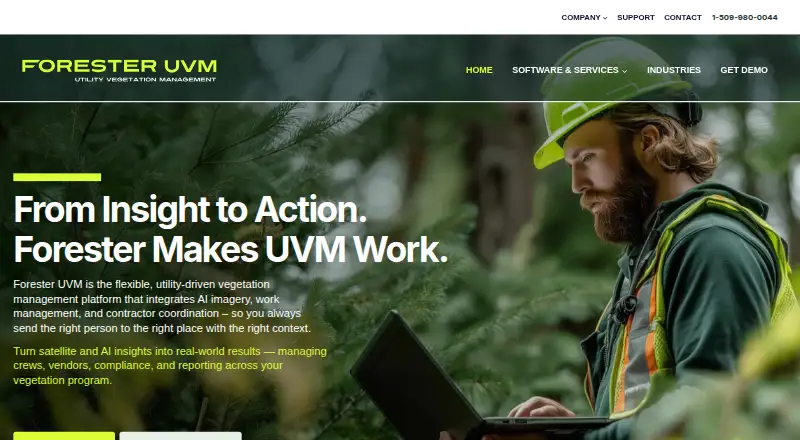
What Forester UVM is
Forester UVM is configurable GIS-based software for planning, assigning, tracking, and reporting electric utilities’ vegetation management work. Managers can map circuits, prioritize spans with GIS overlays, define work types, and assign jobs by crew, territory, or timeframe. Field planners and tree crews can use the mobile app offline; it stores field data locally until it synchronizes with the office database. The platform captures audit data and outcomes, tracks SAIDI/SAIFI and other reliability metrics, and provides role-based dashboards and dynamic reports. Reporting includes Power BI and Telerik dashboards, real-time cost and progress visibility, and AI-powered query-based reports. Forester supports Microsoft Azure AI Services and can work with satellite, drone, and LIDAR imagery, but it does not produce imagery or analytics. Its System Bridge ingests remote-sensing analytics to create work packets. Integrations include utility GIS, WMS, CIS, OMS, and tax assessor databases. Vegetation management staff can change work types and workflows without IT or GSI assistance. The software is hosted on Microsoft Azure and does not replace an asset management system. Pricing is available by requesting a demo.
Good
- Mobile app supports offline field work.
- Maps circuits and prioritizes spans with GIS overlays.
- Tracks SAIDI/SAIFI and reliability metrics.
- Work types and workflows can be changed without IT or GSI.
Watch out
- Does not produce satellite imagery or analytics.
- Does not replace an asset management system.
- Pricing is available on request.
Who it suits
Forester UVM may suit utility managers and foresters planning work, field crews completing it, and directors or executives reviewing metrics and dashboards.
Verdict
Forester UVM covers vegetation-work planning through field execution and reporting, including offline mobile work and reliability metrics. Utilities should note that imagery and analytics must come from elsewhere and that it does not replace an asset management system.
Plans and prices
From Forester UVM's own pricing page, checked 8 Oct 2026.
| Plan | Price | What it gives you |
|---|---|---|
| Forester UVM | Priced on request | Pricing available by requesting a demo; no plan tiers or prices stated. |
The facts
Each one read from Forester UVM's own pages, with the date it was checked.
What it does
- AI and imagery
- It supports Microsoft Azure AI Services and can work with satellite, drone, and LIDAR imagery sources.checked 8 Oct 2026
- Audit and reliability
- The software captures audit data, documents outcomes, and supports SAIDI/SAIFI tracking and reliability metrics.checked 8 Oct 2026
- Audits and reporting
- The platform captures audit data, tracks SAIDI/SAIFI metrics, and provides role-based dashboards and dynamic reports.checked 8 Oct 2026
- Configurability
- Vegetation management personnel can change work types and workflows without IT or GSI assistance.checked 8 Oct 2026
- Field work
- The mobile application works offline on iOS, Android, and Windows devices, capturing crew time, equipment, and notes.checked 8 Oct 2026
- Hosting and security
- The support page says Forester is hosted on Microsoft Azure and that customer data protection and security are priorities; it does not specify a security certification there.checked 8 Oct 2026
- Integrations
- Forester UVM can integrate with utility GIS, WMS, CIS, and OMS systems, as well as tax assessor databases.checked 8 Oct 2026
- Intended users
- The site describes managers and foresters using the web portal, field planners and tree crews using the mobile app, and directors and executives viewing metrics.checked 8 Oct 2026
- Notable limits
- Forester does not produce satellite imagery or analytics and does not replace an asset management system.checked 8 Oct 2026
- Partner ecosystem
- The maker identifies Esri as a partner and describes a System Bridge component that ingests remote-sensing analytics to create work packets.checked 8 Oct 2026
- Pricing and access
- The site invites prospective customers to request a demo but does not state a software price on the pages opened.checked 8 Oct 2026
- Product boundary
- The company says Forester UVM does not produce satellite imagery or analytics and does not replace an asset management system.checked 8 Oct 2026
- Purpose
- Forester UVM is configurable GIS-based software for planning, assigning, tracking, and reporting electric utilities’ vegetation management work.checked 8 Oct 2026
- Reporting
- Forester offers role-based dashboards powered by Power BI and Telerik, real-time cost and progress visibility, and AI-powered query-based reports.checked 8 Oct 2026
- Security and hosting
- Forester is hosted on Microsoft Azure, and the maker says its development teams are U.S.-based in Pennsylvania, Washington, and Texas.checked 8 Oct 2026
- Support
- Support requests sent to [email protected] are answered within 24 hours on weekdays, with listed hours Monday–Friday, 8am–5pm PST or PDT.checked 8 Oct 2026
- Who it serves
- The maker describes managers and foresters using the web portal, field crews using the mobile app, and directors and executives viewing reports and dashboards.checked 8 Oct 2026
The company
- Founded
- 1999checked 28 Sep 2026
Money
- Planning
- Users can map circuits, prioritize spans with GIS overlays, define work types, and assign work by crew, territory, or timeframe.checked 8 Oct 2026
The full review of Forester UVM
Forester UVM is a utility-focused system for turning vegetation-management plans into assigned field work and management reports. It best suits electric utilities with dedicated planners, crews, and managers who need the same operational record across those roles. The strongest case is a configurable GIS workflow with offline execution; the main caveat is that imagery analytics and asset management remain outside its scope.
Overview
Forester UVM connects circuit mapping, span prioritization, crew scheduling, field updates, audits, and reliability reporting. Planners can apply GIS overlays, define work types, and assign jobs by crew, territory, or timeframe. That makes it more than a dispatch tool: it provides a path from network planning to completed work and documented outcomes.
Vegetation-management staff can change work types and workflows without IT or GIS assistance. Utilities with changing clearance policies or operating procedures should benefit from that control, while organizations wanting a fixed, simpler job scheduler may find the configuration depth unnecessary. Forester can use satellite, drone, and LIDAR sources and supports Microsoft Azure AI Services, but it does not create imagery or provide imagery analytics. It also does not replace an asset-management system.
Key features
GIS planning and crew execution
Circuit maps and GIS overlays help planners rank spans before assigning work. Assignments can be organized by crew, territory, or time period, and crew scheduling and equipment tracking are supported. This is a strong fit for utilities coordinating multiple territories or contractors; smaller teams with straightforward routes may not need this level of structure.
Offline mobile work
The mobile app stores field data locally when connectivity is unavailable, then synchronizes with the office database. Crews working in remote corridors can continue recording work rather than waiting for a signal, while office staff retain a consolidated record after synchronization. The workflow is specifically useful where network coverage is inconsistent.
Audits, reliability, and reporting
Forester captures audit data, documents outcomes, and tracks SAIDI and SAIFI metrics. Role-based dashboards, powered by Power BI and Telerik, provide real-time cost and progress visibility, while AI-powered query reports let users ask for operational views. Directors and executives get reliability and performance context instead of relying only on crew completion counts.
Integrations and data sources
Integrations cover utility GIS, WMS, CIS, OMS, and tax-assessor databases. The System Bridge component can ingest remote-sensing analytics and turn them into work packets, and Esri is identified as a partner. These connections make Forester more viable in an established utility stack, but they do not turn it into an imagery-production service.
Pricing
The Forester UVM plan uses custom pricing, with access arranged through a demo request. No public tier structure, seat allowance, trial period, renewal term, or free plan is stated. It is therefore aimed at utilities prepared for a sales-led evaluation rather than buyers comparing transparent self-service subscriptions. The absence of published limits also means prospective customers should confirm user counts, data volumes, implementation, and support terms before committing.
Platforms
Forester UVM runs on Android, iOS, the web, and Windows. The web portal serves managers and foresters, while field planners and tree crews use the mobile app; directors and executives can view dashboards and reports.
Who it's for
Choose Forester UVM when an electric utility needs vegetation work planned against circuit data, executed by field crews, audited, and tied to SAIDI/SAIFI and cost reporting. It is especially appropriate for programs spanning territories, crews, and management layers. Look elsewhere if you need imagery generation, imagery analytics as the primary product, or a replacement for enterprise asset management.
Pros and cons
- Pro: Offline mobile capture keeps field work moving in areas with unreliable connectivity.
- Pro: Configurable work types and workflows let vegetation staff adapt operations without IT or GIS assistance.
- Pro: GIS planning, crew scheduling, audits, reliability metrics, and dashboards cover the full vegetation-work cycle.
- Pro: Utility-system integrations and remote-sensing work packets can fit an existing data environment.
- Con: Imagery and analytics must come from external sources; Forester does not produce them.
- Con: It is not an asset-management replacement, so another system remains necessary for that responsibility.
- Con: Custom pricing and no published plan limits make cost and capacity difficult to compare before a sales discussion.
Alternatives
Tree Service Software is the broader category to compare when you want options beyond a utility-specific GIS platform.
Fieldified is the better starting point for smaller operators wanting a free plan, scheduling, invoicing, CRM, and reporting, with paid expansion available at $49 a month for five users on Basic.
UDC Vegetation Management is a comparable paid, multi-platform option when its Vegetation Compliance Manager approach fits your program; pricing and licensing require inquiry.
Arb Pro suits teams needing desktop and mobile access with separately priced additional users, including £10.00 per month for an extra mobile user and £25.00 per month for an extra desktop user, both plus VAT.
Autopilot is a better match for general field-service scheduling, estimates, dispatch, and invoicing, with a $49.00 USD monthly Run plan including one user.
Clearion UVM is another paid vegetation-management option available on Android, iOS, web, and Windows.
Sheltera is a paid alternative with Android, Windows, and self-hosted deployment options.
ArborNote fits tree-care businesses seeking a paid workflow with a free trial; ArborNote Works costs $75 a month for one crew leader.
Treetask is aimed at smaller crews wanting a free plan or an all-features plan for up to three people at £40 per month.
Verdict
Forester UVM is a strong choice for electric utilities that need configurable, GIS-led vegetation planning connected to offline crews, audits, and reliability reporting. Choose it for the unified operational workflow and utility integrations. Look elsewhere when transparent subscription pricing, built-in imagery analytics, or asset-management capability is a core requirement.
Alternatives to Forester UVM
- 1

Fieldified
Free planAndroidiOSWebAPI8.2From $49 a month - 2

Servgrow
AndroidiOSWebAPI7.9From $19 a month - 3
Invoicerus
Free planAndroidiOSWebAPI7.8From $49 a month - 4
Treetask
AndroidiOSWeb7.5From £40 a month - 5

Autopilot
AndroidiOSWebAPI7.2From $49 a month - 6
ArborNote
AndroidiOSWebmacOS7.1From $75 a month