FluxDHCP
FluxDHCP is a self-hosted DHCPv4 server managed through a web interface.
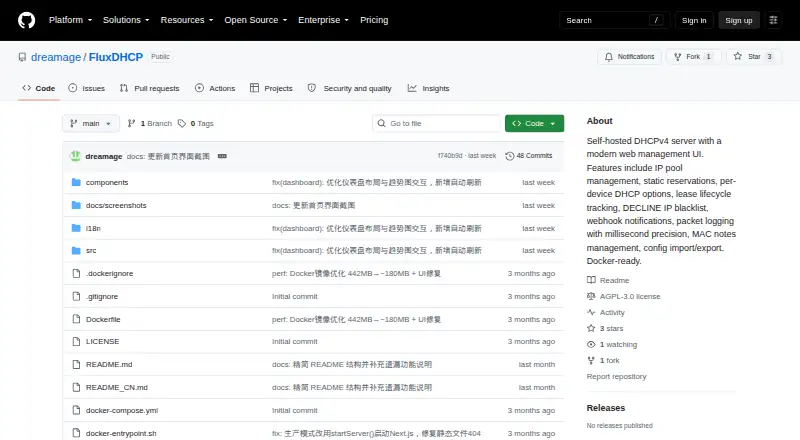
What FluxDHCP is
FluxDHCP is a self-hosted DHCPv4 server managed through a web interface. It supports DHCPv4 message types including DISCOVER, OFFER, REQUEST, ACK, NAK, RELEASE, DECLINE, and INFORM. Administrators can configure pools with subnet ranges, gateways, DNS servers, netmasks, and lease times, then use sequential or random address allocation. The server detects overlapping pools and supports static MAC-to-IP reservations and per-device DHCP option overrides. Lease records track offered, bound, released, and expired states, with automatic cleanup for expired entries. A packet logger records transaction direction, client details, raw options, and millisecond timestamps. Webhooks can send DHCP events to external services by HTTP POST or GET, with template variables and custom headers. Configuration can be moved in or out as JSON, and imported changes are hot-reloaded. FluxDHCP is free and licensed under AGPL-3.0. It runs on Node.js 20 or later; Docker Compose is recommended, and manual installation is documented. Binding UDP port 67 requires root or administrator privileges. It has English and Chinese localization, dark mode, and a responsive mobile-friendly layout.
Good
- Free, self-hosted software under AGPL-3.0
- Supports reservations and per-device DHCP option overrides
- Logs DHCP transactions with millisecond timestamps
- JSON configuration imports hot-reload changes
Watch out
- DHCPv6 is not supported
- Binding UDP port 67 requires root or administrator privileges
- Requires Node.js 20 or later
Who it suits
FluxDHCP suits administrators who want to run and manage a DHCPv4 server themselves, with web-based pool, reservation, lease, and event management. It is not a fit for DHCPv6 needs, and requires Node.js 20 or later and elevated privileges to bind UDP port 67.
Verdict
FluxDHCP brings DHCPv4 pool configuration, reservations, lease tracking, logging, and webhooks into a self-hosted web interface. Check its runtime and port-binding requirements, and note that it does not support DHCPv6.
Plans and prices
From FluxDHCP's own pricing page, checked 4 Oct 2026.
| Plan | Price | What it gives you |
|---|---|---|
| FluxDHCP | Free | AGPL-3.0 licensed; self-hosted |
The facts
Each one read from FluxDHCP's own pages, with the date it was checked.
What it does
- Address pools
- Pools support subnet ranges, gateway, DNS servers, netmask, lease times, overlap detection, and sequential or random allocation.checked 4 Oct 2026
- Configuration
- Configuration can be exported to and imported from JSON, and changes are hot-reloaded after import.checked 4 Oct 2026
- Deployment
- The README recommends Docker Compose and also documents manual installation with Node.js and npm.checked 4 Oct 2026
- DHCP protocol
- It supports DHCPv4 operations including DISCOVER, OFFER, REQUEST, ACK, NAK, RELEASE, DECLINE, and INFORM, and describes itself as RFC 2131 compliant.checked 4 Oct 2026
- IP pools
- Pools support subnet ranges, gateways, DNS servers, netmasks, per-pool lease times, overlap detection, and sequential or random allocation.checked 4 Oct 2026
- Lease tracking
- Lease states include OFFERED, BOUND, RELEASED, and EXPIRED, with automatic expiry cleanup.checked 4 Oct 2026
- License
- The project is licensed under AGPL-3.0, and the README says use, modification, and distribution are free subject to the license terms.checked 4 Oct 2026
- Localization and interface
- The interface supports English and Chinese localization, dark mode, and a responsive mobile-friendly layout.checked 4 Oct 2026
- Logging
- The packet logger records DHCP transactions with millisecond timestamps, packet details, and translated option codes.checked 4 Oct 2026
- Monitoring
- The packet logger records DHCP transactions with millisecond timestamps, direction, raw options, and client details.checked 4 Oct 2026
- Notifications
- Webhooks can send DHCP events to external services using HTTP POST or GET, template variables, and custom headers.checked 4 Oct 2026
- Operational requirement
- Binding UDP port 67 requires root or administrator privileges.checked 4 Oct 2026
- Product
- FluxDHCP is a lightweight, self-hosted DHCPv4 server with a web management UI.checked 4 Oct 2026
- Protocol
- It supports DHCPv4 and lists RFC 2131 message types including DISCOVER, OFFER, REQUEST, ACK, NAK, RELEASE, DECLINE, and INFORM.checked 4 Oct 2026
- Purpose
- FluxDHCP is a lightweight, self-hosted DHCPv4 server with a web management UI.checked 4 Oct 2026
- Requirements
- The listed runtime is Node.js 20 or later, and binding UDP port 67 requires root or administrator privileges.checked 4 Oct 2026
- Reservations and options
- It supports static MAC-to-IP reservations and per-device DHCP option overrides.checked 4 Oct 2026
- Runtime and database
- The documented stack uses Node.js 20 or later and SQLite via better-sqlite3.checked 4 Oct 2026
- Security
- The project lists Origin header validation for API mutations, SSRF-protected webhook URLs, and IP format validation.checked 4 Oct 2026
- Webhooks
- Webhook notifications can send DHCP events to external services via HTTP POST or GET with template variables and custom headers.checked 4 Oct 2026
The full review of FluxDHCP
Overview
FluxDHCP is a self-hosted DHCPv4 server with a web interface, best suited to administrators managing IPv4 address assignment on infrastructure they control. Its focused pool and lease tools are useful without extending to broader IP management; the lack of DHCPv6 support is a firm boundary.
Key features
Pool settings cover subnet ranges, gateways, DNS servers, netmasks and lease durations. Sequential or random allocation and overlap detection give administrators practical control over address assignment and help flag conflicting pool definitions. Static MAC-to-IP reservations and per-device option overrides serve networks where selected clients need consistent addresses or distinct DHCP settings.
Lease tracking separates OFFERED, BOUND, RELEASED and EXPIRED states, with automatic cleanup of expired leases. The packet logger captures transactions with millisecond timestamps, direction, packet details, raw options and client information, giving operators useful material for tracing address-assignment issues. Webhooks can send DHCP events to external services over HTTP POST or GET, with template variables and custom headers to fit the receiving service.
The server supports DHCPv4 message types including DISCOVER, OFFER, REQUEST, ACK, NAK, RELEASE, DECLINE and INFORM, and describes itself as RFC 2131 compliant. Configuration can be exported to and imported from JSON; imported changes hot-reload, which makes configuration transfer more convenient. The project also identifies Origin-header validation for API mutations, SSRF-protected webhook URLs and IP-format validation as safeguards.
Deployment can use the recommended Docker Compose approach or a manual Node.js and npm installation. The documented runtime requires Node.js 20 or later, and binding UDP port 67 requires root or administrator privileges. That makes the product a better fit for operators comfortable with server deployment and privileged network services than for people seeking a managed, low-maintenance appliance.
Pricing
FluxDHCP costs nothing under the AGPL-3.0 license and is self-hosted. The project says use, modification and distribution are free subject to the license terms. There are no paid plans described, so it suits teams comfortable running the software themselves and complying with the license; it is not a hosted service with a managed deployment.
Platforms
FluxDHCP is listed for Linux, self-hosted deployment and web access. Its interface supports English and Chinese, dark mode and a responsive mobile-friendly layout, though the server still needs the documented Node.js runtime and privileged port binding.
Who it's for
Choose FluxDHCP if you need a focused, self-hosted DHCPv4 service with reservations, lease visibility, transaction logging and event notifications, and can manage its runtime and deployment. It is a poor fit for networks requiring DHCPv6 or administrators looking for a turnkey hosted service.
Pros and cons
- Pros: Pool controls, overlap detection, reservations and per-device options cover common IPv4 assignment needs.
- Pros: Lease-state tracking, detailed packet logs and configurable webhooks help operators monitor activity and route events.
- Pros: JSON import/export with hot reload supports configuration transfer without a paid tier.
- Cons: DHCPv6 is unsupported, excluding dual-protocol environments that require it.
- Cons: Node.js 20 or later and administrator-level access to bind UDP port 67 add deployment and privilege requirements.
- Cons: Self-hosting and AGPL-3.0 terms require operational ownership and license awareness.
Alternatives
Compare DHCP management software if you want to survey the category. Choose Subnetly instead if you want a freemium service spanning API, iOS, Linux, web and Windows, with its Free plan capped at 256 IPAM addresses, 10 subnets and 2 DHCP pools, among other quotas. ISC Stork is another free open-source option for Linux, macOS, self-hosted and web environments, with professional support available at custom pricing. teemIP suits readers considering a community edition: its free Community plan provides open-source code, downloads, documentation access and a forum. SagaOS Kea Pilot is a free, MIT-licensed alternative for API, Linux, self-hosted and web use. Danbyte is a free, open-source self-hosted alternative with all features included and no seat license or license expiry. Jen Kea DHCP Management Console may fit Ubuntu 22.04 or 24.04 and Docker deployments that already use ISC Kea with MySQL or MariaDB. SpatiumDDI is another free option for API, Linux, self-hosted and web environments. For a Windows-only local IPv4 DHCP service, consider DacatDHCP, whose official version is permanently free.
Verdict
FluxDHCP is a sound choice for administrators who want a focused, no-cost DHCPv4 server they can run and manage themselves. Its pool controls, reservations, logging and webhooks make it more operationally useful than a bare address server; look elsewhere if you need DHCPv6, hosted management or fewer runtime and privilege obligations.
Getting started
- Open the FluxDHCP GitHub repository
- Deploy with the recommended Docker Compose setup or follow the manual Node.js and npm installation
- Use Node.js 20 or later with the documented SQLite stack
- Run the service with root or administrator privileges to bind UDP port 67
- Open the web management interface and configure pools, reservations, and options
Limits worth knowing
The free FluxDHCP plan is free under AGPL-3.0 for self-hosted use. It supports DHCPv4 only, and UDP port 67 requires root or administrator privileges.
Questions
Is FluxDHCP free?
Yes. The listed FluxDHCP plan costs nothing and is AGPL-3.0 licensed for self-hosted use.
Does it support DHCPv6?
No. The listed protocol support is DHCPv4.
How is FluxDHCP installed?
The README recommends Docker Compose and also documents manual installation with Node.js and npm.
What runtime does it require?
The documented runtime is Node.js 20 or later, with SQLite through better-sqlite3.
Can it send event notifications?
Yes. Webhooks send DHCP events through HTTP POST or GET with template variables and custom headers.
What interface options are available?
The interface supports English and Chinese localization, dark mode, and a responsive mobile-friendly layout.
Alternatives to FluxDHCP
- 1
Subnetly
Free planiOSWebAPILinux7.9From $49 a month - 2

ISC Stork
Free planOpen sourceWebAPILinuxmacOS7.5Free plan - 3

Danbyte
Free planOpen sourceWebAPILinuxSelf-hosted7.4Free plan - 4
OpenIPAM
Free planOpen sourceWebAPILinuxSelf-hosted7.4Free plan - 5
Jen Kea DHCP Management Console
Free planOpen sourceWebAPILinuxSelf-hosted7.1Free plan - 6
teemIP
Free planWebAPILinuxSelf-hosted7.1From €6,000 a year