SagaOS Kea Pilot
SagaOS Kea Pilot is a free, MIT-licensed web platform for managing Kea DHCP, BIND9 DNS, and Dynamic DNS in ISP and enterprise network operations.
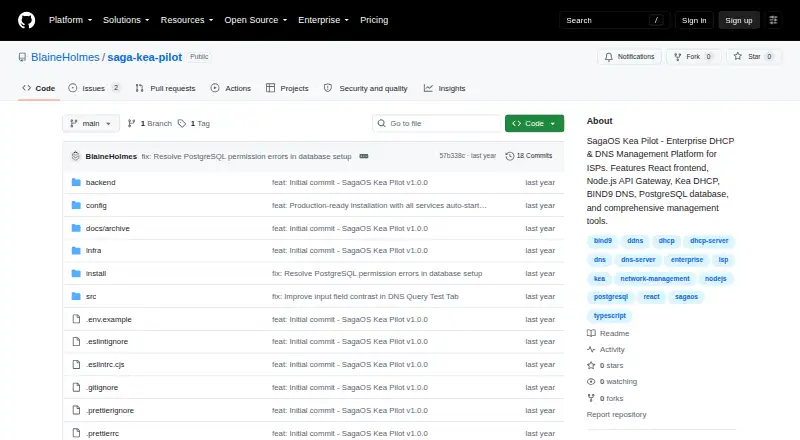
What SagaOS Kea Pilot is
SagaOS Kea Pilot is a free, MIT-licensed web platform for managing Kea DHCP, BIND9 DNS, and Dynamic DNS in ISP and enterprise network operations. It covers DHCPv4 and DHCPv6 subnets, pools, reservations, leases, options, and Kea high availability, alongside BIND9 zones and records, RFC2136 updates, and synchronization with DHCP lease events. A dashboard tracks service status and performance, with live WebSocket updates, audit logs, and analytics. The project also lists multi-tenant data isolation and granular role-based access controls, plus REST endpoints for DHCP and DNS operations. Configuration tools cover backup, restore, versioning, and rollback. Deployment is documented for Linux and Docker; listed systems include Ubuntu 20.04+, CentOS 8+, RHEL 8+, and Debian 11+. The minimum stated requirements are 2 CPU cores, 4 GB RAM, and 20 GB SSD. BIND9 is optional in the minimal installation. The README documents admin/admin as the initial login and says to change it before production use. The project provides no warranty.
Good
- Manages both DHCPv4 and DHCPv6
- Includes BIND9 zone and record management
- Offers live status, metrics, and audit logs
- Configuration backup, restore, versioning, and rollback
- MIT licensed and free
Watch out
- Requires at least 2 CPU cores and 4 GB RAM
- Initial admin/admin credentials must be changed for production
- Software is provided without warranty
Who it suits
It is aimed at ISP and enterprise network teams managing DHCP and DNS services. It may suit operators comfortable with Linux or Docker deployment and the listed system requirements.
Verdict
Kea Pilot brings DHCP, DNS, monitoring, and configuration tools into one self-hosted management platform. Before production, change the documented initial credentials and account for its system requirements and no-warranty terms.
Plans and prices
From SagaOS Kea Pilot's own pricing page, checked 30 Sep 2026.
| Plan | Price | What it gives you |
|---|---|---|
| MIT-licensed software | Free | No paid tiers or usage limits stated |
The facts
Each one read from SagaOS Kea Pilot's own pages, with the date it was checked.
What it does
- Access control
- It lists multi-tenant support, data isolation, and role-based access control with granular permissions.checked 30 Sep 2026
- Access controls
- It lists multi-tenant data isolation and role-based access control with granular permissions and user management.checked 30 Sep 2026
- API
- It provides REST API endpoints for DHCP and DNS operations and WebSocket events for live updates.checked 30 Sep 2026
- Authentication
- The README says the project supports TOTP and hardware-token multi-factor authentication as an enterprise feature.checked 30 Sep 2026
- Authentication caveat
- The documented initial credentials are admin/admin, and the README says to change them for production.checked 30 Sep 2026
- Configuration
- Configuration tools include backup, restore, versioning, and rollback.checked 30 Sep 2026
- Deployment
- The project documents Linux installation and Docker deployment, and lists Ubuntu 20.04+, CentOS 8+, RHEL 8+, and Debian 11+ as supported operating systems.checked 30 Sep 2026
- DHCP
- It supports DHCPv4 and DHCPv6 management, including subnets, address pools, host reservations, leases, DHCP options, and Kea high availability.checked 30 Sep 2026
- DNS
- It provides BIND9 zone and record management, RFC2136 dynamic updates, and DDNS synchronization with DHCP lease events.checked 30 Sep 2026
- Initial credentials
- The README documents admin/admin as the default login and says it must be changed for production.checked 30 Sep 2026
- Integrations
- The documented stack includes Kea DHCP, BIND9, PostgreSQL, Docker, and Nginx; BIND9 is optional in the minimal installation.checked 30 Sep 2026
- License
- The repository states that the software is MIT licensed and permits commercial use, modification, and distribution; it also provides the software without warranty.checked 30 Sep 2026
- Monitoring
- The project lists a live health dashboard, WebSocket updates, service status tracking, performance metrics, audit logging, and analytics.checked 30 Sep 2026
- Purpose
- The project describes itself as a web management platform for Kea DHCP, BIND9 DNS, and Dynamic DNS, aimed at ISP and enterprise network operations.checked 30 Sep 2026
- Requirements
- The listed minimum system requirements include 2 CPU cores, 4 GB RAM, and 20 GB SSD storage.checked 30 Sep 2026
- Security
- Listed security measures include CSRF protection, input validation, secure sessions, SQL injection prevention, XSS protections, rate limiting, and audit logging.checked 30 Sep 2026
- Support
- The README directs users to GitHub Issues, its documentation and community discussions, and says commercial support is available for enterprise deployments and custom integrations.checked 30 Sep 2026
- System requirements
- The README specifies at least 2 CPU cores, 4 GB RAM, and 20 GB SSD, with higher recommendations for production.checked 30 Sep 2026
The full review of SagaOS Kea Pilot
SagaOS Kea Pilot is a self-hosted web platform for managing Kea DHCP, BIND9 DNS, and Dynamic DNS in ISP and enterprise networks. It is best suited to teams that want these services, monitoring, and configuration controls in one Linux deployment. Its open-source licensing and broad management scope are appealing, but production users must replace the documented default login and meet the stated system requirements.
Overview
Kea Pilot brings DHCP and DNS administration together with lease-linked DNS updates, service monitoring, access controls, and configuration rollback. That breadth can simplify operations for teams already running Kea and BIND9, while the multi-tenant model and granular permissions suit environments with distinct users or tenants.
This is infrastructure software, not a hosted service: deployment is documented for Linux or Docker, and the stack includes PostgreSQL and Nginx alongside Kea. BIND9 is optional in the minimal installation, which gives operators some room to tailor the deployment. The 2-core, 4 GB RAM, and 20 GB SSD minimum is a real entry cost, and production use calls for more resources.
Key features
DHCP and DNS administration
DHCPv4 and DHCPv6 management covers subnets, address pools, reservations, leases, options, and Kea high availability. BIND9 zone and record management, RFC2136 updates, and synchronization of DNS with DHCP lease events extend that control across address assignment and name resolution. For teams managing both services, the combined workflow is the main practical advantage; operators seeking only a lightweight DHCP interface may not need the full platform.
Monitoring, access, and configuration
A live health dashboard, service status, performance metrics, WebSocket updates, audit logs, and analytics put operational visibility alongside administration. Multi-tenant data isolation and role-based permissions support controlled access, while backup, restore, versioning, and rollback help operators manage configuration changes. The REST API and WebSocket events also make the platform accessible to external workflows.
The documented security measures include CSRF protection, input validation, secure sessions, SQL injection and XSS protections, and rate limiting. TOTP and hardware-token multi-factor authentication are described as enterprise features. These controls are useful, but the documented admin/admin initial credentials make changing the login a production prerequisite, not an optional hardening step.
Pricing
Kea Pilot is MIT-licensed software at no cost, with no paid tiers or usage limits stated. The MIT license permits commercial use, modification, and distribution. The trade-off is operational: teams provide and maintain their own deployment, and the software is supplied without warranty. Commercial support is available for enterprise deployments and custom integrations.
Platforms
The platform supports API, Linux, self-hosted, and web use. Documented operating systems are Ubuntu 20.04+, CentOS 8+, RHEL 8+, and Debian 11+. Docker deployment is also documented. The Linux and resource requirements make it a fit for operators able to provision and administer infrastructure, rather than users looking for a managed cloud console.
Who it's for
Kea Pilot is a strong fit for ISP and enterprise network teams that already operate Kea DHCP and want DNS management, Dynamic DNS synchronization, monitoring, and configuration safeguards in the same self-hosted platform. Its access controls and multi-tenant isolation also suit organizations separating responsibilities across users or tenants. It is less suitable for teams that cannot maintain Linux or Docker deployments, or that require a warranty-backed product.
Pros and cons
- Pro: DHCPv4/v6, high availability, BIND9 management, and lease-driven DDNS cover core DHCP and DNS operations in one platform.
- Pro: Monitoring, audit logging, granular roles, and configuration rollback add operational oversight beyond basic service administration.
- Pro: MIT licensing allows commercial use and modification without a stated usage cap.
- Con: Self-hosting requires at least 2 CPU cores, 4 GB RAM, and 20 GB SSD, with higher resources recommended for production.
- Con: The documented admin/admin login must be changed before production deployment.
- Con: The software is supplied without warranty, so operators must account for that risk when choosing it for critical infrastructure.
Alternatives
For another free, self-hosted Kea management option, compare ISC Stork, which supports Linux, macOS, and web platforms and offers free open-source software; professional support is a separate option with custom pricing. Subnetly is worth considering when a freemium service and broader platform coverage, including iOS and Windows, matter; its free plan has defined IPAM, subnet, DHCP pool, and DNS zone quotas.
Kubernesis DDI is a paid, self-hosted DDI alternative with custom deployment and pricing. SpatiumDDI is another free option for Linux and self-hosted use, with API and web platforms. FusionLayer DDI may suit buyers considering a perpetual license; it offers a free trial, while license and support costs are quoted separately.
Jen Kea DHCP Management Console is a free, self-hosted alternative for Ubuntu 22.04/24.04 or Docker, requiring ISC Kea with MySQL or MariaDB. ManageEngine DDI Central is a paid option with a free trial and a Professional starting price of $3,199 a year; its plan covers up to six DNS servers and four DHCP servers. teemIP offers a free Community plan with open-source code, installation, and community access.
Browse the DHCP Management Software directory for more options.
Verdict
Choose SagaOS Kea Pilot if your network team wants a free, MIT-licensed, self-hosted control plane for Kea DHCP and BIND9 DNS, with monitoring and configuration tools in the same platform. Its integrated scope and open license are the strongest reasons to choose it. Look elsewhere if you need a warranty-backed deployment or cannot take on the hosting requirements and production security setup.
Alternatives to SagaOS Kea Pilot
- 1
Subnetly
Free planiOSWebAPILinux7.9From $49 a month - 2

ISC Stork
Free planOpen sourceWebAPILinuxmacOS7.5Free plan - 3

Danbyte
Free planOpen sourceWebAPILinuxSelf-hosted7.4Free plan - 4
OpenIPAM
Free planOpen sourceWebAPILinuxSelf-hosted7.4Free plan - 5
Jen Kea DHCP Management Console
Free planOpen sourceWebAPILinuxSelf-hosted7.1Free plan - 6
teemIP
Free planWebAPILinuxSelf-hosted7.1From €6,000 a year