DocsPodcast
DocsPodcast turns uploaded documents into AI-generated podcast conversations and answers questions about their contents.
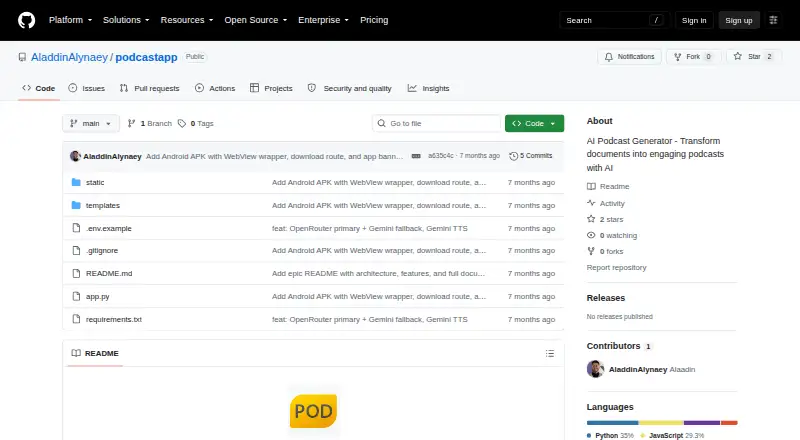
What DocsPodcast is
DocsPodcast turns uploaded documents into AI-generated podcast conversations and answers questions about their contents. It accepts PDF, DOCX, DOC, and TXT files, with uploads limited to 0.5 MB (512 KB). For question answering, its retrieval pipeline stores document sections in ChromaDB and grounds responses in the source material. Podcast scripts support conversations between two and four speakers, combine generated segments into one MP3 file, and offer English or Arabic output. The README lists OpenRouter with GPT-4o-mini as the main text provider, Google Gemini as a fallback, Gemini TTS for speech, and gTTS as a voice fallback. The responsive interface works on mobile and desktop and renders Markdown tables, code blocks, blockquotes, and lists. DocsPodcast is MIT-licensed, free, self-hostable, and available for web and Windows. Self-hosting requires Python 3.9 or later plus OpenRouter and Google Gemini API keys.
Good
- Supports PDF, DOCX, DOC, and TXT
- Two-to-four-speaker podcast conversations
- English and Arabic support
- MP3 audio output
- MIT-licensed and free
Watch out
- Uploads capped at 0.5 MB
- Self-hosting requires two AI API keys
- AI calls send data to third parties
Who it suits
DocsPodcast suits people who want to turn supported documents into podcasts or chat with their files. It also fits users comfortable with self-hosting and configuring AI service keys.
Verdict
DocsPodcast combines document Q&A with multi-speaker audio generation in a free, open-source project. The small upload limit and required external AI services are important constraints.
The facts
Each one read from DocsPodcast's own pages, with the date it was checked.
What it does
- AI integrations
- The documented AI services are OpenRouter with GPT-4o-mini, Google Gemini, Gemini TTS, and Google TTS (gTTS).checked 9 Oct 2026
- AI providers
- The README describes OpenRouter with GPT-4o-mini as the primary text-generation provider, Gemini as a fallback, Gemini TTS, and gTTS as a TTS fallback.checked 4 Oct 2026
- Data handling
- The README says no user data is sent to third parties beyond AI API calls.checked 4 Oct 2026
- Deployment
- The project documents a local setup using Python 3.9 or later and Flask, and links to a live demo.checked 9 Oct 2026
- Document formats
- It supports PDF, DOCX, DOC, and TXT uploads.checked 9 Oct 2026
- Document Q&A
- Its RAG pipeline stores document chunks in ChromaDB for semantic retrieval, and answers are grounded in document content.checked 4 Oct 2026
- File size limit
- The maximum document size is 0.5 MB (512 KB), enforced on both the client and server.checked 9 Oct 2026
- Intended audience
- The maker describes the project as a way to turn documents into podcasts or chat with files; the repository lists PDF, Word, and text document support.checked 9 Oct 2026
- Interface
- The README describes a responsive interface for mobile and desktop with a dark theme and rich Markdown rendering.checked 9 Oct 2026
- Languages
- The README lists English and Arabic for Q&A, podcast scripts, and TTS audio.checked 9 Oct 2026
- License
- The repository states that the project is licensed under the MIT License.checked 4 Oct 2026
- License and contributions
- The repository says the project is MIT-licensed and welcomes contributions through pull requests.checked 9 Oct 2026
- Podcast generation
- It generates natural multi-speaker conversations with 2–4 speakers and combines generated segments into one audio file.checked 4 Oct 2026
- Podcast voices
- Podcast scripts support conversations between two to four speakers, with Gemini TTS and Google TTS listed as the primary and fallback voice-generation options.checked 9 Oct 2026
- Product
- DocsPodcast turns documents into AI podcast conversations and supports question answering about their contents.checked 4 Oct 2026
- Purpose
- DocsPodcast turns documents into AI-generated multi-speaker podcasts and supports question answering about uploaded files.checked 9 Oct 2026
- Question answering
- Its RAG pipeline stores document chunks in ChromaDB and grounds answers in the document content.checked 9 Oct 2026
- Security
- The README says API keys are kept in an uncommitted .env file, filenames are sanitized, rendered HTML is sanitized with DOMPurify, and user data is sent to third parties only for AI API calls.checked 9 Oct 2026
- Setup
- Self-hosting instructions require Python 3.9+ and OpenRouter and Google Gemini API keys.checked 4 Oct 2026