
Disk SpeedUp
Disk SpeedUp is a free Windows utility for analyzing and defragmenting disks, as well as optimizing individual files and folders.
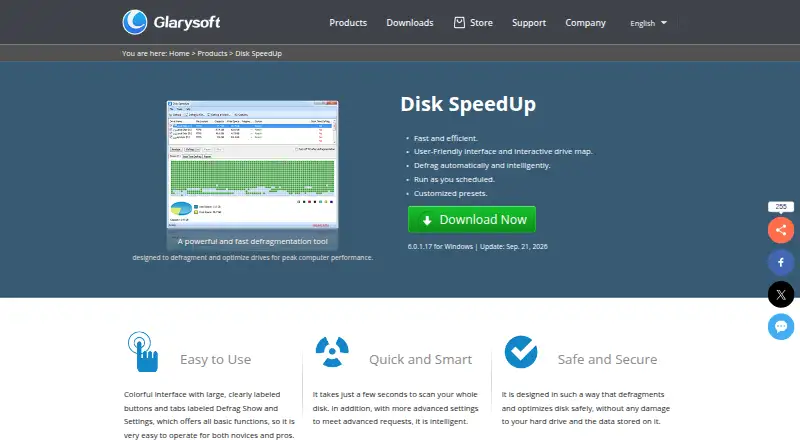
What Disk SpeedUp is
Disk SpeedUp is a free Windows utility for analyzing and defragmenting disks, as well as optimizing individual files and folders. It presents fragmentation results in an interactive drive map. Its defragmentation modes can improve placement for less frequently accessed files or prioritize frequently used files. You can schedule an action by selecting its type, frequency, time, and drives, and it can defragment system files at boot, including page files, registry hives, and hiberfil.sys. The program offers SSD optimization settings, though its knowledge base advises against defragmenting SSDs because this may reduce their lifespan. Supported file systems are FAT 16/32 and NTFS. You can exclude files or folders from defragmentation, add Disk Defrag to the Windows Explorer context menu through Glary Utilities settings, and set the computer to shut down when a run finishes. The download page lists version 6.0.1.17. Glarysoft says it typically responds to technical questions and bug reports within one or two business days.
Good
- Interactive drive map displays fragmentation results.
- Offers scheduled and boot-time defragmentation.
- Can exclude selected files and folders.
- Can shut down after defragmentation finishes.
Watch out
- Defragmenting SSDs may reduce their lifespan.
- Supports FAT 16/32 and NTFS file systems.
Who it suits
Disk SpeedUp suits Windows users who want to inspect drive fragmentation and schedule defragmentation. Its exclusions and boot-time options offer control over what and when it processes.
Verdict
Disk SpeedUp provides drive analysis, scheduling, and several defragmentation modes at no cost. Its SSD warning is important: avoid defragmenting SSDs according to the product’s own guidance.
Plans and prices
From Disk SpeedUp's own pricing page, checked 29 Sep 2001.
| Plan | Price | What it gives you |
|---|---|---|
| Disk SpeedUp | Free | Freeware · Windows 11, 10, 8, 7, 2000, XP, Vista · 32/64-bit |
The facts
Each one read from Disk SpeedUp's own pages, with the date it was checked.
What it does
- Automatic shutdown
- It can shut down the computer automatically after defragmentation finishes.checked 29 Sep 2001
- Boot files
- It supports boot-time defragmentation of system files, including page files, registry hives, and hiberfil.sys.checked 29 Sep 2001
- Current release
- The download page lists version 6.0.1.17, a 9.49 MB file, released September 21, 2026.checked 29 Sep 2001
- Defragmentation
- The product provides basic defragmentation and modes to optimize placement of less frequently accessed files or prioritize frequently used files.checked 29 Sep 2001
- Disk analysis
- It analyzes drive fragmentation and displays results through an interactive drive map.checked 29 Sep 2001
- Exclusions
- Users can add files and folders to an exclusion list so they are skipped during defragmentation.checked 29 Sep 2001
- File systems
- The knowledge base says it supports FAT 16/32 and NTFS file systems.checked 29 Sep 2001
- Purpose
- Disk SpeedUp analyzes, defragments, and optimizes disks or individual files and folders.checked 29 Sep 2001
- Safety claim
- Glarysoft says the product is designed to defragment and optimize disks without damaging the hard drive or stored data.checked 29 Sep 2001
- Scheduling
- Users can schedule defragmentation by choosing an action, frequency, time, and drives.checked 29 Sep 2001
- SSD options
- The product offers SSD optimization settings, and its knowledge base says defragmenting SSDs is not recommended because it may reduce their lifespan.checked 29 Sep 2001
- Support
- Glarysoft says it usually responds to technical questions and bug reports within one or two business days.checked 29 Sep 2001
The company
- Maker
- Glarysoft says it specializes in utility software for Windows systems.checked 29 Sep 2001
Where it runs
- Windows integration
- Disk Defrag can be enabled in the Windows Explorer context menu through Glary Utilities settings.checked 29 Sep 2001
The full review of Disk SpeedUp
Overview
Disk SpeedUp is a Windows utility for analyzing and defragmenting drives or selected files and folders. It suits Windows users who want scheduled maintenance and control over which files are optimized. Its range of defragmentation options is useful for traditional drives, though its own guidance makes clear that SSDs should not be defragmented.
Key features
An interactive drive map makes fragmentation analysis more concrete than a simple status readout: users can inspect a drive before deciding whether to run an optimization. Disk SpeedUp offers basic defragmentation, plus modes that favor either frequently used files or the placement of less frequently accessed ones. That choice gives users some control over optimization priorities without making the utility a general-purpose storage manager.
Scheduling lets users choose an action, frequency, time, and drives, and the product supports automatic optimization. This is practical for routine maintenance without having to start each run manually. Boot-time defragmentation also targets system files such as page files, registry hives, and hiberfil.sys, which cannot be treated like ordinary files while Windows is running. Users can exclude particular files and folders, and have the computer shut down when defragmentation finishes.
Disk SpeedUp supports FAT 16/32 and NTFS. SSD optimization settings are offered, but Glarysoft advises against defragmenting SSDs because doing so may reduce their lifespan; SSD owners should heed that warning rather than assume the setting makes defragmentation appropriate. Windows Explorer context-menu integration is possible through Glary Utilities settings. Glarysoft says the product is designed to avoid damage to drives or stored data, and that it usually responds to technical questions and bug reports within one or two business days.
Pricing
Disk SpeedUp is freeware at no cost, with no trial period because the product is free. Its plan covers Windows 11, 10, 8, 7, 2000, XP, and Vista, in 32-bit and 64-bit editions. There are no paid tiers or plan quotas to weigh against the free edition. That makes it a straightforward option for Windows users who want the included analysis, scheduling, and optimization modes without a subscription or license purchase.
Platforms
Disk SpeedUp is for Windows and supports both drive types. The download page lists version 6.0.1.17, a 9.49 MB download released September 21, 2026. Its file-system support covers FAT 16/32 and NTFS, so it is not a fit for users seeking a Linux utility or support beyond those formats.
Who it's for
Choose Disk SpeedUp if you use Windows, want to inspect fragmentation before acting, and value scheduled or boot-time defragmentation alongside exclusions and automatic shutdown. It is less suitable for anyone primarily looking to optimize an SSD through defragmentation: the product's own guidance cautions against that. Users seeking a tool for Linux should look elsewhere.
Pros and cons
- Useful control over maintenance: scheduling, boot-time runs, file and folder exclusions, and shutdown after completion give users practical ways to fit defragmentation around their routine.
- Free with no paid-tier trade-off: the listed plan includes the product's core analysis and defragmentation capabilities at no cost.
- Clear SSD caution: Glarysoft warns that SSD defragmentation may reduce lifespan, an important constraint for users choosing settings or deciding whether this is the right tool.
- Windows and file-system scope: support is limited to Windows and FAT 16/32 and NTFS, excluding readers who need a Linux tool or other file-system support.
Alternatives
For a broader comparison of category options, browse the Disk Defragmentation Software list.
Pick IObit Smart Defrag if you want a free Windows option whose free plan includes basic file defragmentation, scheduled defrag, and game optimization; its paid plans include a 1-PC tier and a 3-PC tier, with the latter priced at $19.99 a year. Puran Defrag is another free Windows choice; its directory-consolidation feature works only on NTFS partitions. WinContig may suit readers who want freeware for personal or commercial use across unlimited Windows computers, without registration or payment.
UltraDefrag is a paid Windows alternative with lifetime-license Standard and Enterprise plans. Btrfsmaintenance is a free Linux and self-hosted option consisting of scripts for Btrfs filesystem maintenance. O&O Defrag is a paid Windows choice, with its Professional Edition priced at $49.95, paid once for one PC. UltimateDefrag 6 costs $19.97, paid once for a license covering three PCs and offers a free trial. Defragger is a free Linux alternative.
Verdict
Disk SpeedUp is a sensible free pick for Windows users who want drive analysis, flexible defragmentation modes, and scheduled or boot-time maintenance in one utility. Its chief reason to choose it is the breadth of those controls at no cost; its chief reason to look elsewhere is that SSD defragmentation is explicitly discouraged, while the product remains Windows-focused.
Getting started
- Open the Disk SpeedUp website
- Download the Windows freeware release
- Choose drives or individual files and folders to analyze
- Select a defragmentation mode or schedule
- Add exclusions or enable boot-time optimization as needed
- Optionally enable automatic shutdown after completion
Limits worth knowing
The freeware plan is for Windows. Defragmenting SSDs is discouraged in the knowledge base because it may reduce their lifespan.
Questions
Is Disk SpeedUp free?
Yes. The plan is freeware and costs nothing, with no free trial listed.
Which Windows versions are covered by the plan?
The plan lists Windows 11, 10, 8, 7, 2000, XP, and Vista, in 32-bit and 64-bit editions.
What file systems does it support?
The knowledge base lists FAT 16/32 and NTFS support.
Can defragmentation be scheduled?
Yes. You can choose an action, frequency, time, and drives for scheduled defragmentation.
Does it optimize SSDs?
It provides SSD optimization settings, but the knowledge base says defragmenting SSDs is not recommended because it may reduce lifespan.
Alternatives to Disk SpeedUp
- 1

Autoruns
Free planWindows6.2Free plan - 2
DymaxIO
Windows6.2From $5.75 a month - 3

Auslogics Driver Updater
Free planWindows6.1Free plan - 4
IObit Smart Defrag
Free planWindows6.0From $1.67 a month - 5

UltimateDefrag 6
Windows5.9$19.97, paid once - 6
Btrfsmaintenance
Free planLinuxSelf-hosted5.8Free plan