
Didit
Didit is an identity and fraud platform built around one API for user and business verification, anti-money-laundering checks, and transaction monitoring.
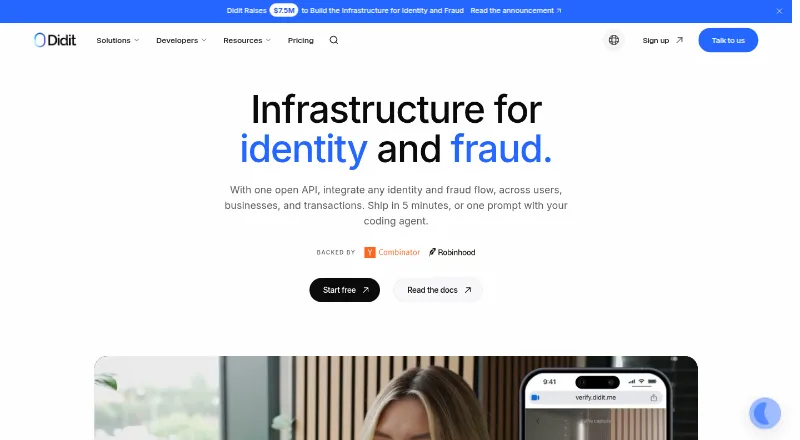
What Didit is
Didit is an identity and fraud platform built around one API for user and business verification, anti-money-laundering checks, and transaction monitoring. Its coverage includes 220+ countries, 14,000+ document types, 10,000+ AML datasets, and 1,000+ government and bureau data sources. Fraud tools include biometric authentication, passive liveness, age estimation, device and IP analysis, and phone and email OTP. Didit describes applications such as neobank KYC, B2B fintech KYB, crypto Travel Rule, and ongoing AML for marketplaces.
Developers can use public API documentation, an MCP server, and SDKs for web, iOS, Android, React Native, and Flutter. Ready-made integrations are listed for Zapier, Shopify, and Salesforce. Didit lists SOC 2 Type 1 and Type 2, ISO/IEC 27001:2022, and iBeta Level 1 PAD. Data is encrypted at rest with AES-256 and in transit with TLS 1.3; sessions are stored in the EU by default. The Free plan is $0.00 per month and includes 500 full KYC verifications each month. Pay as you go costs $0.33 per full KYC. Billing depends on completed checks, and a declined session may still include billable checks.
Good
- Coverage spans 220+ countries and 14,000+ document types.
- Free includes 500 full KYC verifications each month.
- SDKs cover web, iOS, Android, React Native, and Flutter.
- Ready-made Zapier, Shopify, and Salesforce integrations are listed.
- AES-256 at-rest and TLS 1.3 in-transit encryption.
Watch out
- A declined session can still contain billable checks.
- Pay as you go charges $0.33 per full KYC.
- Enterprise requires a custom annual contract.
Who it suits
Didit suits teams that need identity verification, business checks, AML screening, or transaction monitoring through an API. It also fits developers seeking SDKs and listed integrations, and businesses handling KYC, KYB, crypto Travel Rule, or marketplace AML workflows.
Verdict
Choose Didit if you need identity and fraud workflows connected through one API, with a free monthly allowance and a broad set of verification tools. Consider the billing model carefully: declined sessions can contain billable checks, and enterprise access is on a custom annual contract.
Plans and prices
From Didit's own pricing page, checked 15 Oct 2026.
| Plan | Price | What it gives you |
|---|---|---|
| Free | Free | ID verification · liveness · face match · device/IP · workflow builder · case management · SDKs · 500 full KYC verifications monthly forever; no card |
| Pay as you go | $0.33, paid once | 25+ modules · AML from $0.07 · transaction monitoring $0.02 each · wallet screening $0.15 · white label · $0.33 per full KYC; module usage metered |
| Enterprise | — | Committed-volume pricing · 99.99% SLA · data residency · manual reviewers · priority 24/7 support · Custom annual contract |
The facts
Each one read from Didit's own pages, with the date it was checked.
What it does
- AML screening
- AML screening checks more than 1,300 sanctions, PEP and adverse-media lists, with ongoing monitoring available per user per year.checked 15 Oct 2026
- API
- Didit exposes a REST API under the /v3 contract and publishes an OpenAPI 3.1 specification.checked 15 Oct 2026
- Biometrics
- The platform offers passive and active liveness, one-to-one face matching, one-to-many face search and biometric authentication.checked 15 Oct 2026
- Coverage
- The developer site states support for more than 220 countries, 14,000 document types, 1,000 government data sources and 48 languages.checked 15 Oct 2026
- Data protection
- The security page says data is encrypted at rest with AES-256 and in transit with TLS 1.3, and sessions are stored in the EU by default.checked 28 Sep 2026
- Developer tools
- Didit offers public API documentation, an MCP server, and SDKs for web, iOS, Android, React Native, and Flutter.checked 28 Sep 2026
- Documentation depth
- The documentation index includes quickstarts, API reference, SDK integration, workflows, case management, entities, security, audit logs, data retention and changelog sections.checked 15 Oct 2026
- Enterprise data controls
- Enterprise customers can enable in-country data residency subject to availability, and retention can be configured from one month to ten years.checked 28 Sep 2026
- Fraud tools
- Its modules include biometric authentication, passive liveness, age estimation, device and IP analysis, and phone and email OTP.checked 28 Sep 2026
- Funding news
- On May 26, 2026, Didit announced an additional $6 million seed round, bringing total seed funding to $7.5 million, backed by Y Combinator and other investors.checked 15 Oct 2026
- Government validation
- Didit says a year-long Spanish Treasury, CNMV, SEPBLAC and Bank of Spain sandbox concluded its remote verification was at least as safe as in-person checks.checked 15 Oct 2026
- Identity document verification
- ID verification reads government identity documents across 220-plus countries and 14,000-plus document types, including barcodes and MRZ data.checked 15 Oct 2026
- Integrations
- Official pages list Zapier, Shopify and Salesforce integrations plus no-code verification links and QR-code flows.checked 15 Oct 2026
- Limit: document capture constraint
- One G2 reviewer says document-tampering checks require a live capture and do not accept an existing uploaded file.checked 15 Oct 2026
- Limit: local document coverage
- A TrustRadius reviewer lists support for local identity documents as a product weakness.checked 15 Oct 2026
- Limit: verification exceptions
- G2 reviewers report synchronization failures, repeated verification attempts, unclear OCR or face-match outcomes and extra manual review work.checked 15 Oct 2026
- MCP and agent support
- Didit publishes an MCP server and agent skills for AI clients such as Claude, Cursor and Codex.checked 15 Oct 2026
Money
- Billing detail
- Pricing page says billing is based on completed checks and a declined session can still contain billable checks.checked 28 Sep 2026
- Limit: pricing and billing friction
- G2 reviewers mention occasional duplicate session charges and request stronger auto-refill safeguards and more predictable billing.checked 15 Oct 2026
The company
- Company founding and size
- LinkedIn lists Didit as founded in 2023, privately held, headquartered in San Francisco and employing 11–50 people.checked 15 Oct 2026
- Company legal entity
- Website terms identify Didit Identity Spain, S.L. in Barcelona and Didit Identity, Inc. in Delaware as the contracting entities.checked 15 Oct 2026
- Founded
- 2023checked 23 Sep 2026
- Headquarters
- San Francisco, United Stateschecked 23 Sep 2026
- Maker and location
- Didit says it was founded in 2023 in Barcelona by Alberto and Alejandro Rosas and is headquartered in San Francisco.checked 28 Sep 2026
The full review of Didit
Overview
Didit is a business identity and fraud platform that brings verification and monitoring workflows together through an API. It is best suited to fintechs and marketplaces that need both identity checks and ongoing risk controls; its no-card free tier makes it possible to start with a meaningful KYC allowance, though billable checks inside declined sessions require attention to cost.
Its use cases include neobank KYC, B2B fintech KYB, crypto Travel Rule workflows, and ongoing AML for marketplaces. Didit was founded in 2023 in Barcelona by Alberto and Alejandro Rosas and is headquartered in San Francisco.
Key features
Identity, business and fraud checks
Didit puts user and business verification, AML screening, and transaction monitoring behind one API. It states coverage across 220+ countries, 14,000+ document types, 10,000+ AML datasets, and 1,000+ government and bureau sources. That breadth is useful for services operating across jurisdictions, but teams still need to decide which checks fit their own risk rules.
Fraud modules include biometric authentication, passive liveness, age estimation, device and IP analysis, and phone and email OTP. The range makes Didit more than a document-checking tool, while per-check billing means adding checks to a flow can affect cost even when a session is declined.
Workflow and developer access
A workflow builder and case management support day-to-day handling of verification work. Public API documentation, an MCP server, and SDKs for web, iOS, Android, React Native, and Flutter give development teams several routes to integrate the service. Ready-made Zapier, Shopify, and Salesforce integrations can also connect Didit with those platforms without making the product a fit for teams that do not need identity or fraud workflows.
Security and data controls
Didit lists SOC 2 Type 1 and Type 2, ISO/IEC 27001:2022, and iBeta Level 1 PAD. It says data is encrypted at rest with AES-256 and in transit with TLS 1.3, and sessions are stored in the EU by default. Enterprise customers can enable in-country data residency where available and configure retention from one month to ten years. These controls give larger organizations options for data governance, but the residency and retention controls sit behind the enterprise contract.
Pricing
Didit's freemium structure has a free entry point, a per-check option, and custom enterprise pricing. The key billing distinction is that charges apply to completed checks, not simply whether a session succeeds: a declined session can still contain billable checks.
- Free — free, billed $0/ month with no card required. It includes 500 full KYC verifications every month, covering ID, liveness, face match, and device and IP, plus the workflow builder, case management, and SDKs. This is the strongest fit for a small team validating a workflow or operating within the monthly cap; it does not provide unlimited volume.
- Pay as you go — $0.33, paid once, billed $0.33 per full KYC. It includes 25+ publicly priced modules and automatic volume discounts, with no monthly minimum, seat fees, or contract. This suits variable or growing usage, but the per-check billing makes the cost of multi-check or declined sessions important to monitor.
- Enterprise — custom pricing, billed on a custom annual contract. It offers committed-volume pricing, custom legal terms, a 99.99% uptime SLA, data residency, and priority human support through a 24/7 shared Slack channel and named success manager. It is aimed at organizations needing contractual terms, service commitments, and enterprise data controls; the annual commitment is a poor fit for teams seeking a flexible small-volume arrangement.
There is no free trial. The free monthly plan is the route to evaluate the service without a card, while the enterprise tier is not a month-to-month alternative to pay as you go.
Platforms
Didit supports Android, iOS, web, and API access. Its SDKs also cover React Native and Flutter, extending the development options for mobile teams.
Who it's for
Didit fits neobanks, B2B fintechs, crypto businesses, and marketplaces that need identity or business verification alongside AML and fraud workflows. Teams benefit most when they want to connect several kinds of checks rather than buy a narrow document-verification step. A smaller organization can begin with the free allowance, while teams with unpredictable volume can avoid minimums through pay as you go.
It is less compelling for buyers that need only a single check type, cannot tolerate variable per-check costs, or require enterprise residency and contractual terms without an annual commitment. The free cap is substantial enough to start, but teams approaching 500 monthly full KYC verifications should model their usage against paid check charges.
Pros and cons
- Pro: User verification, KYB, AML, and transaction monitoring share one API, helping teams consolidate related risk workflows.
- Pro: The free plan includes 500 full KYC verifications each month and core workflow tools without requiring a card.
- Pro: Broad stated geographic, document, AML dataset, and government/bureau source coverage supports services with cross-market needs.
- Pro: Multiple SDKs, an MCP server, and ready-made integrations give technical and operations teams several integration paths.
- Con: A declined session can still generate billable checks, so outcome-based assumptions can underestimate pay-as-you-go costs.
- Con: Enterprise pricing requires a custom annual contract, which reduces flexibility for teams that need data residency or contractual commitments at low volume.
Alternatives
For broader category browsing, see KYC Software and Identity Verification Software.
- Shufti is another freemium option with a free tier of up to 10 verifications each month and a free trial; choose it if that smaller starter allowance better suits your evaluation.
- Alloy Embedded is a paid alternative for buyers considering another Android, API, iOS, or web platform.
- Entrust Certificate Manager is a paid option with Android, API, iOS, Linux, self-hosted, and web platforms.
- Jumio uses custom enterprise pricing and is a paid option for buyers prepared to request a quote.
- Footprint is another paid Android, API, iOS, and web option.
- Ondato offers Business Onboarding (KYB) from €600 per month, with price dependent on volume, selected solutions and features, and additional checks; consider it when a stated monthly starting point for KYB is useful for budgeting.
- Socure has a free plan and a Document Verification (DocV) option at $0.80 per evaluation for government ID scan and selfie checks covering IDs from 195+ countries; choose it when that defined document-check option aligns with the need.
- Stripe Identity is a paid option with a free plan and a $0.50 per-lookup US Social Security number lookup, charged when verification is completed; consider it for that specific lookup use case.
Verdict
Choose Didit if your product needs identity, business verification, AML, and fraud workflows connected through one API, especially if the 500 monthly free KYC checks can cover an initial workload. Its breadth, developer options, and no-minimum pay-as-you-go tier make it adaptable as usage changes. Look elsewhere if you need predictable costs independent of checks run, or enterprise data controls without signing a custom annual contract.
Getting started
- Open https://didit.me/.
- Choose the Free plan at $0.00 per month or Pay as you go at $0.33 per full KYC.
- Use public API documentation, the MCP server, or an SDK for a supported platform.
- Connect through the dashboard and API, or use a listed Zapier, Shopify, or Salesforce integration.
Limits worth knowing
The Free plan includes 500 full KYC verifications each month. Pay as you go costs $0.33 per full KYC, and a declined session may still contain billable checks.
Questions
Is Didit free?
Yes. The Free plan costs $0.00 per month and includes 500 full KYC verifications each month.
How much does Pay as you go cost?
It costs $0.33 per full KYC. Billing is based on completed checks, and declined sessions may still contain billable checks.
Which platforms does Didit support?
The listed platforms are Android, iOS, web, and API. SDKs are offered for web, iOS, Android, React Native, and Flutter.
What integrations are available?
The site lists ready-made integrations for Zapier, Shopify, and Salesforce.
Who founded Didit, and where is it based?
Didit says it was founded in 2023 in Barcelona by Alberto and Alejandro Rosas. Its headquarters are in San Francisco.
What security measures and certifications does Didit list?
Didit lists SOC 2 Type 1 and Type 2, ISO/IEC 27001:2022, and iBeta Level 1 PAD. Data is encrypted at rest with AES-256 and in transit with TLS 1.3, and sessions are stored in the EU by default.
Alternatives to Didit
- 1
Idswyft
Free planOpen sourceWebAPILinuxmacOS8.0From $49 a month - 2
ProntoID
Free planAndroidiOSWebAPI7.9Free plan - 3

Shufti
Free planAndroidiOSWebAPI7.9$1.50 one-time - 4
Authonex
Free planOpen sourceWebAPISelf-hosted7.6$0.05 one-time - 5

Persona
AndroidiOSWebAPI7.5From $250 a month - 6
FaceTec
Free planAndroidiOSWebAPI7.4Free plan