
DHIS2-Ed
DHIS2-Ed is an education management information system for institutions that need to collect, analyze, visualize, and use education data.
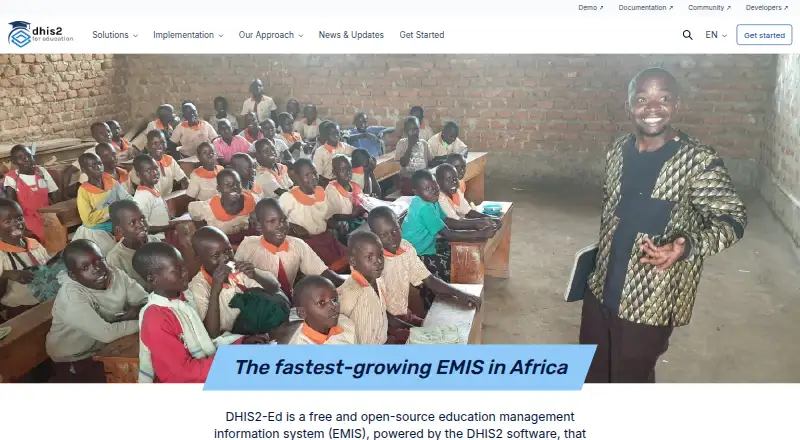
What DHIS2-Ed is
DHIS2-Ed is an education management information system for institutions that need to collect, analyze, visualize, and use education data. Its SEMIS app manages student, staff, and school records, including attendance, student progress, and staff registration. Attendance can be handled on the web and Android in both online and offline modes.
The Education Toolkit provides customizable annual school census forms, standardized data collection metadata, dashboards, and analysis modules. Users can review data through maps, charts, tables, and reports, including pre-configured SDG4 and CESA dashboards. Controlled access supports data and analytics use at different levels of an education system.
DHIS2 for Education can exchange data with public health programs and other sectors using DHIS2, as well as integrate with existing software and data sources. Country-specific forms and tools can be developed as custom applications, and SEMIS can be extended with functions such as payroll management or timetable scheduling. The platform is free and open-source, with custom dashboards and API access. Use requires a secure central server, computers and/or Android devices, and periodic internet connectivity for uploads. HISP groups support implementation and staff capacity building; development is led by the HISP Centre at the University of Oslo.
Good
- Free and open-source, with a free plan.
- SEMIS supports attendance online and offline on web and Android.
- Toolkit includes customizable census forms and analysis modules.
- Pre-configured SDG4 and CESA dashboards are included.
- Can exchange data across DHIS2 sectors and integrate existing sources.
- Offers custom dashboards and API access.
Watch out
- Requires a secure central server and computers or Android devices.
- Periodic internet connectivity is required for data uploads.
Who it suits
DHIS2-Ed suits ministries and educational institutions seeking to make greater use of education data for evidence-based decisions. It is also a fit for organizations that can provide the required server, devices, and periodic internet access.
Verdict
Choose DHIS2-Ed if an education ministry or institution needs an adaptable system for managing records and analyzing education data. Its free, open-source toolkit and offline attendance support are useful, but implementation depends on technical infrastructure and periodic connectivity.
Plans and prices
From DHIS2-Ed's own pricing page, checked 7 Oct 2026.
| Plan | Price | What it gives you |
|---|---|---|
| DHIS2-Ed | Free | Free and open-source; some technical infrastructure is required |
| DHIS2 software | Free | All core modules · no user or facility limits stated · free to install and use · No licensing fee |
| Shared Services Fee – public sector, low-income country | $5,000 a year | Supports core development, security, interoperability, documentation and coordination · not required for access · Voluntary annual contribution per production instance |
| Shared Services Fee – public sector, lower-middle-income country | $10,000 a year | Supports shared DHIS2 services · not a license or paywall · Voluntary annual contribution per production instance |
| Shared Services Fee – public sector, upper-middle-income country | $20,000 a year | Supports shared DHIS2 services · implementation, hosting and training excluded · Voluntary annual contribution per production instance |
| Shared Services Fee – public sector, high-income country | $30,000 a year | Recommended contribution · software remains freely available · Voluntary annual contribution per production instance |
The facts
Each one read from DHIS2-Ed's own pages, with the date it was checked.
What it does
- Access controls
- The education monitoring solution provides controlled access to data and analytics at all levels of the education system.checked 7 Oct 2026
- Compliance limitation
- The security guide states that DHIS2 deployments are generally not automatically HIPAA- or GDPR-compliant and that implementers must follow applicable national law.checked 15 Oct 2026
- Cross-sector surveillance
- The school-health approach supports immunization tracking and responses to Covid-19, Ebola, measles and malaria through school-level surveillance and referral.checked 15 Oct 2026
- Customization and extensions
- SEMIS can be customized for teacher appraisal and extended with payroll, timetable or external-data integrations.checked 15 Oct 2026
- Customizations
- Country-specific tools and forms can be built as custom applications, and SEMIS can be extended with features such as payroll management or timetable scheduling.checked 7 Oct 2026
- Data governance
- Each organization runs its own DHIS2 instance and retains ownership of its application and data.checked 15 Oct 2026
- Development lead
- Development of DHIS2 for Education is led by the HISP Centre at the University of Oslo.checked 7 Oct 2026
- Documentation and support
- Official resources include multilingual documentation, community support, HISP implementation assistance, training and an Academy program.checked 15 Oct 2026
- Documentation depth
- DHIS2 documentation covers user guides, implementation, security, hosting, APIs, Android deployment, app development, maintenance, upgrades and data models.checked 15 Oct 2026
- Education analytics
- Education reporting includes SDG4 and CESA dashboards, legacy-data import, maps, charts, tables and reports.checked 15 Oct 2026
- Education toolkit
- The Education Toolkit includes customizable annual school census forms, standardized data collection metadata, dashboards, and analysis modules.checked 7 Oct 2026
- Education Toolkit
- The Education Toolkit provides configurable annual school-census forms, standardized metadata, dashboards and analysis modules from early-childhood through tertiary education.checked 15 Oct 2026
- Hosting requirements
- Reliable deployments require skilled technical staff, backups, HTTPS, monitoring, stable connectivity and power, secure facilities and scalable hardware.checked 15 Oct 2026
- Implementation support
- HISP groups support implementation from pilot to national scale, including capacity building for national and district staff.checked 7 Oct 2026
- Independent technical assessment
- A UNICEF-hosted assessment found DHIS2 stable and ready to implement, locally or in the cloud, but said interoperability can be expensive.checked 15 Oct 2026
- Infrastructure limit
- Using SEMIS requires technical infrastructure including a secure central server, computers and/or Android devices, and periodic internet connectivity for data uploads.checked 7 Oct 2026
- Integration mechanisms
- DHIS2 supports routes for credentialed service calls, datastores, SQL views and event hooks that can call webhooks, Apache Artemis or Kafka.checked 15 Oct 2026
- Integrations
- DHIS2 for Education can exchange data with public health programs and other sectors using DHIS2, and can integrate with existing software and data sources.checked 7 Oct 2026
Where it runs
- Android extensibility
- Android developers can define custom services through the SDK's Ktor-based HttpServiceClient for Web API endpoints.checked 15 Oct 2026
- Android SDK
- The Android SDK abstracts Web API calls, synchronizes metadata and data, stores an offline Room database and supports Kotlin coroutines, RxJava and blocking calls.checked 15 Oct 2026
- Education platform basis
- DHIS2-Ed extends the DHIS2 data platform from health into education and supports individual and aggregate data from learning institutions.checked 15 Oct 2026
The company
- Company headquarters and age
- LinkedIn lists Oslo, Norway as headquarters and 2006 as the founding year.checked 15 Oct 2026
- Company identity
- LinkedIn lists DHIS2 as a nonprofit IT-services organization developed by the HISP Centre at the University of Oslo.checked 15 Oct 2026
- Company size
- LinkedIn lists DHIS2's organization size as 51–200 employees.checked 15 Oct 2026
The full review of DHIS2-Ed
Overview
DHIS2-Ed is an education management information system for coordinating school records and turning education data into analysis. Its scope suits ministries and institutions working across multiple levels of an education system; it is a poor fit for organizations that cannot provide the infrastructure needed to run it.
The platform is led by the HISP Centre at the University of Oslo. Its central strength is adaptability: records, collection tools, and analytics can be shaped around local education needs, with the trade-off of technical and implementation demands.
Key features
SEMIS brings student, staff, and school data into one system, including attendance, student progress, and staff registration. Attendance can be recorded on web and Android devices while online or offline, which helps schools keep collecting data through connectivity gaps. Uploads still require periodic internet access, so this is not a fully disconnected system.
The Education Toolkit includes customizable annual school census forms, standardized data-collection metadata, dashboards, and analysis modules. Maps, charts, tables, and reports offer several ways to examine results, while the pre-configured SDG4 and CESA dashboards give users a starting point for monitoring. Custom dashboards and API access add room to tailor analysis and connect other systems, but institutions will need the capacity to configure and maintain those workflows.
DHIS2-Ed can exchange data with public health programs and other sectors using DHIS2, and can integrate with existing software and data sources. Country-specific forms and tools can be built as custom applications, and SEMIS can be extended with features such as payroll management or timetable scheduling. Controlled access to data and analytics at every level of the education system is useful for coordinating oversight without making all information universally accessible.
Implementation support from HISP groups covers work from pilot projects to national scale, including capacity building for national and district staff. That support is relevant for institutions planning a substantial rollout, but it does not remove the need to establish and operate the underlying technical environment.
Pricing
DHIS2-Ed is free and open-source: the DHIS2-Ed plan costs nothing. There is no paid tier described, so institutions do not have to choose between feature bundles or pay per seat. The meaningful cost is operational rather than subscription-based: SEMIS requires a secure central server, computers and/or Android devices, and periodic internet connectivity for data uploads.
The free plan is the natural fit for ministries and institutions able to provide that infrastructure and the technical work needed to adapt the system. Organizations without server capacity, devices, or reliable periodic connectivity should weigh those requirements before committing; the zero subscription price does not make deployment infrastructure-free.
Platforms
DHIS2-Ed supports web and Android. Web access suits centralized work and reporting, while Android provides a mobile option for attendance capture, including offline use. The stated platform coverage does not include iOS.
Who it's for
DHIS2-Ed is aimed at ministries and educational institutions seeking stronger education data use and evidence-based decisions. It is especially compelling when an organization needs shared records across schools, locally adaptable collection tools, and coordinated analytics, and can support a secure server and implementation process.
It is less suitable for a school or organization looking for a ready-to-run, low-maintenance app or one that can operate indefinitely without connectivity. Periodic uploads and technical infrastructure are core requirements, not optional extras.
Pros and cons
- Pros: Free and open-source access keeps subscription cost at zero, while allowing institutions to adapt forms, dashboards, and applications to local needs.
- Pros: Offline attendance on web and Android helps staff continue recording data during connectivity interruptions.
- Pros: Student, staff, and school records sit alongside configurable analysis, controlled access, and cross-sector DHIS2 data exchange.
- Cons: A secure central server, devices, and periodic internet access are required, making implementation more demanding than the free price suggests.
- Cons: Custom applications and extensions offer flexibility but require technical capacity to build and sustain.
Alternatives
For a broader starting point, browse Learning Analytics Software.
- Enflux is a paid web platform with a free Chrome extension to try; choose it if you want to explore that alternative rather than adopt DHIS2-Ed's open-source education-management approach.
- EdOptimize is a free, self-hosted web option under GPLv3, whose modifications and copies must use GPLv3 and disclose source code; consider it if those licensing terms and self-hosting suit your needs.
- D2L Brightspace is a paid Android, iOS, API, and web platform with customized pricing based on learner numbers, licenses, features, add-ons, and services; consider it if you want an institution-priced alternative.
- PowerSchool Behavior Support is a paid Android, iOS, and web option; contact PowerSchool for a demo.
- Blackboard Learn is a paid institution-focused LMS with Android, iOS, API, and web access and no free plan; its core license includes AI Design Assistant and AI Conversation.
- LinkIt! is a paid web-based alternative.
- Civitas Learning Student Impact Platform is a paid web platform sold as an annual subscription shaped by institution size, scope, and integrated systems.
- Ellucian Advising is a paid web-based alternative.
Verdict
Choose DHIS2-Ed when a ministry or educational institution needs adaptable, system-wide records and analysis without a subscription fee, and has the technical infrastructure to support deployment. Its offline attendance and flexible toolkit are meaningful advantages, but organizations seeking a turnkey product or freedom from periodic connectivity should look elsewhere.
Getting started
- Visit https://education.dhis2.org/.
- Prepare a secure central server and computers and/or Android devices.
- Arrange periodic internet connectivity for data uploads.
- Contact a HISP group or email [email protected] for implementation support.
Limits worth knowing
The free plan is free and open-source. Using SEMIS requires a secure central server, computers and/or Android devices, and periodic internet connectivity for uploads.
Questions
Is DHIS2-Ed free?
Yes. Its plan is listed as free, and the platform is free and open-source.
Which platforms does it support?
The listed platforms are Android and web. SEMIS supports attendance on web and Android devices, online and offline.
Can it connect with other systems?
It can exchange data with public health programs and other sectors using DHIS2, and integrate with existing software and data sources.
Does it provide dashboards and API access?
Yes. Custom dashboards and API access are listed. The Education Toolkit also includes pre-configured SDG4 and CESA dashboards.
Who leads development?
Development of DHIS2 for Education is led by the HISP Centre at the University of Oslo.
What infrastructure does it require?
SEMIS requires a secure central server, computers and/or Android devices, and periodic internet connectivity for data uploads.
Alternatives to DHIS2-Ed
- 1
EdOptimize
Free planOpen sourceAndroidWebAPISelf-hosted7.5Free plan - 2

Intellischool Analytics
WebAPIExtensionLinux6.9 - 3
Enflux
Free planWebExtension6.8Free plan - 4

LinkIt!
Web5.8 - 55.8
- 65.7