
Delivr
Delivr is an open-source mobile DevOps platform for building, releasing, and updating mobile apps.
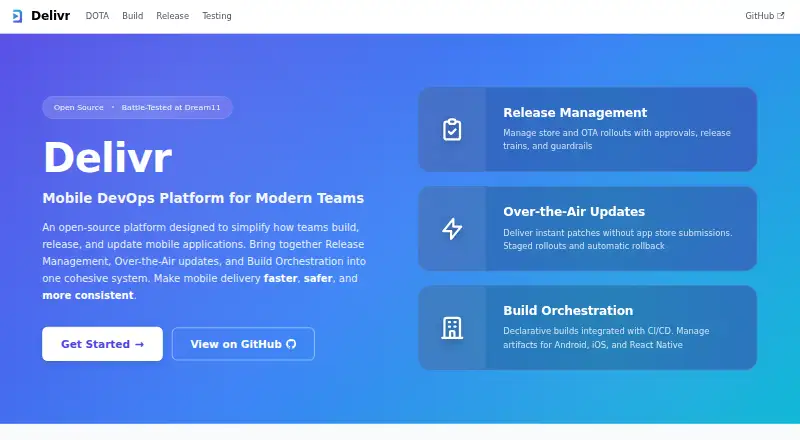
What Delivr is
Delivr is an open-source mobile DevOps platform for building, releasing, and updating mobile apps. Its DOTA service sends JavaScript and asset updates to React Native apps without waiting for app store approval. Teams can target deployments, stage gradual rollouts, run A/B experiments, require updates, and return to an earlier update. The React Native SDK can fetch updates in the background and apply them at the next app launch; it also keeps a previous update for automatic rollback if a new one causes crashes. DOTA can run locally, on-premise, or in a preferred cloud environment. Its developer tools include an SDK, backend API, web dashboard, and command-line interface for terminal or CI/CD deployments. The site also lists declarative CI/CD builds and APK, IPA, AAB, and JavaScript bundle generation, but marks Build, Release, and Testing as “Coming Soon.” Documentation describes role-based access control and Google OAuth, with passwordless authentication available for local or development use. Delivr is free and open source.
Good
- Targets deployments and supports gradual rollouts.
- Offers A/B experiments, mandatory updates, and rollback.
- Can run locally, on-premise, or in a preferred cloud.
- Free and open source.
Watch out
- Build, Release, and Testing are marked “Coming Soon.”
- DOTA’s update delivery is for React Native apps.
Who it suits
Delivr suits mobile developers, QA and product teams, and engineering leaders working with React Native apps. It may also suit teams that want to self-host their update service.
Verdict
Delivr combines React Native over-the-air updates with deployment controls and self-hosting options. Build, Release, and Testing remain marked “Coming Soon,” so those capabilities are not presented as available yet.
The facts
Each one read from Delivr's own pages, with the date it was checked.
What it does
- Audience
- The documentation identifies mobile developers, backend engineers, DevOps teams, and product managers as intended users.checked 7 Oct 2026
- Availability
- Build, Release, and Testing are marked “Coming Soon” on the site.checked 4 Oct 2026
- Build orchestration
- The site lists declarative CI/CD builds and APK, IPA, AAB, and JavaScript bundle generation as build capabilities.checked 4 Oct 2026
- Current product
- DOTA delivers JavaScript and asset updates to React Native apps without waiting for app store approval.checked 7 Oct 2026
- Delivery formats
- The CLI can release full bundles or patch bundles; patch bundles require users to have the referenced base bundle version.checked 7 Oct 2026
- Developer tools
- The DOTA ecosystem includes a React Native SDK, backend API, web dashboard, and command-line interface for deployments from terminals or CI/CD pipelines.checked 4 Oct 2026
- Hosting
- DOTA can run locally, on-premise, or in a preferred cloud using its plugin-based architecture.checked 7 Oct 2026
- Integrations
- The documented provider options include AWS S3, Azure Blob Storage, MySQL, PostgreSQL, Google OAuth, and optional Redis analytics.checked 7 Oct 2026
- Management tools
- DOTA includes a web dashboard, command-line interface, backend API, and React Native SDK.checked 7 Oct 2026
- Notable limitation
- DOTA updates do not apply in React Native Debug mode; the documentation says to test them in Release or another non-Debug mode.checked 7 Oct 2026
- OTA updates
- DOTA delivers JavaScript and asset updates to React Native apps without waiting for app store approval.checked 4 Oct 2026
- Other products
- The maker’s home page marks Build, Release, and Testing as coming soon.checked 7 Oct 2026
- Product
- Delivr describes itself as an open-source mobile DevOps platform combining release management, over-the-air updates, and build orchestration.checked 7 Oct 2026
- Rollouts
- DOTA supports targeted deployments, gradual rollouts, A/B experiments, mandatory updates, and rollback to a previous update.checked 4 Oct 2026
- Rollouts and recovery
- DOTA supports targeted deployments, gradual rollouts, mandatory updates, and rollbacks.checked 7 Oct 2026
- Security
- The documentation describes role-based access control and configurable authentication providers; it does not name a compliance certification on that page.checked 7 Oct 2026
- Self-hosting
- DOTA can run locally, on-premise, or in a preferred cloud environment.checked 4 Oct 2026
- Support
- The documentation directs users to troubleshooting guides and GitHub Issues for help.checked 4 Oct 2026
- Supported audience
- The site presents Delivr for mobile developers, QA and product teams, and engineering leaders.checked 4 Oct 2026
- Update behavior
- The React Native SDK supports silent background downloads, configurable install policies, and updates for both old and new React Native architectures.checked 7 Oct 2026
The company
- Maker
- The site footer credits Dream Horizon.checked 4 Oct 2026
The full review of Delivr
Delivr is an open-source mobile DevOps platform centered on DOTA, its over-the-air update service for React Native applications. It is best suited to development, DevOps, QA and product teams that need controlled JavaScript and asset delivery and want to run the service in their own environment. The strongest case for Delivr is release control without app-store approval; the main reservation is that its broader build, release and testing ambitions are not yet part of the current product.
Overview
DOTA updates JavaScript and assets in React Native apps after deployment, avoiding an app-store review for those changes. That makes it useful for bug fixes, content changes and other in-scope updates that need to reach users quickly. It is not a substitute for a store submission when a change falls outside those update types, nor does it currently amount to a complete mobile delivery suite.
Teams can run DOTA locally, on premises or in a preferred cloud. Its plugin-based architecture supports providers including AWS S3, Azure Blob Storage, LocalStack, MySQL, PostgreSQL, Google OAuth, Redis and Azure Cache, giving organizations with existing infrastructure a practical path to fit the service into their stack.
Key features
Targeted deployments, gradual rollouts and A/B experiments let teams limit exposure or compare variants before a broad release. Mandatory updates cover changes that users must receive, while manual rollback to a previous update and automatic recovery provide safeguards when a deployment misbehaves. The SDK downloads updates in the background and applies them at the next app launch, avoiding disruption to the active session. It also keeps a prior update and can roll back automatically if a new one causes crashes.
The React Native SDK, web dashboard, backend API and command-line interface support both interactive administration and terminal or CI/CD workflows. The CLI can publish full bundles or patch bundles. Patches are efficient only when a user already has the referenced base bundle; where that prerequisite cannot be guaranteed, a full bundle is the less fragile release choice.
Environment promotion and approval gates add useful governance for teams separating development, staging and production. DOTA updates do not apply in React Native Debug mode, so validation must use Release or another non-Debug mode. Build orchestration, release management and testing are presented as future capabilities rather than current reasons to choose the product.
Pricing
Delivr is free and open source, with a free plan and no paid tiers described. That removes license cost and makes it attractive to teams able to operate their own infrastructure. The trade-off is operational responsibility: hosting, storage, authentication and support remain part of the team's workload. Documentation points users to troubleshooting guides and GitHub Issues rather than a commercial support package.
Platforms
Delivr is offered across Android, iOS, Linux, macOS, Windows and the web, with API and self-hosted deployment options. The client focus is React Native, while the server can be placed locally, on premises or in a chosen cloud.
Who it's for
Mobile developers gain an SDK and CLI for shipping React Native updates; backend engineers and DevOps teams can integrate the API, storage and authentication components; QA and product teams benefit from staged, targeted and approval-controlled releases. Engineering leaders should consider it when ownership of deployment infrastructure and update policy matters more than a managed service. Teams seeking an immediately complete build-to-test platform should wait for the planned capabilities or choose a broader product.
Pros and cons
Pros
- App-store-independent updates: JavaScript and asset changes can reach React Native users without waiting for store approval.
- Controlled exposure: Targeting, gradual rollout, A/B testing, mandatory updates and approval gates support disciplined releases.
- Recovery built in: Previous-update retention and rollback options reduce the impact of crash-inducing deployments.
- Hosting control: Local, on-premise and preferred-cloud operation suits organizations with infrastructure or data-residency requirements.
- No license charge: The open-source, free model lowers the barrier for teams prepared to run it.
Cons
- React Native scope: DOTA's current update mechanism is designed for React Native JavaScript and assets, not every kind of mobile change.
- Debug-mode restriction: Updates cannot be applied in React Native Debug mode, complicating development validation.
- Patch dependency: Patch bundles require the referenced base bundle on the device.
- Self-operation required: Running storage, databases, authentication and support is the user's responsibility.
- Incomplete platform ambition: Build, Release and Testing remain future capabilities.
Alternatives
For general release orchestration across broader deployment environments, compare Release Orchestration Software. MidVision RapidDeploy suits teams wanting a freemium orchestrator with a free community tier for up to 10 endpoints. Choose Octopus Deploy when a freemium, self-hosted-capable deployment tool and machine or tenant add-ons fit your operations. HCL Launch is the paid option for teams wanting a 60-day license-free evaluation with full product features during that period. Copado fits users seeking a web/API freemium service, though its free Essentials tier is limited to 15 deployments per month and one user. Devtron Release Orchestration offers a freemium self-hosted/web option with a 50-vCPU, 10-user and one-cluster allowance. Ozone is a self-hosted/web alternative with a free tier for up to five users. ReleaseOwl is a web-based paid product with a free tier for eligible SAP Cloud ALM customers. Relicta is another free, self-hosted-capable release option.
Verdict
Choose Delivr if you run React Native apps and want open-source, self-hosted control over targeted OTA releases, staged exposure and rollback without a license bill. Look elsewhere if you need a managed service, broad non-React-Native coverage or build, release and testing functions today. DOTA is a focused and capable update layer, not yet the finished all-in-one mobile DevOps platform its roadmap suggests.
Alternatives to Delivr
- 1

Octopus Deploy
Free planWebAPILinuxSelf-hosted7.3From $4,330 a year - 2

MidVision RapidDeploy
Free planWebAPILinuxmacOS7.1From $50 a year - 3

Devtron Release Orchestration
Free planWebAPISelf-hosted6.9From $499 a month - 4
Planview AdaptiveWork
AndroidiOSWebAPI6.9 - 5

Copado
Free planWebAPI6.7From $99 a year - 6
Ozone
Free planWebSelf-hosted6.6From $1,000 a month