
DeepFake-O-Meter
DeepFake-O-Meter is a free web platform from the University at Buffalo’s UB Media Forensics Lab that aggregates research AI media-detection results.
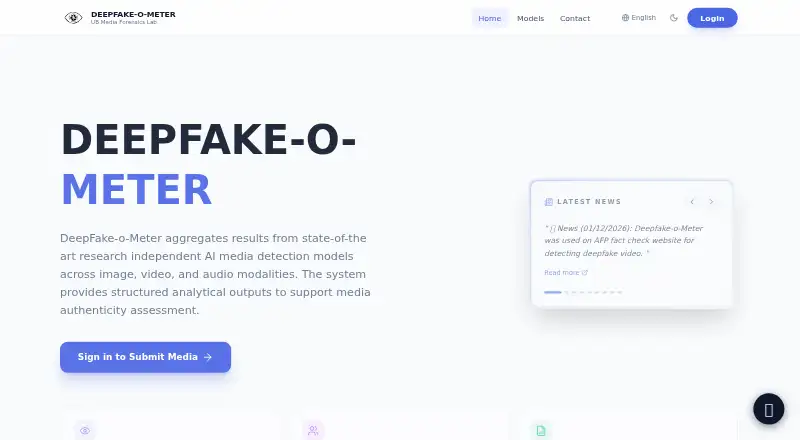
What DeepFake-O-Meter is
DeepFake-O-Meter is a free web platform from the University at Buffalo’s UB Media Forensics Lab that aggregates research AI media-detection results. It analyzes images, videos, and audio through a catalog listing 37 integrated forensic research models. Users can choose algorithms using listed measures such as accuracy, running time, and development year. Each selected method returns a percentage indicating the likelihood that submitted content was AI-generated. The platform is described as open source, with algorithm source code publicly accessible. Before uploading media, users are asked whether they want to share it with researchers; the team says shared submissions can help train detection algorithms. Results combine multiple methods, but the platform does not make strong claims about authenticity and leaves interpretation to users. The model catalog includes image, video, and audio methods, and notes that WAV2LIP-STA performance may suffer under heavy compression. Registration is available with an email, username, and password.
Good
- Analyzes images, video, and audio
- Lists 37 forensic research models
- Model selection includes accuracy and runtime
- Open-source algorithm code is public
- Free web access
Watch out
- Results are not definitive authenticity judgments
- WAV2LIP-STA may suffer under heavy compression
- Media sharing with researchers is optional but requested
Who it suits
It suits social media users, journalists, and law enforcement seeking public access to deepfake analysis. Users who can interpret multiple model outputs may find the catalog useful.
Verdict
DeepFake-O-Meter provides several research-model perspectives on potentially AI-generated media at no cost. Treat its percentages as analysis to consider rather than a final authenticity decision.
The facts
Each one read from DeepFake-O-Meter's own pages, with the date it was checked.
What it does
- Account access
- The site provides account sign-up and login pages, and its login page offers a guest option to return to the home page.checked 7 Oct 2026
- Current use
- The home page reports that Deepfake-o-Meter was used on the AFP fact check website to detect a deepfake video.checked 7 Oct 2026
- Detection models
- The models page lists 37 integrated forensic research models.checked 7 Oct 2026
- Intended users
- The University at Buffalo describes the platform as serving users including social media users, journalists, and law enforcement.checked 7 Oct 2026
- Interpretation caveat
- The platform provides analysis from multiple methods and does not make strong claims about whether uploaded content is authentic.checked 7 Oct 2026
- Media types
- The platform analyzes images, videos, and audio.checked 7 Oct 2026
- Model categories
- The model catalog includes methods labeled for image, video, and audio detection.checked 7 Oct 2026
- Model limitations
- The model catalog notes that WAV2LIP-STA performance may suffer under heavy compression.checked 7 Oct 2026
- Model selection
- Users can select detection algorithms using listed metrics that include accuracy, running time, and year developed.checked 7 Oct 2026
- Multiple analyses
- The University at Buffalo says users can run multiple detection algorithms, each returning a percentage likelihood that content was AI generated.checked 7 Oct 2026
- Open source
- The platform is described as open source, with algorithm source code publicly accessible.checked 7 Oct 2026
- Purpose
- DeepFake-o-Meter aggregates results from research AI media detection models to support media authenticity assessment.checked 7 Oct 2026
- Research models
- The detection models page lists 37 integrated forensic research models.checked 7 Oct 2026
- Result interpretation
- The University at Buffalo says the platform provides analysis from a broad range of methods and leaves users to decide whether content is real.checked 7 Oct 2026
- Results
- Each selected algorithm returns a percentage representing the likelihood that content was AI-generated.checked 7 Oct 2026
- Submission sharing
- Before upload, users are asked whether they want to share the media with researchers; the team says shared submissions can help train detection algorithms.checked 7 Oct 2026
- Support contact
- The contact page lists [email protected] for contacting the lab.checked 7 Oct 2026
- User audience
- The maker describes the platform as intended to make deepfake analysis available to the public, including social media users, journalists, and law enforcement.checked 7 Oct 2026
The company
- Headquarters
- Buffalo, New York, United Stateschecked 28 Sep 2026
- Maker
- The site attributes DeepFake-O-Meter to the University at Buffalo and the UB Media Forensics Lab.checked 7 Oct 2026
- Project team
- The site identifies the UB Media Forensics Lab as the developer and lists Siwei Lyu as project director.checked 7 Oct 2026
Alternatives to DeepFake-O-Meter
- 1

FauxLens
Free planAndroidWebAPIExtension7.6$2.99 one-time - 2

Hive AI-Generated Content Detection
Free planWebAPIExtensionSelf-hosted7.4$6 one-time - 3

Resemble Detect
Free planWebAPIExtensionSelf-hosted7.4From $350 a month - 4
Netarx
Free planAndroidiOSWebExtension6.8Free plan - 5

Reality Defender
Free planWebAPISelf-hosted6.8From $399 a year - 6

Deepfake Detector
Free planWebAPIExtension6.7From $4,939 a month