DataDocks
DataDocks is dock scheduling and yard management software for warehouses and distribution centers.
What DataDocks is
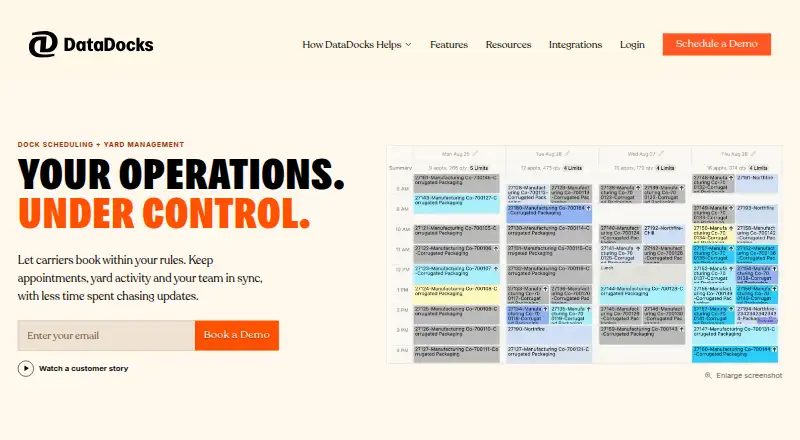
DataDocks is dock scheduling and yard management software for warehouses and distribution centers. Carriers can book appointments themselves within facility capacity and booking rules, while scheduling rules, appointment validation, and capacity controls help manage dock use. A live dashboard tracks arrivals, loading progress, waiting trailers, and yard moves. Its iOS and Android app supports schedule management, yard visibility, photo capture, and quality-control checks; the system also works in mobile browsers. Teams can attach load documents and inspection records to appointments and synchronize them with the web platform. Reporting covers detention and carrier performance. DataDocks connects to warehouse, transportation, and ERP systems through APIs, and lists integrations including Power BI, Microsoft Entra SSO, NetSuite, Oracle Fusion Cloud, and SAP products. The company describes the software as SOC 2 compliant and offers help configuring facilities and onboarding staff and carriers. Pricing is available by quote based on facility and requirements; no fixed plan price is listed.
Good
- Carriers can self-schedule within facility rules
- Live dashboard tracks arrivals and yard moves
- Mobile app supports photos and QC checks
- Detention and carrier performance reports
Watch out
- Pricing requires a quote
- No fixed plan price is listed
Who it suits
DataDocks is aimed at warehouses and distribution centers managing dock appointments and yard activity. Its mobile app is described for warehouse managers and coordinators.
Verdict
DataDocks brings appointment scheduling, yard visibility, and operational records into one system for warehouse and distribution operations. Facilities should request a quote based on their requirements.
Plans and prices
From DataDocks's own pricing page, checked 30 Sep 2026.
| Plan | Price | What it gives you |
|---|---|---|
| Custom quote | Priced on request | Quote based on facility and requirements |
The facts
Each one read from DataDocks's own pages, with the date it was checked.
What it does
- Carrier booking
- Carriers can self-schedule appointments within the facility’s capacity limits and booking rules.checked 30 Sep 2026
- Integrations
- The integrations page lists Microsoft Power BI, Microsoft Entra SSO, NetSuite ERP, Oracle Fusion Cloud, SAP Business ByDesign, and SAP S/4HANA.checked 30 Sep 2026
- Pricing
- The company says to request a quote based on facility and requirements; no fixed plan price is stated on the page opened.checked 30 Sep 2026
- Product
- DataDocks provides dock scheduling and yard management software for warehouses and distribution centers.checked 30 Sep 2026
- Records
- Load documents and inspection records can be kept with appointments and synchronized to the web platform.checked 30 Sep 2026
- Reporting
- DataDocks offers detention and carrier performance reports.checked 30 Sep 2026
- Scheduling controls
- The platform supports automated scheduling rules, appointment validation, and dock capacity management.checked 30 Sep 2026
- Security
- The company describes DataDocks as SOC 2 compliant and displays an AICPA SOC 2 certification badge.checked 30 Sep 2026
- Support and onboarding
- The company says its team helps configure facilities and onboard staff and carriers.checked 30 Sep 2026
- System connections
- DataDocks says it connects with WMS, TMS, and ERP systems through APIs.checked 30 Sep 2026
- Target users
- The mobile app is described for warehouse managers and coordinators, and the company describes its software as serving warehouses and distribution centers.checked 30 Sep 2026
- Yard visibility
- Teams can track arrivals, loading progress, waiting trailers, and yard moves through a live dock dashboard.checked 30 Sep 2026
The company
- Founded
- 2013checked 23 Sep 2026
- Headquarters
- Bolton, Ontario, Canadachecked 23 Sep 2026
Where it runs
- Mobile app
- The iOS and Android app supports schedule management, yard visibility, photo capture, and QC checks; the platform also works in mobile browsers.checked 30 Sep 2026
The full review of DataDocks
DataDocks is a dock scheduling and yard management platform for warehouses and distribution centers. It suits operations that need carriers to book within controlled rules while staff coordinate dock and yard activity in the same workflow. Its main advantage is operational breadth; its main drawback is quote-based pricing rather than a published entry plan.
Overview
DataDocks brings carrier appointment booking, dock capacity control, yard monitoring, records, and reporting into one system. Carriers can request and self-schedule slots, while facilities retain control through capacity limits, booking rules, automated scheduling, and appointment validation. That is a strong fit for sites where unstructured booking creates congestion or excessive coordinator work.
The product is focused on warehouse and distribution-center operations rather than positioned as a general logistics suite. It covers dock door scheduling, recurring appointments, driver check-in, and both supported load types. Facilities should expect a system designed around repeatable inbound and outbound procedures, not a lightweight booking page aimed at occasional use.
Key features
Controlled appointment scheduling
Carrier self-service can move routine booking away from warehouse staff, but it does not surrender operational control. Capacity limits and facility rules constrain what carriers can select, and automated rules plus validation help prevent appointments that do not fit available dock resources. Appointment requests and recurring appointments support regular carrier relationships, while driver check-in extends the workflow to arrival.
Live yard visibility
A live dock dashboard follows arrivals, loading progress, waiting trailers, and yard moves. For warehouse managers and coordinators, that shared view can make bottlenecks visible before they become missed slots or idle equipment. It is most useful when teams actively manage several stages of dock activity; a small site with little yard movement may not need this level of operational visibility.
Mobile records and reporting
The iOS and Android app supports schedule management, yard visibility, photo capture, and quality-control checks, and the platform also works in mobile browsers. Load documents and inspection records stay with their appointments and synchronize with the web platform, keeping evidence alongside the transaction it describes. Detention and carrier-performance reports add a way to review delays and carrier execution rather than relying only on live status.
Connections and security
DataDocks says it connects to WMS, TMS, and ERP systems through APIs. Its integrations page names Microsoft Power BI, Microsoft Entra SSO, NetSuite ERP, Oracle Fusion Cloud, SAP Business ByDesign, and SAP S/4HANA. Those connections make the platform more suitable for facilities that need dock activity to fit an existing enterprise stack. The company describes the service as SOC 2 compliant and displays an AICPA SOC 2 certification badge. Its team also says it helps configure facilities and onboard staff and carriers, which matters when rules and participants vary by site.
Pricing
DataDocks uses a custom quote model. The Custom quote plan has no published price; the company asks facilities to request a quote based on their requirements. That approach can accommodate different facility sizes and workflows, but it prevents a buyer from comparing a known monthly cost or starting without a sales conversation. There is no stated free plan, fixed-price tier, or trial term to evaluate before requesting a quote.
Custom pricing is therefore aimed at warehouses and distribution operations with enough scheduling, yard, integration, or onboarding needs to justify tailored commercial terms. Smaller facilities seeking a transparent, self-serve price should look at a freemium alternative first.
Platforms
DataDocks supports Android, iOS, web, and API access. Native mobile apps cover field activity such as check-in, photos, and quality-control work, while mobile-browser support gives teams another way to reach schedules and yard information. API access supports connections with operational systems and the named ERP, WMS, TMS, identity, and reporting tools.
Who it's for
DataDocks is built for warehouses and distribution centers, especially those coordinating multiple carriers, constrained dock capacity, and active yards. Warehouse managers and coordinators are the clearest mobile users, while carriers benefit from self-service booking within facility rules. It is a less natural fit for a single low-volume location that only needs a basic booking link and has no need for yard records, inspection documentation, or performance reporting.
Pros and cons
- Pro: Carrier self-scheduling operates within capacity and booking rules, reducing manual appointment handling without removing facility control.
- Pro: The live dashboard covers arrivals, loading, waiting trailers, and yard moves, giving coordinators one operational view.
- Pro: Mobile photo capture, quality checks, documents, and inspection records keep evidence connected to appointments.
- Pro: API connectivity and named enterprise integrations support organizations with established WMS, TMS, ERP, identity, and reporting systems.
- Con: Quote-based pricing offers no public cost benchmark or low-risk free starting tier.
- Con: Its broader controls and onboarding process may be unnecessary for facilities that only want simple appointment intake.
Alternatives
Choose ProDocks when a permanent free plan is more important than custom commercial terms: its free tier covers one warehouse, unlimited doors and appointments, carrier booking, and QR check-in. Pick LoadMetrics Dock Scheduling for a free plan with one facility and 25 dock appointments per month, plus a free trial.
SimpleDock is the clearer choice for a small operation wanting published pricing: its free plan allows one location and three team members, while Pro costs $49 per location per month. Consider Inbound Connect, Mobiledock, DockFlow, DockSlot, or DockSync when their respective paid approaches and platform coverage better match your procurement needs. DockSync is the one with a published Starter price of £79 a month for up to eight bays and one warehouse, with no per-user fees; its Growth plan is £179 a month.
For a wider category comparison, see Dock Scheduling Software.
Verdict
DataDocks is a strong choice for warehouses and distribution centers that need governed carrier booking, live yard coordination, mobile records, and connections to existing operational systems. Choose it when those combined controls matter more than a public price. Look elsewhere if you need a free or fixed-cost plan, a very small deployment, or a simple booking link without the overhead of a broader yard-management workflow.
Alternatives to DataDocks
- 1

ProDocks
Free planAndroidiOSWebAPI7.2From $25 a month - 2

DockSync
AndroidiOSWeb6.8From £756 a year - 3

Goramp Dock Scheduling
WebAPI6.8From $249 a month - 4
LoadMetrics Dock Scheduling
Free planWebAPI6.5From $500 a year - 5

SimpleDock
Free planWebAPI6.5From $49 a month - 6

Mobiledock
AndroidiOSWebAPI6.4