
d.AP
d.AP is an AI context platform for enterprises connecting business knowledge across systems for agents, applications, and BI tools.
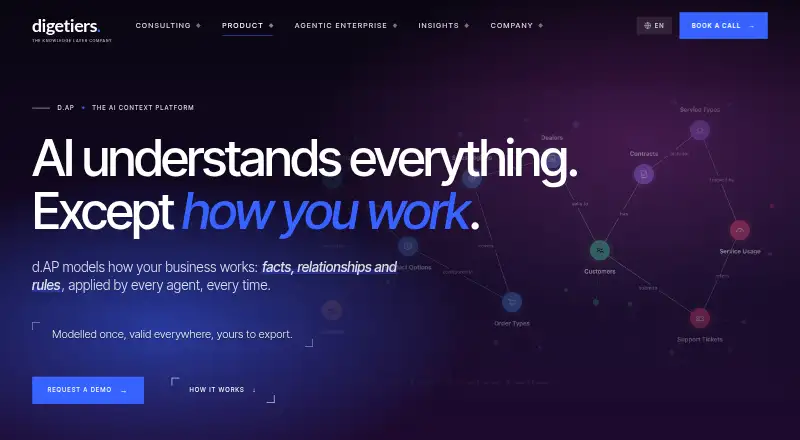
What d.AP is
d.AP is an AI context platform for enterprises connecting business knowledge across systems for agents, applications, and BI tools. Its ontology-based knowledge graph links CRM, ERP, and analytics through shared semantics without copying source data. A visual Workbench supports ontology modeling, isolated change testing, and Git-based version control. Aluna turns natural-language requests into graph queries and returns answers with sources, logic, and filters. Knowledge is exposed through MCP, A2A, and REST/JSON, while federators connect through REST, JDBC, and SOAP to ERP, CRM, MES, IoT, and document systems. Dashboards provide live graph views with inspectable SPARQL definitions. The platform describes SSO, SAML, role-based access, granular permissions, and traceable lineage. Ontologies use OWL and can be exported. d.AP runs only in cloud environments, with European hosting options. Licensing depends on sources and use cases, not token consumption; pricing is on request.
Good
- Connects systems without copying data
- Visual ontology Workbench
- Natural-language graph queries
- MCP, A2A, and REST/JSON interfaces
- OWL export for portability
Watch out
- Cloud deployment only
- Pricing is on request
- Go-live typically takes three months
Who it suits
It suits enterprises seeking a shared semantic layer for AI agents, applications, and BI across business systems. Teams needing ontology modeling, federated access, SPARQL, and audit traces are the intended audience.
Verdict
d.AP provides a federated knowledge graph with ontology tools, agent interfaces, and traceable answers. Its cloud-only deployment and implementation timeline should be considered by enterprise buyers.
Plans and prices
From d.AP's own pricing page, checked 8 Oct 2026.
| Plan | Price | What it gives you |
|---|---|---|
| Custom enterprise licensing | Priced on request | Based on sources and use cases; not token consumption |
The facts
Each one read from d.AP's own pages, with the date it was checked.
What it does
- Access controls
- The product describes support for SSO, SAML, role-based access, and granular permissions.checked 8 Oct 2026
- AI agent
- Aluna translates natural language into graph queries and returns answers with their sources, logic and filters.checked 8 Oct 2026
- Audience
- The product is aimed at enterprises seeking a shared knowledge layer for agents, applications, and BI across business systems.checked 8 Oct 2026
- Auditability
- Answers can be traced to their source, joins, filters, and aggregation, and the product describes exporting lineage and reasoning traces for audits.checked 8 Oct 2026
- Commercial model
- Licensing is based on the sources and use cases used, rather than token consumption; the page does not state a price.checked 8 Oct 2026
- Dashboards
- Dashboards are live graph views whose metrics retain inspectable SPARQL definitions and can be embedded in other dashboards and apps.checked 8 Oct 2026
- Data portability
- The ontology is modeled in OWL and can be exported in that open format for reuse on other platforms.checked 8 Oct 2026
- Deployment scope
- The company says d.AP currently runs in cloud environments only.checked 8 Oct 2026
- Deployment timing
- The maker says go-live with five to six sources typically takes three months and each additional source takes one to two weeks.checked 8 Oct 2026
- Federation
- It connects to data in source systems through adapters without copying the data or requiring ETL.checked 8 Oct 2026
- Hosting
- d.AP runs in a European cloud environment, either in the customer's account as a managed service or as SaaS operated by digetiers.checked 8 Oct 2026
- Integrations
- Federators connect to interface technologies including REST, JDBC and SOAP, and to systems such as ERP, CRM, MES, IoT platforms and document stores.checked 8 Oct 2026
- Intended users
- The product is presented for enterprises connecting business knowledge across systems so AI agents, applications and BI tools can use it.checked 8 Oct 2026
- Interfaces
- d.AP exposes knowledge through MCP, A2A and REST/JSON for agents, applications and BI tools.checked 8 Oct 2026
- Knowledge graph
- Its ontology based knowledge graph connects CRM, ERP and analytics through shared semantics without copying data.checked 8 Oct 2026
- Ontology workbench
- The Workbench provides visual ontology modeling, isolated testing of changes and Git based version control.checked 8 Oct 2026
- Portability
- The ontology is stored in OWL and can be exported for reuse on another platform.checked 8 Oct 2026
- Purpose
- d.AP is an AI context platform that models enterprise facts, relationships and rules for use by AI agents.checked 8 Oct 2026
- Security and auditability
- The product describes granular role based access and traceability from answers to their sources, logic and filters.checked 8 Oct 2026
- Source connectivity
- Federators connect through interface technologies including REST, JDBC, and SOAP to systems such as ERP, CRM, MES, IoT platforms, and document stores.checked 8 Oct 2026
- Support and sales
- The maker offers a live demonstration by appointment and says it replies personally to questions.checked 8 Oct 2026
- Time to go live
- A go live with five to six data sources typically takes three months, and each additional source takes one to two weeks.checked 8 Oct 2026
The company
- Founded
- 2020checked 28 Sep 2026
- Headquarters
- Stuttgart, Germanychecked 28 Sep 2026
Alternatives to d.AP
- 1
Virtuoso Universal Server
Open sourceWebAPILinuxmacOS7.9From $99.99 a year - 2

Mendix
Free planAndroidiOSWebLinux7.8From $1,090 a month - 3

RDFox
Free planWebAPILinuxmacOS7.8Free plan - 4

Stardog
Free planAndroidiOSWebAPI7.7Free plan - 5
Eclipse RDF4J
Free planOpen sourceWebAPILinuxmacOS7.6Free plan - 6
Apache Jena Fuseki
Free planOpen sourceWebAPILinuxSelf-hosted7.5Free plan