Cygwin
Cygwin brings GNU and other open-source tools to Windows through a library that supplies POSIX system calls and an environment.
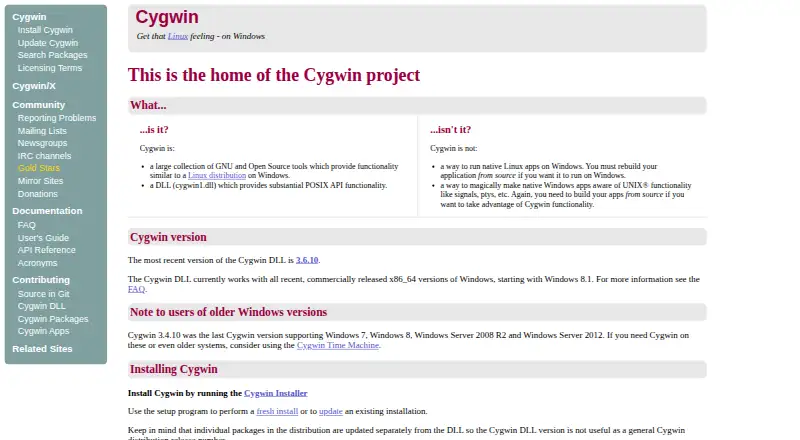
What Cygwin is
Cygwin brings GNU and other open-source tools to Windows through a library that supplies POSIX system calls and an environment. Its distribution has thousands of packages, including GNU and BSD tools, an X server, and X applications. Developers can use its tools, headers, and libraries to write Windows console or GUI applications using parts of the POSIX API, or to port Unix programs. Cygwin programs work from shells such as bash, tcsh, and zsh. The recommended Cygwin Setup GUI lets users select packages and update them individually; only a minimal base set, about 100 MB, is installed by default. Setup also supports automated command-line installs and installation from a local package repository without internet access. The current Cygwin DLL supports recent 64-bit Windows versions starting with Windows 8.1. Cygwin does not run native Linux applications as-is: those applications must be rebuilt from source to work with it. Cygwin is free to download and use.
Good
- Thousands of packages are available
- Choose and update packages individually
- Supports automated command-line installation
- Local repositories enable offline installation
Watch out
- Windows only
- Native Linux apps require rebuilding from source
- Minimal base packages only install by default
Who it suits
Cygwin suits Windows users who want GNU and other open-source tools, or developers porting Unix programs and building with parts of the POSIX API. It is not a way to run native Linux applications without rebuilding them.
Verdict
Cygwin provides a broad set of Unix-style tools and development components for Windows. Its package selection model suits users who want to add only the tools they need.
Plans and prices
From Cygwin's own pricing page, checked 9 Oct 2026.
| Plan | Price | What it gives you |
|---|---|---|
| Cygwin | Free | Windows only · installable packages selected individually · does not run native Linux apps without rebuilding from source · Free to use; source and binaries are free to download. |
The facts
Each one read from Cygwin's own pages, with the date it was checked.
What it does
- Automation and offline use
- Setup accepts command-line arguments for automated installs, and the site documents installing from a local package repository without internet access.checked 9 Oct 2026
- For developers
- Cygwin includes tools, headers, and libraries for writing Windows console or GUI applications using parts of the POSIX API and for porting Unix programs.checked 9 Oct 2026
- Included software
- The distribution includes thousands of packages, including GNU and BSD tools, an X server, and X applications.checked 9 Oct 2026
- Installation
- The recommended installation method is the Cygwin Setup GUI, which lets users choose packages and update them individually.checked 9 Oct 2026
- Licensing
- Cygwin tools use various licenses, including GPL, public domain, and X11-style licenses; the Cygwin API library is under LGPL version 3 or later.checked 9 Oct 2026
- Not supported
- Cygwin does not run native Linux applications on Windows; applications must be rebuilt from source to run with Cygwin.checked 9 Oct 2026
- Package selection
- Only minimal base packages are installed by default, taking about 100 MB, and users can select additional packages in Setup.checked 9 Oct 2026
- Package updates
- Individual packages are released separately from the Cygwin DLL, so the DLL version is not a general distribution release number.checked 9 Oct 2026
- Security
- Setup verifies signed package metadata and checks downloaded packages against their listed cryptographic hashes; the FAQ says Cygwin uses SHA-512 for setup metadata.checked 9 Oct 2026
- Shells
- Cygwin programs can be used from shells including bash, tcsh, and zsh.checked 9 Oct 2026
- Support
- The project directs users to its FAQ, User's Guide, mailing list archives, and mailing lists for questions and bug reports.checked 9 Oct 2026
- What it does
- Cygwin provides GNU and other open source tools on Windows, with a library that supplies POSIX system calls and environment.checked 9 Oct 2026
Where it runs
- Supported platform
- The current Cygwin DLL supports recent 64-bit Windows versions starting with Windows 8.1; the FAQ also describes x64 emulation on ARM PCs running Windows 11.checked 9 Oct 2026