CPAN
CPAN is a free archive of Perl software and documentation, with ways to discover, download, and install modules.
What CPAN is
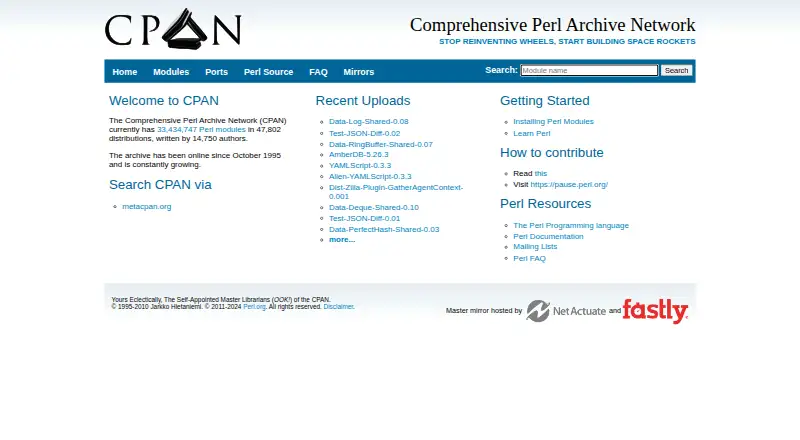
CPAN is a free archive of Perl software and documentation, with ways to discover, download, and install modules. Its homepage lists 33,464,960 modules in 47,830 distributions from 14,750 authors. The archive has been online since October 1995. Users can search through MetaCPAN or browse modules, authors, and recent uploads. Modules can be installed with CPAN.pm, and the site also provides instructions for manual installation. Dependencies may involve other modules, a specific version, or a C compiler. Perl source archives and instructions for compiling and installing Perl are available as well. Authors submit uploads through PAUSE, which checks and indexes them before propagation to CPAN and its mirrors. For existing package namespaces, only the owner or an authorized maintainer can have uploads indexed. PAUSE documentation says submissions are tested across dozens of architectures by CPAN Testers. The Ports page lists support for more than 100 platforms, including Windows, macOS, and Linux. CPAN is backed by a CDN. Its FAQ addresses CPAN-related operation questions, not debugging users' code.
Good
- Free archive of Perl software and documentation
- Offers search and browsing through modules and authors
- Modules can be installed with CPAN.pm
- Lists Perl support for more than 100 platforms
- Uploads are tested across dozens of architectures
Watch out
- Some modules need dependencies or specific versions
- Some modules require a C compiler
- FAQ does not provide users' code debugging help
Who it suits
CPAN suits Perl users looking for modules, documentation, or Perl source archives, as well as authors distributing Perl software. Users seeking help debugging their own code should note the FAQ's stated support boundary.
Verdict
CPAN provides discovery, installation, and distribution resources for Perl modules, alongside source archives and platform information. Dependencies and occasional compiler requirements can affect installation, and the FAQ is not a code-debugging helpdesk.
Plans and prices
From CPAN's own pricing page, checked 4 Oct 2026.
| Plan | Price | What it gives you |
|---|---|---|
| CPAN | Free | Free Perl software and documentation archive |
The facts
Each one read from CPAN's own pages, with the date it was checked.
What it does
- Archive size
- The homepage states that CPAN contains 33,464,960 Perl modules in 47,830 distributions by 14,750 authors.checked 4 Oct 2026
- Contributor access
- Registered PAUSE developers receive password-protected write access to their CPAN author directory.checked 4 Oct 2026
- Dependencies
- Modules can depend on other modules, and some require a specific version or a C compiler.checked 4 Oct 2026
- Distribution workflow
- Authors upload modules to PAUSE, which inspects, validates, and indexes uploads before they propagate to CPAN and mirrors.checked 4 Oct 2026
- Find modules
- The site links to MetaCPAN for searching and lists ways to browse modules, authors, and recent uploads.checked 4 Oct 2026
- History
- The archive has been online since October 1995.checked 4 Oct 2026
- Install modules
- Perl modules can be downloaded and installed using the CPAN.pm tool, with instructions also available for manual installation.checked 4 Oct 2026
- Mirrors and CDN
- The mirror page says CPAN is backed by a CDN and users can point at www.cpan.org for access.checked 4 Oct 2026
- Namespace controls
- PAUSE checks package namespaces and only indexes uploads from the owner or an authorized maintainer for existing namespaces.checked 4 Oct 2026
- Source downloads
- The source page provides Perl source archives and instructions for compiling and installing Perl.checked 4 Oct 2026
- Support
- The FAQ says CPAN is not a helpdesk for debugging users’ code, but handles questions and problems related directly to CPAN’s operation.checked 4 Oct 2026
- Testing
- The PAUSE documentation says uploaded modules are tested across dozens of architectures by CPAN Testers.checked 4 Oct 2026
- What it is
- CPAN is a large collection of Perl software and documentation.checked 4 Oct 2026
Where it runs
- Platform support
- The Ports page says Perl supports over 100 platforms and lists Windows, macOS, Linux, and other operating systems.checked 4 Oct 2026
The full review of CPAN
CPAN is a public archive and distribution system for Perl software and documentation. It suits Perl developers who need modules or want to publish them; its reach is substantial, but installation can involve dependencies, version constraints, or a compiler.
Overview
Online since October 1995, CPAN is a long-established home for Perl modules and their documentation. Its homepage reports 33,464,960 modules in 47,830 distributions from 14,750 authors. That breadth gives Perl users a central place to look for software, though the size of the collection does not remove the need to check whether a particular module fits a project.
Search is routed through MetaCPAN, while CPAN itself offers browsing by module, author, and recent upload. Modules can be installed with CPAN.pm or downloaded for manual installation. A CDN backs the archive, and users can point at www.cpan.org for access. The site also provides Perl source archives and instructions for building and installing Perl, useful when a machine needs the language itself as well as additional modules.
Key features
CPAN supports a publication workflow as well as downloads. Authors upload through PAUSE, which inspects, validates, and indexes submissions before they propagate to CPAN and its mirrors. PAUSE also checks package namespaces: for an existing namespace, only its owner or an authorized maintainer can have uploads indexed. This gives maintainers a defined route to publish without treating every upload as an unrestricted claim on an established package name.
Uploaded modules are tested by CPAN Testers across dozens of architectures. That breadth is valuable in an ecosystem used across varied systems, but it is not a promise that every module will work in every environment. Modules may depend on other modules, require a particular version, or need a C compiler, so installation can take more work than fetching an archive.
Registered PAUSE developers receive password-protected write access to their CPAN author directory. The FAQ is aimed at questions and problems directly related to CPAN’s operation, not debugging users’ code, so developers should not treat it as a general programming support desk.
Pricing
CPAN is free. Its CPAN plan costs nothing and provides the Perl software and documentation archive. There is no free trial; the archive itself is the free offering, rather than a time-limited evaluation.
That makes CPAN a straightforward choice for accessing and publishing Perl modules without a subscription cost. It is a single package ecosystem, however, not a general-purpose registry spanning multiple languages. Its price also does not eliminate the practical costs of resolving module dependencies or satisfying compiler and version requirements.
Platforms
The Ports page says Perl supports over 100 platforms and includes Windows, macOS, and Linux among them. CPAN’s platform reach is therefore tied to Perl’s broad portability, rather than to a guarantee that each individual module supports every system. Compatibility testing across dozens of architectures helps, but users still need to account for module-specific requirements.
CPAN is also available on the web for browsing and downloads, alongside its Linux, macOS, and Windows platform coverage. The source archive and build instructions give users a route to compile and install Perl when a suitable installation is not already in place.
Who it's for
CPAN is the natural fit for Perl developers looking for established modules, documentation, or a path to distribute their own work. Its author directory access and PAUSE publishing workflow make it relevant to maintainers as well as people installing dependencies. Users comfortable with Perl’s package ecosystem and with checking compatibility requirements will get the most from its breadth.
It is less suitable for someone seeking a registry for unrelated languages or a helpdesk for debugging application code. Installations that depend on a specific module version or require a C compiler may also call for more setup than a simple package download.
Pros and cons
- Pros: The large archive and routes for searching and browsing give Perl users a deep source of modules and documentation.
- Pros: PAUSE validates and indexes uploads, with namespace controls for existing packages and password-protected author-directory access.
- Pros: CPAN Testers checks uploaded modules across dozens of architectures, a useful compatibility signal for a portable ecosystem.
- Pros: Free access, a CDN-backed archive, and Perl source build instructions serve both module users and people setting up Perl.
- Cons: Dependencies, version requirements, and occasional C compiler needs can make installation more involved.
- Cons: The FAQ does not provide general help debugging users’ code, limiting its value as a support channel.
- Cons: CPAN focuses on one package ecosystem, so it is not the right registry for teams managing software across multiple languages.
Alternatives
For a directory of other package registries, see Package Registries.
npm is an alternative for JavaScript packages, with a free public-publishing plan and paid options for other needs. Choose it when JavaScript, rather than Perl, is the target ecosystem.
Inedo ProGet is worth considering when private package feeds or Docker feeds matter; its free edition includes unlimited feeds, with limited security and compliance features.
LuaRocks is the free package manager and module-hosting option for Lua software, so it fits Lua projects instead of Perl ones.
Bioconductor is a free option for open-source software without stated usage limits, and is the more relevant choice for work in its package ecosystem rather than Perl.
R-universe provides a free public publishing platform for R packages; publishing requires a GitHub account, making it a fit for R authors who can use that workflow.
CocoaPods is a free alternative for iOS and macOS projects, rather than Perl module distribution.
Conan is a free and open-source package manager for C and C++ dependency and binary management, making it the better-aligned choice for those ecosystems.
Hex offers an open-source plan with unlimited public packages and multiple package owners. It is an alternative for teams whose package workflow matches that public registry model rather than CPAN’s Perl focus.
Verdict
Choose CPAN if you work in Perl and want a large, free archive with established publishing and indexing processes. Its strongest reason to choose it is the combination of breadth and a defined author workflow; look elsewhere if you need another language’s ecosystem or expect installation and code-debugging support to be handled for you.
Alternatives to CPAN
- 1
PyPI
Free planOpen sourceWebAPILinuxmacOS8.1Free plan - 2
Bioconductor
Free planOpen sourceWebLinuxmacOSSelf-hosted7.6Free plan - 3
npm
Free planLinuxmacOSWindows7.5From $7 a month - 4

Inedo ProGet
Free planWebAPILinuxSelf-hosted7.4From $2,395 a year - 5
GNU ELPA
Free planOpen sourceWebSelf-hosted7.0Free plan - 6
LuaRocks
Free planAPILinuxmacOSSelf-hosted6.9Free plan