Bioconductor
Bioconductor is an open-source software project for rigorous, reproducible analysis of biological data.
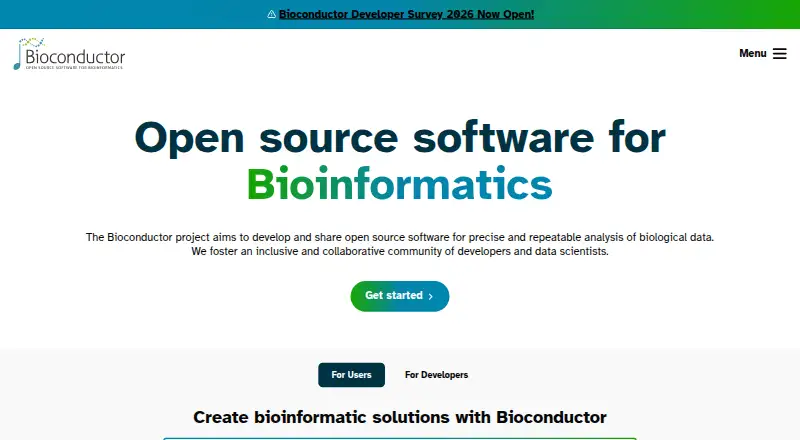
What Bioconductor is
Bioconductor is an open-source software project for rigorous, reproducible analysis of biological data. It is intended for researchers and data scientists working with biological and genomic information. Built around the R statistical programming language, it distributes most of its components as R packages for DNA microarray, sequence, flow, SNP, and other genetic or genomic analyses. Tools can connect genomic data with biological metadata from resources such as GenBank, Entrez genes, and PubMed. Packages include task-focused vignettes, reflecting the project's goal of reproducible research. Bioconductor offers a stable release updated twice a year and a development version for new packages and features; each release is designed for a particular R version. The current release page lists Bioconductor 3.23 with R 4.6.0. Docker containers with preinstalled R and Bioconductor versions support reproducible environments, and deployment guidance covers several container services and Docker tools. The project began in 2001. It is free, and users can seek help through its Support site and community chat.
Good
- Free open-source software.
- Packages cover several genetic and genomic data types.
- Vignettes support task-oriented package use.
- Docker containers provide preinstalled R and Bioconductor versions.
- Support site and community chat are available.
Watch out
- Each release is tied to a specific R version.
- Most components are distributed as R packages.
Who it suits
Bioconductor suits researchers and data scientists analyzing biological or genomic data with R. It is also relevant to users who need package-based methods and reproducible environments.
Verdict
Bioconductor brings a broad set of R-based methods to biological and genomic analysis, with reproducibility reflected in package vignettes and container options. Check the R-version requirement for the release you plan to use.
Plans and prices
From Bioconductor's own pricing page, checked 7 Oct 2026.
| Plan | Price | What it gives you |
|---|---|---|
| Bioconductor | Free | Free open-source software; no paid plans or usage limits stated |
| Free | Free | open-source bioinformatics software · R packages · Docker containers · Free |
The facts
Each one read from Bioconductor's own pages, with the date it was checked.
What it does
- Analysis methods
- Its packages support analysis of DNA microarray, sequence, flow, SNP, and other genetic or genomic data.checked 7 Oct 2026
- Biological annotation
- Annotation tools connect genomic results with resources including GenBank, Entrez Genes, PubMed, Gene Ontology and UCSC data.checked 15 Oct 2026
- Compatibility limit
- Each Bioconductor release is designed for a specific R version; the current release page lists Bioconductor 3.23 with R 4.6.0.checked 7 Oct 2026
- Current release
- Release 3.23 was published April 29, 2026 with 2,418 software packages and R 4.6 compatibility.checked 15 Oct 2026
- Dependencies
- The project warns that its structured releases create extensive inter-package dependencies and require packages to stay within a compatible release.checked 15 Oct 2026
- Developer extensibility
- Developers can submit R packages that undergo open review and are expected to meet documentation, interoperability and build-check requirements.checked 15 Oct 2026
- Docker
- Official Docker images are provided for every supported Bioconductor release plus a development image.checked 15 Oct 2026
- Documentation
- Each package contains one or more task-oriented vignettes, including tutorials and workflow explanations.checked 15 Oct 2026
- Genomic analysis
- Its packages cover DNA microarray, sequence, flow-cytometry, SNP and other genomic-data analyses.checked 15 Oct 2026
- Installation
- The recommended installer is BiocManager, which selects repositories matching the installed R and Bioconductor versions.checked 15 Oct 2026
- Integrations
- SourceForge lists integrations with R and Docker.checked 15 Oct 2026
- Intended users
- The project serves researchers and data scientists working with biological and genomic data.checked 7 Oct 2026
- Licence
- Core Bioconductor packages are typically licensed under Artistic-2.0, while individual packages may use other open-source licences.checked 15 Oct 2026
- Limit: compatibility
- Respondents reported friction with tidyverse compatibility, duplicate packages, namespace collisions and some packages that install dependencies unexpectedly.checked 15 Oct 2026
- Limit: learning curve
- Survey respondents reported a steep learning curve because the ecosystem contains many packages and choices.checked 15 Oct 2026
- Limit: outages
- The public status history records incidents including a package-stats failure lasting 26 hours 58 minutes and an archive outage lasting 24 hours 3 minutes.checked 15 Oct 2026
- Limit: release cycle
- Survey respondents said the six-month development and release cycle can be inconvenient and that non-Bioconductor dependencies can be difficult to identify.checked 15 Oct 2026
- Limit: website usability
- Survey respondents criticized the website as difficult for new users and developer information as redundant or scattered.checked 15 Oct 2026
- LinkedIn founding fact
- LinkedIn describes Bioconductor as an open-source project founded in 2001 and used in bioinformatics and biomedical research.checked 15 Oct 2026
- Metadata
- Bioconductor provides tools for associating genomic data with biological metadata from resources including GenBank, Entrez genes, and PubMed.checked 7 Oct 2026
Where it runs
- Common platform
- The project aims to provide extensible, scalable and interoperable software through shared data structures and package conventions.checked 15 Oct 2026
The company
- Company founding
- Bioconductor started in 2001.checked 15 Oct 2026
- Company location
- SourceForge lists Bioconductor's company information location as the United States.checked 15 Oct 2026
- Founded
- 2001checked 28 Sep 2026
The full review of Bioconductor
Bioconductor is a free, open-source R ecosystem built for biological and genomic data analysis. It suits researchers and data scientists whose work spans sequencing, microarrays, flow, SNPs or related datasets and who need documented, repeatable methods. The trade-off is a release model tied to a particular R version, so teams must plan their environment before adopting it.
Overview
Founded in 2001 and overseen by a core team, Bioconductor focuses on rigorous analysis of biological data rather than serving as a general-purpose package registry. Most of its components are R packages, giving R users a concentrated collection of methods for genetic and genomic research. That specialization is valuable when your data and questions are biological; it is less suitable when you need a language-neutral package system or tooling aimed at unrelated software domains.
The project is free to use and has no paid tier or stated usage cap. Its scope is correspondingly defined by the community’s package ecosystem, not by commercial service-level commitments or private-package offerings.
Key features
Genomic methods and metadata
Packages address DNA microarray, sequence, flow, SNP and other genetic or genomic data. Bioconductor also supplies tools for associating genomic results with biological metadata from GenBank, Entrez genes and PubMed. In practice, this helps analysts move from raw measurements to biologically interpretable results without assembling an unrelated set of tools themselves.
Reproducible documentation
Each package includes one or more task-oriented vignettes, and reproducible research is an explicit project goal. The vignettes provide a practical path from a package’s purpose to an analyzable workflow, which is particularly useful for research groups that must explain or revisit methods later.
Release and environment control
A stable release is updated twice a year, while a development version carries new features and packages. Every release is designed for a specific R version; the current release page identifies Bioconductor 3.23 with R 4.6.0. This pairing keeps tested combinations clear, but it means an R upgrade can require a corresponding Bioconductor decision rather than an automatic package refresh.
Docker containers with preinstalled R and Bioconductor versions provide a way to pin those combinations. Deployment guidance covers Amazon ECS, Google Kubernetes Engine, Microsoft Azure Container Instances, and Docker Desktop or Docker Engine, making the containers relevant to both local reproducibility and managed infrastructure.
Community support
Users can turn to the Bioconductor Support site and community chat. A published Code of Conduct sets expectations for participation. The official pages do not state a security certification or compliance standard, so organizations with formal assurance requirements will need separate evaluation.
Pricing
| Plan | Price | What you get |
|---|---|---|
| Bioconductor | free | Free open-source software; no paid plans or usage limits stated |
There is no free trial because the software is already free, and no renewal, seat, or consumption charge is stated. The ecosystem has a single package ecosystem, does not offer private packages, and lists a 10 MB package size limit. That makes it a straightforward choice for publicly shared analytical work, while teams needing private package hosting or larger package artifacts should look elsewhere or add separate infrastructure.
Platforms
Bioconductor is available for Linux, macOS and Windows, with web and self-hosted use also supported. Docker images and documented deployment on ECS, Google Kubernetes Engine, Azure Container Instances, Docker Desktop and Docker Engine extend it to containerized local or cloud environments. The platform breadth helps mixed operating-system teams, but the R-version requirement still governs whether a particular release fits your stack.
Who it's for
Choose Bioconductor if you are a researcher, bioinformatician or data scientist working in R with genomic or biological datasets and you value package-level examples, biological metadata integration and reproducible environments. It is especially well matched to teams that can standardize on the R version required by their chosen release and benefit from twice-yearly stable updates.
It is a weaker fit for developers seeking a general package registry, private-package distribution, or a workflow centered on another programming language. Organizations that require a stated security certification should also treat it as a community software project rather than a compliance product.
Pros and cons
Pros
- Deep biological focus: Methods cover microarray, sequence, flow, SNP and other genomic data types instead of forcing researchers to adapt generic tooling.
- Biological metadata links: Connections to GenBank, Entrez genes and PubMed support interpretation alongside analysis.
- Reproducibility support: Task-oriented vignettes, twice-yearly stable releases and versioned Docker containers make workflows easier to document and recreate.
- No licensing cost: The single plan is free, with no stated usage limits or paid upgrade.
Cons
- R dependency: Most components are R packages, limiting appeal for language-neutral or non-R teams.
- Version coupling: Each release targets a specific R version, adding upgrade planning and environment-management work.
- No private packages: The ecosystem does not provide private-package support, and the package size limit is 10 MB.
- No stated certification: A security certification or compliance standard is not provided on the official pages.
Alternatives
For a broader directory of package registries, see Package Registries.
- npm is the better pick for JavaScript and Node.js packages, with public publishing and registry access on its free plan and paid options beyond it.
- Inedo ProGet suits teams that need private feeds and Docker support, with a free edition plus a free trial, though its free tier has limited security and compliance features.
- LuaRocks is a free alternative when your modules are written for Lua rather than R.
- pypiserver fits a self-hosted, minimal PyPI-compatible server for Python packages.
- CPAN is the natural free archive for Perl software and documentation.
- R-universe is preferable for free public R package publishing through GitHub, with a GitHub account required to publish a packages.json registry.
- aptly is aimed at Debian-style repositories, offering a CLI tool and HTTP REST service.
- CocoaPods is the focused choice for iOS and macOS dependency distribution.
Verdict
Bioconductor is a strong recommendation for R-based biological and genomic analysis: its specialized methods, metadata connections, vignettes and container options support serious, repeatable research at no software cost. Look elsewhere if you need a language-agnostic registry, private packages, larger package artifacts or a formally certified security and compliance posture.
Alternatives to Bioconductor
- 1
PyPI
Free planOpen sourceWebAPILinuxmacOS8.1Free plan - 2
npm
Free planLinuxmacOSWindows7.5From $7 a month - 3

Inedo ProGet
Free planWebAPILinuxSelf-hosted7.4From $2,395 a year - 4
GNU ELPA
Free planOpen sourceWebSelf-hosted7.0Free plan - 5
LuaRocks
Free planAPILinuxmacOSSelf-hosted6.9Free plan - 6
pypiserver
Free planAPILinuxmacOSSelf-hosted6.9Free plan