CPAchecker
CPAchecker is a configurable software verification tool for analyzing programs.
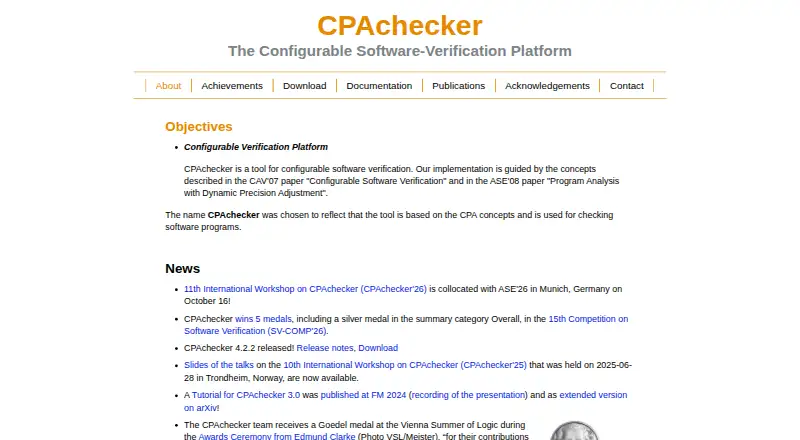
What CPAchecker is
CPAchecker is a configurable software verification tool for analyzing programs. It supports C and SV-LIB inputs, with predicate analysis listed for SV-LIB, and uses a hybrid verification method with invariants. Its outputs include counterexamples and proof artifacts, and it can validate termination witnesses in YAML formats 2.1 and 1.0. The project lists version 4.2.2, released in December 2025, with Unix and Windows ZIP archives. Debian and Ubuntu users can install it through the SoSy-Lab APT repository, and a Docker image is available. CPAchecker requires Java 21 or later as of version 4.2. Documentation includes installation guidance, tutorials, getting-started material, and an example counterexample report. An older 1.6.1 version is available through a web interface, though some features are unavailable there. CPAchecker is free and licensed under Apache 2.0; listed platforms include Linux, macOS, Windows, and self-hosted deployment.
Good
- Free software under the Apache 2.0 License
- Supports C and SV-LIB inputs
- Produces counterexamples and proof artifacts
- Docker image and Linux package installation are available
- Includes tutorials and installation guidance
Watch out
- Requires Java 21 or later
- Online version 1.6.1 lacks some features
- Newer Linux releases may require recent distributions
Who it suits
CPAchecker suits developers and researchers verifying C or SV-LIB programs who need invariant-based analysis and counterexamples or proof artifacts. It is intended for users able to run it on supported desktop systems or self-hosted environments.
Verdict
CPAchecker offers a focused verification workflow with multiple deployment options and documentation. Check the Java and Linux requirements against your environment before choosing it.
Plans and prices
From CPAchecker's own pricing page, checked 8 Oct 2026.
| Plan | Price | What it gives you |
|---|---|---|
| CPAchecker | Free | Free software under the Apache 2.0 License · latest binary release 4.2.2 |
The facts
Each one read from CPAchecker's own pages, with the date it was checked.
What it does
- Analysis support
- The page lists predicate analysis support for SV-LIB programs and validation of termination witnesses in YAML formats 2.1 and 1.0.checked 8 Oct 2026
- Container support
- The project provides a Docker image named sosylab/cpachecker:4.2.2.checked 8 Oct 2026
- Development
- Development takes place on GitLab, and the download page also links to a read-only GitHub mirror.checked 8 Oct 2026
- Documentation
- The documentation page links to installation instructions, getting-started guidance, tutorials, and a counterexample report for a program with a bug found by CPAchecker.checked 8 Oct 2026
- Online version
- An older version, 1.6.1, is available through a web interface, where some features are unavailable because of the restricted environment.checked 8 Oct 2026
- Purpose
- CPAchecker is a tool for configurable software verification based on configurable program analysis concepts.checked 8 Oct 2026
- Release
- The download page lists version 4.2.2, released in December 2025, with Unix and Windows ZIP archives.checked 8 Oct 2026
- Requirements
- The download page says Java 21 or later is required as of CPAchecker 4.2.checked 8 Oct 2026
- Security and compliance
- The download page identifies the license as Apache 2.0; it does not state a security certification or compliance standard.checked 8 Oct 2026
- Support
- The project directs installation questions, bug reports, and suggestions to its CPAchecker users mailing list, and also provides an issue tracker.checked 8 Oct 2026
The company
- Headquarters
- Munich, Germanychecked 28 Sep 2026
Where it runs
- Linux installation
- Debian and Ubuntu users can install CPAchecker through the SoSy-Lab APT repository.checked 8 Oct 2026
- Newer Linux requirements
- The project says most configurations will require Ubuntu 24.04, Debian 13, or newer after the next release because of common SMT solver system requirements.checked 8 Oct 2026