
Contractbook
Contractbook is a cloud-based contract lifecycle platform for creating, collaborating on, signing, organizing, and tracking contracts.
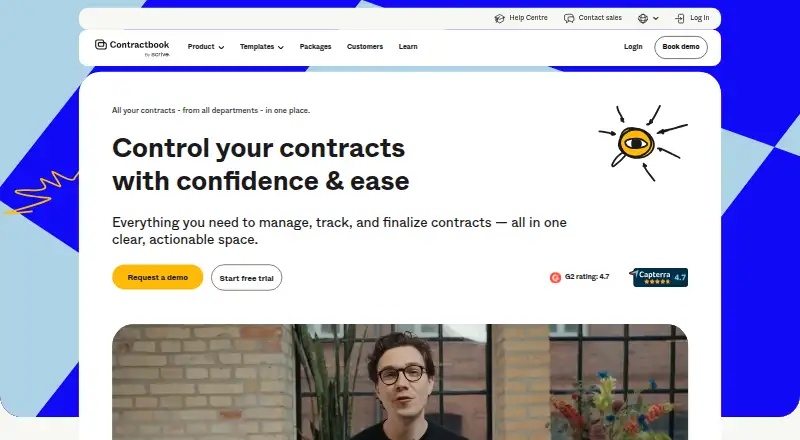
What Contractbook is
Contractbook is a cloud-based contract lifecycle platform for creating, collaborating on, signing, organizing, and tracking contracts. Teams can prepare drafts using CRM data, forms, or other tools, then work from pre-approved templates. Collaboration includes approval workflows, suggestions, comments, and version history. Electronic signatures support signing order, identity checks, and two-factor signing; recipients can complete signing without a Contractbook account. Existing contracts can be bulk imported, scanned, extracted for data, organized, searched, and managed with permissions. Contract data can trigger deadline and renewal reminders as well as customizable tasks after signing. Contractbook advertises more than 3,000 integrations, including Salesforce, HubSpot, Pipedrive, Google Calendar, Slack, Zapier, and Make.com. It states that it is SOC 2 and GDPR compliant and describes additional security controls, including encrypted storage and regular penetration testing. The service offers a free plan and a 14-day trial; paid plans include Centralize at $399 a month and Growth at $599 a month, both billed annually. Its lifecycle-management offering is presented for companies with 11–1000 employees.
Good
- Approval workflows include comments and version history.
- Recipients can sign without a Contractbook account.
- Reminders can track deadlines and renewals.
- Advertises more than 3,000 integrations.
- All plans include live chat, email, and phone support.
Watch out
- Centralize is $399 a month, billed annually.
- Growth is $599 a month, billed annually.
- Essential lists one user and 100 signed contracts per year.
Who it suits
It suits companies looking to create, sign, and manage contracts in a shared web-based workflow. Its lifecycle-management offering is aimed at companies with 11–1000 employees.
Verdict
Contractbook covers contract drafting through repository management, with e-signatures, reminders, and integrations. Compare plan limits and annual billing terms against the team’s needs.
Plans and prices
From Contractbook's own pricing page, checked 28 Sep 2026.
| Plan | Price | What it gives you |
|---|---|---|
| Centralize | $399 a month | 5 users · 15 templates · 350 signed contracts/year · AI data extraction · CSV export · .docx download · billed annually |
| Growth | $599 a month | unlimited users · unlimited contracts · conditional templates · automations · SSO · dedicated success manager · billed annually |
| Essential | Free | 1 user · 5 custom templates · 100 signed contracts/year · unlimited e-signatures |
| Free trial | Free | 14-days access · no credit card required · all features · limited Free plan afterward |
| Accelerate | Priced on request | 10 users · 25 templates · 500 signed contracts/year · automations · user provisioning · dynamic templates |
| Custom | Priced on request | tailored setup · initial consultancy · 1:1 Customer Success Manager support |
The facts
Each one read from Contractbook's own pages, with the date it was checked.
What it does
- API access
- Yeschecked 21 Sep 2026
- Built-in e-signature
- Yeschecked 21 Sep 2026
- Collaboration
- The platform supports approval workflows, suggestions, comments, and version history.checked 28 Sep 2026
- Contract creation
- Users can pre-fill drafts from CRM, forms, or other tools and use pre-approved templates.checked 28 Sep 2026
- Contract lifecycle management
- Contractbook lets teams create, collaborate on, sign, centralize, track, and connect contracts in one platform.checked 28 Sep 2026
- Contract repository
- Existing contracts can be bulk imported, scanned, data-extracted, organized, searched, and managed with permissions.checked 28 Sep 2026
- Contract templates
- Yeschecked 21 Sep 2026
- Deployment
- cloudchecked 21 Sep 2026
- Electronic signatures
- Contractbook provides legally binding electronic signatures, signing order, identity verification, and two-factor signing.checked 28 Sep 2026
- Integrations
- Contractbook advertises more than 3,000 integrations and lists Salesforce, HubSpot, Pipedrive, Google Calendar, Slack, Zapier, Make.com, and API access.checked 28 Sep 2026
- Recipient access
- Recipients do not need a Contractbook account to open a document and complete signing.checked 28 Sep 2026
- Reminders and tasks
- Contract data can generate deadline and renewal reminders and customizable post-signature tasks.checked 28 Sep 2026
- Renewal tracking
- Yeschecked 21 Sep 2026
- Security compliance
- Contractbook states that it is SOC 2 compliant and GDPR compliant and has completed Google Partner Security Program assessments.checked 28 Sep 2026
- Security controls
- The service uses SHA-256 RSA SSL encryption, encrypted password and token storage, verified email and phone accounts, two-factor signatures, and regular black-box penetration testing.checked 28 Sep 2026
- Support
- All plans include live chat, email, and phone support; some plans include a dedicated success manager.checked 28 Sep 2026
- Target customers
- The lifecycle-management offering is presented for companies with 11–1000 employees.checked 28 Sep 2026
Where it runs
- Approval workflows
- Yeschecked 21 Sep 2026
- Browser platform
- Contractbook describes its contract review workflow as running in a single web-based browser.checked 28 Sep 2026
Money
- Free plan
- Yeschecked 21 Sep 2026
The company
- Headquarters
- Copenhagen, Denmarkchecked 23 Sep 2026
The full review of Contractbook
Overview
Contractbook is a cloud-based contract lifecycle platform for teams that want drafting, review, signing, and ongoing contract tracking together. It is best suited to companies with 11–1,000 employees that need to manage more than the signature step. Its broad workflow and integration coverage are appealing, but plan quotas and annual billing make a careful fit check important.
Teams can pre-fill drafts from a CRM, forms, or other tools, then collaborate through approvals, comments, suggestions, and version history. Signed and existing contracts can be centralized, searched, managed with permissions, and used to trigger deadline reminders or post-signature tasks. Recipients can sign without creating a Contractbook account, reducing friction for external parties.
Key features
- Drafting and review: Pre-approved templates and pre-filled drafts can reduce repetitive document preparation. Approval workflows, suggestions, comments, and version history support review across a team.
- Electronic signatures: Legally binding signatures include signing order, identity verification, and two-factor signing. This covers more than a basic signature flow, while recipient account creation is not required.
- Repository and tracking: Teams can bulk-import contracts, scan and extract data, organize and search records, and apply permissions. Contract data can drive renewal and deadline reminders plus customizable follow-up tasks, making the repository useful after signing.
- Integrations and security: Contractbook advertises more than 3,000 integrations, including Salesforce, HubSpot, Pipedrive, Google Calendar, Slack, Zapier, and Make.com, alongside API access. It states SOC 2 and GDPR compliance and completed Google Partner Security Program assessments; controls include SHA-256 RSA SSL encryption, encrypted password and token storage, verified email and phone accounts, two-factor signatures, and regular black-box penetration testing.
- Support: Every plan includes live chat, email, and phone support. Some plans add a dedicated success manager, a meaningful distinction for teams that want ongoing implementation guidance.
Pricing
Contractbook uses a freemium model, with a free plan and a 14-day trial. The trial costs nothing, requires no credit card, and provides access to all features before moving to a limited Free plan. That is useful for evaluating the full workflow, but the post-trial free-plan caps matter for continued use.
- Essential: Custom pricing; includes 1 user, 100 signed contracts per year, and 5 templates. The narrow seat and signing allowance suits a very small operation, but limits headroom as volume grows.
- Centralize: $399 a month, billed annually; includes 5 users, 15 templates, 350 signed contracts per year, AI data extraction, CSV export, and .docx download. It adds repository-oriented tools and a higher quota, though the annual commitment and capped users and contracts are important constraints.
- Accelerate: Custom pricing; includes 10 users, 25 templates, and 500 signed contracts per year. It raises capacity for a larger team, but retains a yearly signing cap.
- Custom: Custom pricing for a tailored setup, initial setup consultancy, and 1:1 Customer Success Manager support. This is the option for organizations needing guided configuration rather than a fixed package.
- Growth: $599 a month, billed annually; includes unlimited users and contracts, conditional templates, automations, SSO, and a dedicated success manager. It removes the published seat and contract caps and adds administrative and workflow capabilities, at a higher annual-billed price.
Platforms
Contractbook is cloud-deployed and lists web and API platforms. Its contract review workflow runs in a single web-based browser, while API access supports connection to other systems. It is not presented as a native mobile app.
Who it's for
Contractbook is a strong fit for growing companies that need a shared contract process from initial draft through renewal tracking, especially when they rely on business tools that can connect through its integration catalog. Teams with few users or low signing volume may find Essential's caps restrictive; those needing high volume, automation, or SSO should compare Growth's unlimited allowances against its annual-billed price.
Pros and cons
- Pro: Drafting, approvals, e-signatures, repository search, reminders, and tasks sit in one lifecycle workflow, reducing the need to separate post-signature management from document execution.
- Pro: Recipients can sign without an account, and signing order plus identity verification and two-factor signing support controlled external execution.
- Pro: More than 3,000 advertised integrations and API access give teams broad connection options.
- Con: Essential and Accelerate cap annual signed contracts at 100 and 500 respectively, while Centralize caps them at 350; teams must estimate volume before selecting a tier.
- Con: Centralize and Growth are billed annually, so their monthly prices do not represent a month-to-month commitment.
- Con: Growth is the plan with unlimited users and contracts, conditional templates, automations, and SSO; teams that need these capabilities face a higher tier than capped plans.
Alternatives
For a different contract lifecycle option, compare Contract Lifecycle Management Software. Readers focused on negotiation can browse Contract Negotiation Software, while broader management needs may suit Contract Management Software or Legal Contract Management Software. For drafting assistance, see AI Contract Generators; for document routing beyond contracts, consider Document Workflow Software.
- OpenCLM is worth considering when a self-hosted option or a free plan with unlimited contracts is the priority; its free plan includes one user and five e-signatures per month.
- DocuSign eSignature is an alternative for readers primarily seeking a freemium service to send, sign, and manage agreements, with a free trial and a Personal plan priced at $11 a month on an annual commitment.
- Mitratech CaseCloud is another paid option, with Android, iOS, and web platforms and pricing by personalized demo.
- SpotDraft may suit buyers seeking a paid service whose price is based on users or contract volume, with implementation, dedicated customer success, and 24/7 support included.
- Docusign CLM is a paid alternative with API access and custom pricing through sales.
- JAGGAER Contracts is a paid web-based alternative with unpublished pricing.
- Onit Contract Lifecycle Management is a paid web-based alternative offering a demo and custom solution.
- Oracle Procurement Contracts is a paid API and web option priced at $405 a month per user, including Procurement Contracts, Supplier Management, and Transactional Business Intelligence for Procurement; it has no free plan or trial.
Verdict
Choose Contractbook if your company wants one platform for contract drafting, approvals, signing, repository management, and renewal follow-up, with integrations to connect the process to other tools. Look elsewhere if your team needs an uncapped workflow at a lower commitment: lower plans have annual signing limits, while the unlimited Growth plan is billed annually at $599 a month.
Getting started
- Open https://contractbook.com/ in a web browser.
- Choose the 14-day free trial, which requires no credit card, or use the limited Free plan afterward.
- Select a plan that fits the listed user, template, and contract limits.
- Use pre-approved templates or pre-fill a draft from CRM, forms, or other tools.
- Set up approvals, signatures, repository permissions, reminders, or integrations as needed.
Limits worth knowing
The Free trial lasts 14 days and is followed by a limited Free plan. Essential lists 1 user, 5 templates, and 100 signed contracts per year; Centralize lists 5 users, 15 templates, and 350 signed contracts per year.
Questions
Does Contractbook have a free plan or trial?
Yes. It lists a limited Free plan and a 14-day trial with access to all features and no credit card required.
How much does Contractbook cost?
Centralize is $399 a month, billed billed annually, and Growth is $599 a month, billed billed annually. Other listed plans do not have a price stated.
Which platforms does Contractbook support?
The listed platforms are web and API. Contractbook says its contract review workflow runs in a web-based browser.
Can recipients sign without an account?
Yes. Recipients do not need a Contractbook account to open a document and complete signing.
What integrations does it offer?
Contractbook advertises more than 3,000 integrations and lists Salesforce, HubSpot, Pipedrive, Google Calendar, Slack, Zapier, Make.com, and API access.
Who makes Contractbook?
The maker is Contractbook, founded in 2017 and headquartered in Copenhagen, Denmark.
Alternatives to Contractbook
- 1

fynk
Free planWebAPI7.9From €19 a month - 2

Zoho Contracts
Free planAndroidiOSWebAPI7.8Free plan - 3

Legito
Free planWebAPI7.8From €6.90 a month - 4

OpenCLM
Free planAPISelf-hosted7.7From $49 a month - 5
Timemy
Free planAndroidiOSWeb7.7From $29 a month - 6

Icertis Contract Management
AndroidiOSWebAPI7.6