
CloudFix
CloudFix identifies potential AWS cost savings and can implement changes after customers approve them.
What CloudFix is
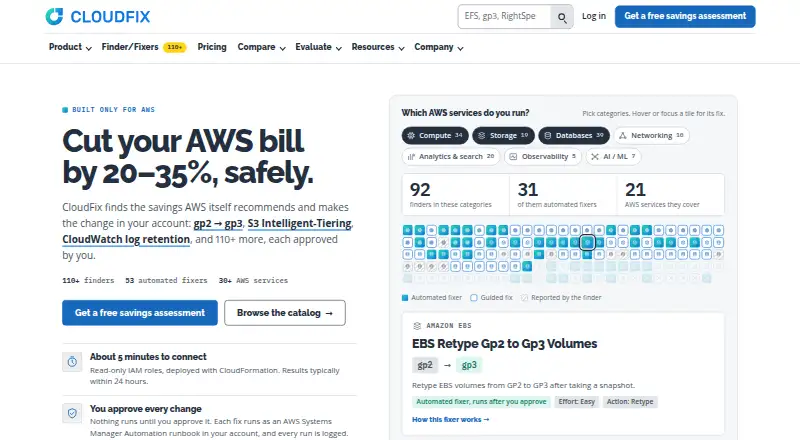
CloudFix identifies potential AWS cost savings and can implement changes after customers approve them. Its product lists 110+ finders and 53 automated fixers across 30+ AWS services. Finders assess Cost and Usage Reports, CloudWatch metrics, and resource metadata; CloudFix says they do not access information held in customer data stores. The service connects through least-privilege IAM roles created with CloudFormation, without agents or stored credentials. Approved changes run as AWS Systems Manager Automation runbooks in the customer’s account, and CloudFix says activity is recorded in the customer’s CloudTrail with each fix execution logged. The Trust Center lists SOC 2 Type 2 auditing, TLS 1.2+ in transit, AES-256 at rest, and a 99.5% per-quarter uptime SLA for the dashboard and API. Plans are processed through AWS Marketplace with monthly or annual billing. A free tier provides scans, savings by category, and full resource details for 30 days; paid tiers vary by annual AWS spend and add options such as reporting, support, and integrations.
Good
- Lists 110+ finders and 53 automated fixers
- Customers approve fixes before they run
- Approved fixes execute in the customer’s AWS account
- Free tier includes full resource details for 30 days
Watch out
- Supports AWS only
- Budget alerts are not provided
- Paid plans are organized around annual AWS spend levels
Who it suits
CloudFix is aimed at AWS users seeking cost recommendations and approved automated changes. Its plan descriptions range from startups to large organizations with complex multi-account setups.
Verdict
CloudFix pairs AWS cost discovery with customer-approved implementation and logged fix activity. Its free tier provides a way to review savings information, while paid plans add capabilities at different spend levels.
Plans and prices
From CloudFix's own pricing page, checked 15 Oct 2026.
| Plan | Price | What it gives you |
|---|---|---|
| Free | Free | free scan · savings by category · resource details for 30 days · free tier |
| Starter | $149 a month | up to $250K AWS spend/year · 53 automated fixers · one-click implementation · basic reporting · email support · monthly or $1,490/year |
| Growth | $499 a month | $250K-$1M AWS spend/year · priority support · advanced reporting · quarterly optimization review · monthly or $4,990/year |
| Scale | $1,499 a month | $1M-$5M AWS spend/year · dedicated success manager · Jira/ServiceNow integration · SSO/SAML · monthly optimization review · monthly or $14,990/year |
| Enterprise | $2,999 a month | $5M+ AWS spend/year · custom SLAs · dedicated Slack channel · executive reviews · early fixer access · custom integrations · starts at $2,999/month or $29,990/year |
The facts
Each one read from CloudFix's own pages, with the date it was checked.
What it does
- API authentication
- The API accepts bearer or API-token authorization, with tenant-scoped tokens created and revoked in the product interface.checked 15 Oct 2026
- API limitations
- The API does not expose UI-only rendering, PDF layout, client telemetry or direct one-click UI controls.checked 15 Oct 2026
- Auditability
- CloudFix says activity is recorded in the customer’s CloudTrail and each fix execution is logged.checked 7 Oct 2026
- Automated fixers
- CloudFix lists 53 automated fixers that can implement approved recommendations.checked 15 Oct 2026
- Availability
- The Trust Center lists a 99.5% per-quarter uptime SLA for the CloudFix dashboard and API.checked 7 Oct 2026
- AWS onboarding
- Connection uses CloudFormation StackSets to deploy scoped IAM roles and does not require long-lived credentials.checked 15 Oct 2026
- AWS scope
- The product is built only for AWS and covers more than 30 AWS services.checked 15 Oct 2026
- Connection
- CloudFix connects using least-privilege IAM roles created through CloudFormation, with no agents or stored credentials.checked 7 Oct 2026
- Coverage
- The product lists 110+ finders and 53 automated fixers across 30+ AWS services.checked 7 Oct 2026
- Data access
- CloudFix says it reads Cost and Usage Reports, CloudWatch metrics and resource metadata, while not accessing application data or database records.checked 15 Oct 2026
- Developer documentation
- Support documentation includes a customer guide, endpoint summary and workflow examples for the API.checked 15 Oct 2026
- Discovery
- Finders analyze Cost and Usage Reports, CloudWatch metrics, and resource metadata; the company says they do not access customer data in data stores.checked 7 Oct 2026
- Email and Google Chat
- CloudFix supports configurable email notifications and optional Google Chat webhooks; its support article says Slack notifications are not currently supported.checked 15 Oct 2026
- Execution engine
- Approved changes run as AWS Systems Manager Automation runbooks in the customer account and are logged.checked 15 Oct 2026
- Finder library
- CloudFix advertises more than 110 automated finders.checked 15 Oct 2026
- Hosting
- CloudFix hosts its platform on AWS in us-east-1 and states that data-processing endpoints are not public.checked 15 Oct 2026
- Integrations
- Paid Scale plans include Jira and ServiceNow integration, while Enterprise adds custom integrations and a dedicated Slack channel.checked 15 Oct 2026
Where it runs
- Approval control
- Customers approve recommendations before fixes run, and approved fixes run as AWS Systems Manager Automation runbooks in their own account.checked 7 Oct 2026
- Approval workflow
- Fixes do not run until a customer approves them, with options for scheduling or automatic approval settings.checked 15 Oct 2026
Money
- Billing
- CloudFix subscriptions are processed through AWS Marketplace and are offered with monthly or annual billing.checked 7 Oct 2026
The company
- Company ownership
- CloudFix is described as a product of Aurea, Inc., a subsidiary of ESW Operations, LLC.checked 15 Oct 2026
- Company size
- LinkedIn lists CloudFix in the 1,001-5,000 employee range.checked 15 Oct 2026
- Founded
- Craft lists CloudFix as founded in 2018.checked 15 Oct 2026
- Headquarters
- CloudFix lists Austin, Texas as headquarters, with an address at 2028 E Ben White Blvd.checked 15 Oct 2026
The full review of CloudFix
CloudFix is an AWS cost-optimization service for teams that want savings recommendations to lead to controlled infrastructure changes. Its approval-first approach and customer-account execution make it a strong fit for organizations that need an audit trail; it is less suitable for multi-cloud management or budget alerting.
Overview
CloudFix identifies savings opportunities from AWS Cost and Usage Reports, CloudWatch metrics, and resource metadata. Its 110+ finders and 53 automated fixers span 30+ AWS services, alongside cost allocation, rightsizing guidance, and commitment management. That breadth gives AWS teams a substantial set of opportunities to assess, but AWS is the only supported cloud and budget alerts are not included.
Recommendations require customer approval before a fix runs. Approved changes execute as AWS Systems Manager Automation runbooks in the customer’s account, with activity recorded in CloudTrail and each execution logged. This is a meaningful control for teams wary of unattended infrastructure changes, though savings depend on someone reviewing and authorizing recommendations.
Connection uses least-privilege IAM roles created through CloudFormation, with no agents or stored credentials. Finders do not access customer data in data stores. CloudFix is SOC 2 Type 2 audited, uses TLS 1.2+ in transit and AES-256 at rest, and provides a 99.5% per-quarter uptime SLA for its dashboard and API. Those controls suit security-conscious teams, while the uptime commitment applies to the dashboard and API rather than promising uninterrupted access.
Key features
- Discovery and fixes: More than 110 finders and 53 automated fixers across 30+ AWS services offer a broad route from identifying potential savings to implementing approved changes.
- Customer control: Approval is required before execution, and runbooks execute in the customer’s account. This limits the risk of recommendations becoming changes without customer sign-off.
- Audit trail: CloudTrail activity and per-execution logs help teams trace what happened after a fix was approved.
- Cloud connection: Least-privilege IAM roles, CloudFormation setup, and the absence of agents or stored credentials reduce the connection footprint.
- Reporting and integrations: Reporting improves at higher tiers; Jira/ServiceNow integration is included with Scale, and Enterprise adds custom integrations.
Pricing
CloudFix uses a flat-rate freemium model, with subscriptions processed through AWS Marketplace and monthly or annual billing. The free tier costs nothing, requires no credit card, and provides a free scan, savings by category, and full resource details for 30 days. It is a useful way to inspect findings, but the 30-day resource-detail window and lack of paid-plan capabilities make it a starting point rather than a continuing implementation plan.
- Starter: $149 a month, or $1,490/year (save $298). It covers up to $250K/year AWS spend and includes 53 automated fixers, one-click implementation, basic reporting and exports, and email support. This is the entry paid option for startups; it gives up the advanced reporting and higher-touch support of more expensive plans.
- Growth: $499 a month, or $4,990/year (save $998). For $250K–$1M/year AWS spend, it adds priority support, advanced reporting, and a quarterly optimization review. It suits growing companies with cloud or FinOps functions that can benefit from more regular review without needing a dedicated success manager.
- Scale: $1,499 a month, or $14,990/year (save $2,998). For $1M–$5M/year AWS spend, it includes a dedicated success manager, Jira/ServiceNow integration, SSO/SAML, and a monthly optimization review. The higher price is most defensible for mid-market teams needing integrations and recurring, dedicated support.
- Enterprise: $2,999 a month, or $29,990/year (saving $5,998). For $5M+/year AWS spend, it adds custom SLAs, a dedicated Slack channel, executive business reviews, early access to new fixers, and custom integrations. It is aimed at large organizations with complex multi-account setups; smaller AWS estates are better matched to lower tiers.
Annual billing shows savings against monthly billing, while the plans are separated by annual AWS spend bands. The free tier’s 30-day resource-detail period is its stated limit; paid plans specify spend bands rather than seat quotas. A 30-day trial is also offered.
Platforms
CloudFix is available through web and API, and supports AWS. That combination suits teams managing AWS cost workflows programmatically or through a dashboard, but does not extend the service to other cloud providers.
Who it's for
CloudFix is strongest for AWS-focused teams that want to move from cost analysis to approved fixes while retaining execution control and an audit trail. Startups can begin with Starter, while growing FinOps teams may value Growth’s review cadence and reporting; Scale and Enterprise are more appropriate when spend, integrations, and support requirements justify their higher monthly costs. Teams that primarily need alerts, multi-cloud coverage, or cost visibility without implementation should consider other tools.
Pros and cons
- Pro: Approval before execution and runbooks in the customer’s AWS account keep the customer in control of infrastructure changes.
- Pro: CloudTrail records activity and each fix execution is logged, giving teams a practical audit trail.
- Pro: Coverage across 30+ AWS services and more than 110 finders gives AWS teams a broad discovery base.
- Con: AWS-only support rules out teams that need cost management across multiple cloud providers.
- Con: No budget alerts means teams need another way to be notified about spending changes.
- Con: The free tier limits full resource details to 30 days, and support and reporting capabilities expand mainly with paid plans.
Alternatives
For a broader comparison, see Cloud Cost Management Software. Consider these alternatives for different cost-management needs:
- Infracost is a better fit when the priority is cost checks in development workflows: its free CI/CD tier includes 1,000 runs per month, and its Starter plan is $250 a month for 10,000 runs.
- Teevity suits readers looking for cross-cloud spending in one place; its free services tier provides high-level cost monitoring, a dashboard, and daily email.
- Azure Application Insights is the alternative to consider for Azure Monitor Logs usage-based ingestion, with the first 5 GB/month per billing account free.
- AWS Billing and Cost Management is a no-cost AWS-native option for cost management, though some features have usage-based charges and Cost Explorer API requests and hourly granularity are charged separately.
- CloudBolt is worth considering when a free core cloud management platform for up to 100 resources is a better match.
- Google Cloud Cost Management is the relevant alternative for Google Cloud customers seeking its cost-management tools at no additional charge, with charges potentially applying for services used.
- OpenCost is a free, open-source option for teams using Kubernetes and Prometheus.
- Economize offers a free tier for one cloud provider, one account, and one organization, up to $100k monthly cloud spend.
Verdict
Choose CloudFix if your organization runs AWS and wants to turn cost findings into customer-approved, logged changes without handing over execution control. Its strongest reason to buy is the combination of approval, in-account runbooks, and traceable activity; its clearest reasons to look elsewhere are a need for budget alerts or multi-cloud support.
Getting started
- Open the CloudFix website
- Select the Free tier or a paid plan
- Connect AWS through least-privilege IAM roles created with CloudFormation
- Review savings recommendations from the finders
- Approve fixes to run as Systems Manager Automation runbooks
Limits worth knowing
The Free tier provides a scan, savings by category and full resource details for 30 days. Paid plans apply to stated annual AWS-spend bands, from up to $250K on Starter to $5M+ on Enterprise.
Questions
Is CloudFix free to use?
Yes. The Free tier costs 0.00 USD, requires no credit card and includes a 30-day period for full resource details. A 30-day trial is also listed.
How is CloudFix billed?
Subscriptions are processed through AWS Marketplace with monthly or annual billing. Paid plans use a flat-rate model.
Which cloud does CloudFix support?
CloudFix supports AWS.
Does CloudFix make changes automatically?
Customers approve recommendations first. Approved fixes then run as AWS Systems Manager Automation runbooks in the customer’s account.
What integrations are available?
The Scale plan includes Jira and ServiceNow integration. Enterprise includes custom integrations.
Does CloudFix provide budget alerts?
No. CloudFix lists cost allocation, rightsizing guidance and commitment management, but not budget alerts.
Alternatives to CloudFix
- 1

Infracost
Free planOpen sourceWebAPIExtensionLinux8.1From $250 a month - 2
Teevity
Free planWebAPILinuxmacOS7.7From €99 a month - 3

AWS Billing and Cost Management
Free planWebAPI6.6From $0.01 a month - 4

Flexera One IT Asset Management
WebSelf-hosted6.4 - 5
CloudBolt
Free planWebAPISelf-hosted6.2Free plan - 6

OpenCost
Free planWebAPILinuxSelf-hosted6.2Free plan