
Clonable
Clonable creates and maintains website versions for international markets, with optional translation.
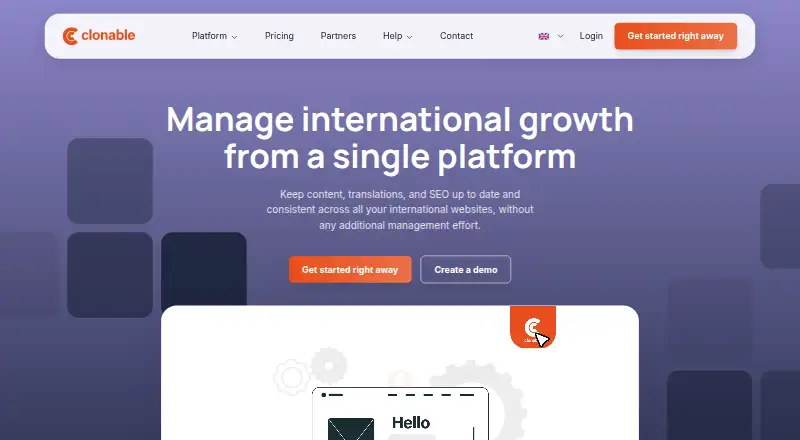
What Clonable is
Clonable creates and maintains website versions for international markets, with optional translation. The original site remains the master; Clonable creates versions outside the CMS and synchronizes them. Teams can tailor content, translations, and SEO for each market without changing other versions. Its localization tools include a visual translation editor, hybrid translation methods, language versions, and hreflang support. Integrations include WordPress, WooCommerce, Magento, Shopware, Shopify, and Logic4, and the maker says it works with most CMS systems and website platforms. The WooCommerce integration supports region-based product visibility, conversion tracking between clones, and language-specific domains, subdomains, or subfolders. Clonable offers a free plan with one clone and up to 20 translated pages; upgrading to 50 pages costs €25 per month. A 14-day trial allows a clone with a limited number of translated pages. Other plan prices are available on request. The service is aimed at organizations managing international e-commerce and corporate websites.
Good
- Keeps the original site as the master.
- Supports market-specific content, translations, and SEO.
- Includes a visual translation editor.
- WooCommerce supports region-based product visibility.
Watch out
- Trial translations are limited in number.
- Dynamic content may not always load.
- Shopify and Wix can have compatibility limitations.
Who it suits
Clonable suits organizations that need to manage localized versions of corporate or e-commerce websites. It may fit teams seeking per-market content and SEO settings while keeping one original site as the master.
Verdict
Clonable brings website cloning, localization, and synchronization together for organizations managing international sites. Check its compatibility limitations and request pricing for paid plans before choosing it.
Plans and prices
From Clonable's own pricing page, checked 14 Oct 2026.
| Plan | Price | What it gives you |
|---|---|---|
| Free | Free | 1 clone · 20 translated pages · one-time upgrade to 50 pages · monthly |
| Business | €49 a month | 3 clones · 400 translated pages · optional installation help €250 · monthly |
| Pro | €79 a month | 5 clones · 1,200 translated pages · optional installation help €250 · monthly |
| E-commerce Small | €99 a month | 1 clone · 1,000 translated pages · XML feeds €30 per feed/month · non-translation clone from €49 · monthly |
| Expert | €249 a month | 10 clones · 5,000 translated pages · optional installation help €250 · monthly |
| E-commerce Medium | €299 a month | 1 clone · 5,000 translated pages · XML feeds €50 per feed/month · non-translation clone from €149 · monthly |
| E-commerce Large | €499 a month | 1 clone · 15,000 translated pages · XML feeds €75 per feed/month · non-translation clone from €249 · monthly |
| Premium | €999 a month | 20 clones · 50,000 translated pages · optional installation help €1,000 · monthly |
| Ecommerce Small | — | 1 clone · Up to 1,000 translated pages · Optional setup assistance €250 · XML feed €30 per month per feed · per month |
| Ecommerce Medium | — | 1 clone · Up to 5,000 translated pages · Optional setup assistance €950 · XML feed €50 per month per feed · per month |
| Ecommerce Large | — | 1 clone · Up to 15,000 translated pages · Optional setup assistance €950 · XML feed €75 per month per feed · per month |
The facts
Each one read from Clonable's own pages, with the date it was checked.
What it does
- AI proofreading
- AI proofreading is included with quotas that vary by subscription tier.checked 14 Oct 2026
- API authentication
- API access uses account keys that users create or revoke in profile settings; Clonable warns that keys should be protected like passwords.checked 14 Oct 2026
- Architecture
- Clonable describes itself as a reverse proxy that fetches pages from the customer's origin server and transforms the responses into clones.checked 14 Oct 2026
- Automatic synchronization
- Changes to the original website are automatically reflected in its clones.checked 14 Oct 2026
- Central management
- Users manage market-specific content, translations and SEO from one central environment while the original site remains the master.checked 14 Oct 2026
- Compatibility limit
- Clonable says dynamic content cannot always be loaded, and notes limitations can occur with Shopify and Wix, including captcha codes, plugins, and filters.checked 9 Oct 2026
- Data sharing
- The privacy policy says Clonable generally does not sell, trade, rent, or share personal information without consent, but may share it with vendors and service providers performing work on its behalf.checked 9 Oct 2026
- Documentation depth
- The knowledge base covers setup, translation editing, URL translation, clone settings, tooling, integrations, platform guides and technical networking.checked 14 Oct 2026
- Integrations
- The maker lists WordPress, WooCommerce, Magento, and Shopware integrations, and says it works with most CMS systems and website platforms.checked 9 Oct 2026
- Language coverage
- An independent hands-on review reports support for more than 142 languages.checked 14 Oct 2026
- Legal entity
- The documentation footer identifies the maker as Clonable BV.checked 14 Oct 2026
- Limit: dynamic content
- Clonable says dynamically loaded content is not always supported, especially on systems such as Shopify and Wix.checked 14 Oct 2026
- Limit: human review
- An independent review says AI output is below professional localization for nuance-heavy or regulated content and recommends human review there.checked 14 Oct 2026
- Limit: quota dependence
- Independent testing identifies page-based subscription quotas as a constraint for large sites and says extra pages or clones require add-ons or upgrades.checked 14 Oct 2026
- Limit: translation quality review
- Clonable recommends manually checking menus, important pages and legal documents because automated translations can choose incorrect synonyms.checked 14 Oct 2026
- Limit: vendor dependence
- Independent testing notes that language versions depend on Clonable infrastructure and an active subscription.checked 14 Oct 2026
- Localization
- Users can customize content, translations, and SEO for each market without changing other versions.checked 9 Oct 2026
The company
- Company founding
- LinkedIn lists Clonable as founded in 2021.checked 14 Oct 2026
- Company headquarters
- LinkedIn lists headquarters in Uden, North Brabant, Netherlands.checked 14 Oct 2026
- Company size
- LinkedIn lists Clonable as a privately held company with 11–50 employees.checked 14 Oct 2026
- Founded
- 2019checked 28 Sep 2026
- Headquarters
- Uden, Netherlandschecked 28 Sep 2026
Money
- Free trial
- The documentation says users can try one clone free for 14 days, with only a limited number of pages translated during the trial.checked 14 Oct 2026
Where it runs
- Limit: platform-specific restrictions
- The FAQ warns that Shopify and Lightspeed can have limited functionality with captchas, plugins and some filters.checked 14 Oct 2026
The full review of Clonable
Clonable is a web service for creating and maintaining localized copies of a master website. It suits ecommerce and corporate organizations running several international markets, particularly when each market needs its own content and search settings. The centralized model is its strongest reason to consider it, while compatibility and page quotas determine whether it fits a particular site.
Overview
Clonable leaves the original website as the master and builds international versions outside the CMS, then synchronizes those versions with the source. Teams can change translations, page content, and SEO for one market without altering the others. That is a sensible structure for organizations that want one publishing center rather than separate CMS installations for every country.
The approach has a meaningful limitation: Clonable says dynamic content may not always load. It also warns of limitations on Shopify and Wix involving captcha codes, plugins, and filters. A site whose customer journey depends on those elements should verify the specific implementation before committing to a clone-based setup.
Key features
Localization and translation
A visual translation editor and hybrid translation methods support localized editing rather than forcing every market to use identical wording. Content and translations can be tailored independently, which is useful for regional offers, legal copy, and merchandising. The number of translated pages remains the practical constraint, especially on the free and smaller plans.
International SEO
Clonable provides SEO localization and supports optimized language versions with hreflang. Those controls help distinguish market pages for international search and let teams adapt SEO alongside translated content instead of treating it as a separate project.
Integrations and ecommerce controls
The service lists integrations for WordPress, WooCommerce, Magento, Shopware, Shopify, and Logic4, and says it works with most CMS and website platforms. Its WooCommerce integration can show products by region, track conversions between clones, and use domains, subdomains, or language subfolders. Those controls make it more relevant to multi-market stores than a translation layer with no regional catalog logic.
Support and hosting
Clonable offers onboarding, support, and optimization assistance, with contact by email. It says the service is hosted by TransIP and uses reasonable precautions and industry best practices to protect personal information. Its privacy policy allows sharing with vendors and service providers carrying out work on its behalf, while saying it generally does not sell, trade, rent, or share personal information without consent.
Pricing
Clonable uses custom pricing for its paid plans and offers a 14-day trial. The FAQ says the trial covers one website clone and a limited number of translated pages, so it is useful for checking workflow and compatibility but not for translating a full large site.
| Plan | What it includes | Best fit and trade-offs |
|---|---|---|
| Free | free; 1 clone and up to 20 translated pages. Upgrade to 50 pages for €25 per month. | Suitable for a small proof of concept. The 20-page ceiling is restrictive for a substantial site. |
| Business | Custom monthly pricing; 3 clones and up to 400 translated pages. Setup assistance €250; additional clone plus pages €25 per month. | Fits a small international rollout, with less capacity than Pro or Expert. |
| Pro | Custom monthly pricing; 5 clones and up to 1,200 translated pages. Setup assistance €250; additional clone plus pages €25 per month. | A practical middle tier for several markets and a moderate catalog. |
| Expert | Custom monthly pricing; 10 clones and up to 5,000 translated pages. Setup assistance €250; additional clone plus pages €50 per month. | Better for larger international programs, at a higher expansion charge. |
| Premium | Custom monthly pricing; 20 clones and up to 50,000 translated pages. Installation assistance €1000; additional clone plus pages €50 per month. | The high-capacity choice for extensive localization, with the largest assistance fee. |
| Ecommerce Small | Custom monthly pricing; 1 clone and up to 1,000 translated pages. Setup assistance €250; XML feed €30 per month per feed. | Designed for a single localized store with a smaller catalog. |
| Ecommerce Medium | Custom monthly pricing; 1 clone and up to 5,000 translated pages. Setup assistance €950; XML feed €50 per month per feed. | More page room for one store, but materially higher setup and feed costs. |
| Ecommerce Large | Custom monthly pricing; 1 clone and up to 15,000 translated pages. Setup assistance €950; XML feed €75 per month per feed. | For a large single-market catalog where one clone is sufficient. |
Paid plans are billed monthly. Because their base prices are custom, buyers should budget for the stated setup or installation assistance and any extra clone, page, or XML-feed charges rather than comparing only the page quota.
Platforms
Clonable is a web service. Its listed website integrations include WordPress, WooCommerce, Magento, Shopware, Shopify, and Logic4, with broader compatibility claimed for most CMS and website platforms. Shopify and Wix limitations, plus possible dynamic-content failures, make platform-specific validation important.
Who it's for
Clonable is aimed at organizations managing international corporate websites and ecommerce operations. It is strongest for teams that want centralized control of many localized versions, market-specific SEO, and regional WooCommerce behavior. It is less suitable for a small site needing only a few translated pages, or for a site built around dynamic widgets, captcha-dependent flows, plugins, or filters that may not carry into a clone.
Pros and cons
Pros
- One master site with synchronized international clones reduces the need to maintain separate CMS copies.
- Market-specific content, translation, SEO, and hreflang support more than literal page duplication.
- WooCommerce regional visibility, conversion tracking, and flexible language URL structures suit international stores.
- Plans scale from 20 translated pages to 50,000, with multiple-clone tiers for larger organizations.
Cons
- Paid prices are custom, making procurement less predictable.
- The free plan's 20-page limit is too small for most complete websites.
- Dynamic content may fail to load, and Shopify or Wix can have captcha, plugin, and filter limitations.
- Setup or installation assistance can add €250 to €1000, while extra clones, pages, and feeds cost more monthly.
Alternatives
Choose Crowdin instead when you need a freemium localization platform spanning web, desktop, mobile, API, and Linux environments rather than synchronized website clones.
Proxylang is a better starting point for readers who want a freemium service with a no-card Test Drive capped at 2,000 words, one language, and 1,500 page views per month.
Pick Webflow CMS when you want to build and experiment within Webflow's CMS, including its free starter limits, instead of localizing an existing master site through clones.
ConveyThis suits a smaller translation deployment with a free tier covering one language, 5,000 words, one domain, and 2,500 monthly translation requests.
Choose GTranslate when a free language-selector widget and machine translation across all languages are the priority.
Polylang is the natural alternative for a WordPress-centered multilingual setup, with a free plugin and a separate WooCommerce offering.
TextUnited fits teams that prefer a translation workspace with a free 15,000-words-per-month tier and one user.
Linguana is an option for a web-only deployment starting with one translated language and one website on its free tier.
Browse the Website Translation Software category for a wider shortlist.
Verdict
Choose Clonable if your organization needs a master website synchronized to multiple market versions, with independent localization and international SEO controls. Its WooCommerce regional features and broad integration list strengthen that case. Look elsewhere if your site relies heavily on dynamic content or Shopify/Wix-specific plugins and filters, or if custom pricing and page-based expansion charges make costs difficult to justify.
Alternatives to Clonable
- 1

TranslatePress
Free planOpen sourceWebAPISelf-hosted7.9From €99 a year - 2

Crowdin
Free planAndroidiOSWebAPI7.8Free plan - 3
Polylang
Free planOpen sourceWebAPISelf-hosted7.7From €99 a year - 4
Proxylang
Free planAndroidiOSWebAPI7.4From $7 a month - 5

Transifex
AndroidiOSWebAPI7.4From $140 a month - 6

TextUnited
Free planWebAPI7.2From €150 a month