
Chinese University MOOC
Chinese University MOOC is an online learning platform launched by NetEase and Higher Education Press in 2014.
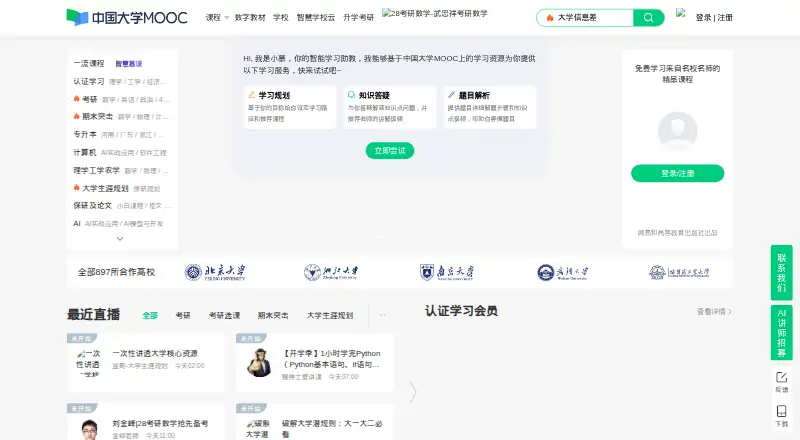
What Chinese University MOOC is
Chinese University MOOC is an online learning platform launched by NetEase and Higher Education Press in 2014. It offers courses from Chinese universities, with subjects spanning humanities, arts, philosophy, history, engineering, agriculture, and medicine. Course activities may include video lessons, discussions, assignments, questions, and a final exam; instructors can support learners in forums and grade assignments.
Anyone can register for free access, though paid courses are also offered. A paid course purchase covers published and upcoming lessons during the course’s validity period, and prices vary by course. Learners meeting a course’s assessment standard can apply for an instructor-signed electronic certificate, which is linked to real identity and verifiable by number or QR code. Android and iOS apps support lessons, quizzes, assignments, communication, material downloads, and course notifications. The service also supports offline learning and enterprise plans. Its privacy controls let users manage personalized course recommendations and request access to, correction or deletion of personal information, among other rights.
Good
- Free courses are available.
- Courses may include videos, discussions, and assignments.
- Eligible learners can apply for certificates.
- Mobile apps support downloads and notifications.
Watch out
- Paid course prices vary by course.
- Certificates require meeting course assessment standards.
- Eligible iOS refunds follow Apple's rules.
Who it suits
It suits learners seeking courses from Chinese universities, including people who want mobile or offline study options. Organizations can also consider its enterprise plans.
Verdict
Chinese University MOOC offers free and paid courses with varied learning activities and mobile access. Check each course’s price and certificate conditions before enrolling.
Plans and prices
From Chinese University MOOC's own pricing page, checked 9 Oct 2026.
| Plan | Price | What it gives you |
|---|---|---|
| Free courses | Free | Free courses are available; course and certificate terms vary |
| Paid courses | — | Course purchase covers published and upcoming lessons during the course validity period; prices vary by course |
The facts
Each one read from Chinese University MOOC's own pages, with the date it was checked.
What it does
- Certificates
- Some courses offer paid certificates after learners complete the required study and assessment, and certificates can be checked using a certificate number or QR code.checked 9 Oct 2026
- Certificate verification
- Certificates are linked to the learner’s real identity and can be checked by certificate number or QR code.checked 8 Oct 2026
- Course activities
- Courses can include videos, discussions, assignments, questions, and final examinations.checked 9 Oct 2026
- Course breadth
- The mobile page says courses from 985 universities span subjects including humanities, arts, philosophy, history, engineering, agriculture, and medicine.checked 8 Oct 2026
- Course formats
- Courses may include video lessons, discussions, assignments, questions, and a final exam.checked 8 Oct 2026
- Integration video support
- For third-party resource access, encrypted video playback requires a player SDK, and the documented supported platforms are web and H5.checked 9 Oct 2026
- Intended learners
- The platform describes its audience as people seeking to improve themselves through courses from well-known Chinese universities.checked 9 Oct 2026
- Mobile learning
- The mobile app supports video lessons, quizzes, assignments, discussions with teachers and classmates, course material downloads, and course notifications.checked 9 Oct 2026
- Paid course terms
- The sales policy says paid courses are purchased as a whole, with one purchase covering published and upcoming lessons during the course validity period.checked 8 Oct 2026
- Personalized recommendations
- Users can turn off personalized course recommendations in the app’s privacy settings.checked 8 Oct 2026
- Privacy controls
- Users can access, correct, delete, or withdraw consent for certain personal information and can submit an account closure request through the app.checked 9 Oct 2026
- Purpose
- Chinese University MOOC is an online education platform offering courses from well-known Chinese universities.checked 8 Oct 2026
- Refund limits
- Eligible self-developed courses may be fully refunded within seven days of purchase only if the course has not started; iOS purchases follow Apple's refund rules.checked 9 Oct 2026
- Security
- The privacy policy says identity verification may be required when users delete certain personal information to help protect account security.checked 9 Oct 2026
- Support
- Users can contact online customer service for refund questions, and the help page lists [email protected] for password recovery assistance.checked 9 Oct 2026
- Teaching
- Course teachers participate in forum support and assignment grading during a course.checked 8 Oct 2026
- Third-party integration
- The platform provides interfaces for third-party teaching platforms to access course information, video and PDF materials, and objective question banks.checked 9 Oct 2026
- What it does
- Chinese University MOOC is an online education platform launched by NetEase and Higher Education Press that offers MOOC courses from Chinese universities.checked 9 Oct 2026
The company
- Founded
- 2014checked 28 Sep 2026
- Makers
- The platform was launched jointly by NetEase and the Higher Education Press.checked 8 Oct 2026
Money
- Free access
- The about page describes MOOC as a learning model that anyone can register for and use for free.checked 8 Oct 2026
- Free plan
- Yeschecked 23 Sep 2026
The full review of Chinese University MOOC
Chinese University MOOC is a university-focused online learning platform for people seeking courses from prominent Chinese institutions. It is best suited to learners who want assessed activities, teacher participation, and study on a phone as well as the web. Its broad academic catalogue and free entry are compelling, but paid access and certificate eligibility must be judged course by course.
Overview
Launched in 2014 by NetEase and the Higher Education Press, Chinese University MOOC brings online courses from Chinese universities, including 985 institutions. The platform is aimed at people improving themselves through university-level study, with subjects ranging from humanities, arts, philosophy, and history to engineering, agriculture, and medicine.
A course can combine video lessons, discussion, questions, assignments, and a final examination. That combination gives motivated learners a defined path and several ways to practice, rather than a video-only experience. Teachers may answer questions in forums and grade assignments during the course, although the exact activities and assessment standard depend on the individual offering.
Anyone can register for the MOOC model and use free courses. Learners who satisfy an eligible course’s assessment standard can apply for an electronic certificate signed by the instructor. Certificates are tied to the learner’s real identity and can be checked with a certificate number or QR code, useful when verifiable completion matters.
Key features
- Mixed learning activities: Videos, discussions, questions, assignments, and final exams support a more disciplined study routine. Because courses choose their own combination, prospective students should inspect the syllabus rather than assume every format is included.
- Instructor involvement: Forum support and assignment grading provide feedback that self-study libraries often lack. The benefit is greatest for learners who will submit work and participate, not those seeking only occasional viewing.
- Verified completion: Eligible students can obtain an instructor-signed electronic certificate linked to their identity and verifiable by number or QR code. Eligibility and assessment thresholds are course-specific, so enrollment is not a guarantee of a credential.
- Mobile study: Android and iOS apps handle video, quizzes, assignments, classmate and teacher communication, downloads of course materials, and notifications. Offline material access helps learners study away from a connection, while notifications can keep a scheduled course on track.
- Third-party teaching interfaces: Integrations can expose course information, video and PDF materials, and objective question banks to external teaching platforms. Encrypted video playback for these integrations requires a player SDK, with documented support for web and H5.
- Privacy controls: Users can request access, correction, deletion, consent withdrawal, account closure, or a copy of personal information. Personalized course recommendations can be disabled in the app, while account, transaction, device, and log data may be used for identity checks, risk assessment, and security incident prevention.
Pricing
| Plan | Price | What it includes |
|---|---|---|
| Free courses | free | Free courses; course and certificate conditions vary |
| Paid courses | Custom pricing | One purchase covers published and upcoming lessons during the course validity period |
The free tier is the sensible starting point for sampling subjects and formats without payment. It does not promise uniform access or a certificate, since both depend on the course. Paid courses are bought as a complete course rather than lesson by lesson; the purchase covers material released during its validity period, with prices set per course. Eligible self-developed courses can be fully refunded within seven days only when the course has not started. Purchases made on iOS follow Apple’s refund rules.
Platforms
Chinese University MOOC runs on the web and has official Android and iOS apps. Mobile software supports downloads for course materials and learning activities, making it practical for commuting or other offline study. Enterprise plans are offered, and third-party integrations document web and H5 support for encrypted video through an SDK.
Who it's for
This is a strong fit for learners seeking Chinese-university content across both humanities and technical fields, especially those who value assignments, discussion, teacher feedback, and a potentially verifiable certificate. It also suits students who need mobile access and offline materials. Readers wanting a completely uniform, self-paced catalogue, guaranteed certificates, or transparent single-price access across all courses should look elsewhere.
Pros and cons
Pros
- University-oriented breadth: Courses span major academic disciplines and include offerings associated with 985 universities.
- More than passive video: Discussions, questions, assignments, and exams can create measurable progress.
- Teacher participation: Forum support and grading add human feedback during a course.
- Useful credential verification: Eligible certificates carry instructor signatures and can be checked by number or QR code.
- Capable mobile access: Apps combine lessons, assessment, communication, downloads, and notifications.
Cons
- Variable course terms: Activities, assessment standards, prices, and certificate eligibility differ by course.
- Paid access is course-specific: There is no single published price for the paid catalogue, and purchases cover a course’s validity period rather than permanent access.
- Refund window is narrow: The seven-day full-refund rule applies only to eligible self-developed courses that have not started, while iOS purchases use Apple’s policy.
- Data is used for security and risk controls: Device, transaction, account, and log information may be processed for verification and incident prevention.
Alternatives
For a broader MOOC directory and category comparison, see MOOC Platforms or Online Course Marketplaces.
- Stepik is a better choice for free public course creation with video, text, and automatically checked assignments, and it supports more desktop platforms plus an API.
- Alison suits learners wanting self-paced free courses with certificates and diplomas available, alongside a free trial.
- Canvas Network is preferable when course pricing and certificates are set by instructors or sponsoring institutions.
- edX fits learners comfortable auditing courses free with limited content and no graded assignments or certificate.
- Codecademy is aimed at coding learners seeking course and skill paths, with a free Basic tier and limited access.
- Khan Academy is an alternative for school and district enterprise licensing, including a $10/student/year Enterprise Starter plan for qualifying U.S. schools and districts.
- Brilliant favors interactive daily practice, while its free plan limits users to two lessons or practice sets per day.
- fast.ai is the focused option for a free practical deep-learning course where coding experience is the stated prerequisite.
Verdict
Choose Chinese University MOOC if you want Chinese-university courses with structured activities, possible instructor feedback, mobile learning, and verifiable completion credentials. Its main advantage is the combination of academic breadth and active coursework at a free starting price. Look elsewhere if you need predictable pricing, identical features across courses, or a guaranteed certificate and access term before enrolling.
Alternatives to Chinese University MOOC
- 1
DataCamp
Free planAndroidiOSWebAPI8.9From $164 a year - 2

edX
Free planAndroidiOSWeb8.8From $150 a year - 3
Stepik
Free planAndroidiOSWebAPI8.8From 2,900 RUB a month - 4

Pluralsight
AndroidiOSWebAPI8.7From $299 a year - 5

Alison
Free planAndroidiOSWeb8.7From $5 a month - 6

Great Learning
Free planAndroidiOSWeb8.7From ₹999 a month