
Check Point DDoS Protector
Check Point DDoS Protector is a perimeter defense device for mitigating network and application attacks in real time.
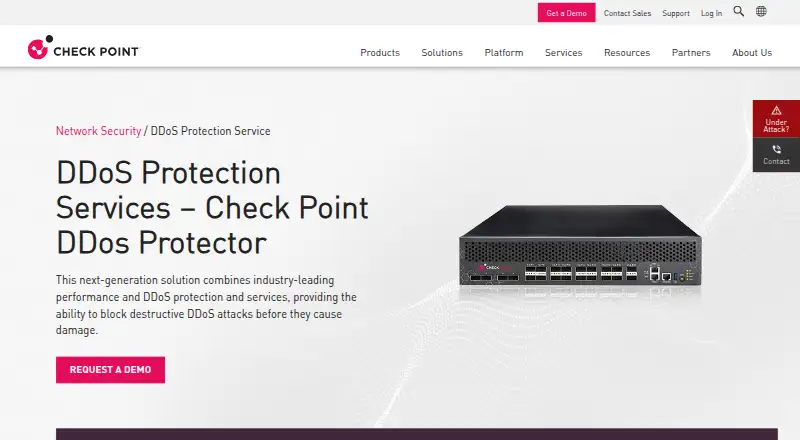
What Check Point DDoS Protector is
Check Point DDoS Protector is a perimeter defense device for mitigating network and application attacks in real time. Its behavioral AI/ML algorithms are designed to automate protection against known and zero-day attacks, including DNS amplification, IoT botnet floods, SSL/TLS floods, and Layer 3–7 attacks. Check Point says real-time signatures can detect attacks and protect in less than 10 seconds. Deployment choices include inline, SPAN-port monitoring, copy-port monitoring, and out-of-path mitigation, with cloud-based, hardware-based, and hybrid options. A virtual appliance is available for software-defined data centers. The management dashboard supports event viewing, policy application, and configuration changes. The X Series integrates with Check Point’s Hybrid Cloud DDoS Protection Service. Maximum programmable mitigation throughput is listed as up to 800 Gbps, depending on model, and the datasheet lists latency below 60 microseconds. Pricing is available on request, and Check Point offers a free demo through a request form.
Good
- Covers network and application attacks.
- Detection and protection are listed at under 10 seconds.
- Offers inline, monitoring, and out-of-path deployment modes.
- Hybrid integration with Check Point’s cloud DDoS service.
- A free demo is available by request.
Watch out
- Pricing is available only on request.
- Maximum throughput varies by model.
- Hardware and software maintenance is listed for one year.
Who it suits
It is intended for organizations protecting enterprise networks and cybersecurity operations, as well as service providers needing multitenant and multipolicy capabilities.
Verdict
Check Point DDoS Protector offers several deployment modes and coverage for multiple attack types. Organizations should request pricing and confirm the model capacity that fits their requirements.
The facts
Each one read from Check Point DDoS Protector's own pages, with the date it was checked.
What it does
- Attack coverage
- It protects against network and application attacks, including HTTP/S floods, DNS attacks, SSL attacks, and network anomalies.checked 4 Oct 2026
- Attack detection
- The product creates real-time attack signatures and says it can detect attacks and protect in less than 10 seconds.checked 4 Oct 2026
- Capacity limits
- The product specifications list maximum programmable mitigation throughput of up to 800 Gbps, depending on model.checked 3 Oct 2026
- Certifications
- The X Series datasheet lists RoHS compliance and safety and electromagnetic certifications including UL/TUV, FCC, CE, and UKCA.checked 4 Oct 2026
- Certifications and warranty
- The datasheet lists RoHS compliance and multiple regional safety and EMC certifications, and specifies one-year hardware and software maintenance.checked 3 Oct 2026
- Demo
- Check Point offers a free demo of Quantum DDoS Protector through a request form.checked 4 Oct 2026
- Deployment
- Deployment modes include inline, SPAN-port monitoring, copy-port monitoring, and out-of-path mitigation; the page also describes cloud, hardware, and hybrid options.checked 4 Oct 2026
- Deployment options
- Check Point describes cloud-based, hardware-based, and hybrid deployment options, as well as a virtual appliance for software-defined data centers.checked 3 Oct 2026
- Detection
- Behavioral AI/ML algorithms provide automated protection against known and zero-day attacks.checked 3 Oct 2026
- Hybrid integration
- The datasheet says the product integrates with Check Point’s Hybrid Cloud DDoS Protection Service for a single-vendor hybrid solution.checked 3 Oct 2026
- Integration
- The DDoS Protector X Series integrates with Check Point's Hybrid Cloud DDoS Protection Service.checked 4 Oct 2026
- Intended users
- Check Point says the X Series can serve service providers protecting hosted applications and network tenants with multitenant and multipolicy support.checked 4 Oct 2026
- Latency
- The datasheet lists latency below 60 microseconds.checked 3 Oct 2026
- Managed service
- Check Point's Emergency Response Team can set up, manage, and tune on-premises devices.checked 4 Oct 2026
- Management
- Its dashboard provides visibility and control across out-of-path and inline protection, network analytics, and policy and configuration tools.checked 4 Oct 2026
- Mitigation capacity
- The product page lists programmable mitigation throughput up to 800 Gbps across its models.checked 4 Oct 2026
- Mitigation speed
- Real-time signatures detect attacks and protect in less than 10 seconds.checked 3 Oct 2026
- Purpose
- Check Point DDoS Protector combines AI/ML behavioral algorithms, performance, and unified management to block destructive DDoS attacks.checked 4 Oct 2026
- Support
- The X Series datasheet lists the Check Point Support Program and a one-year hardware and software maintenance warranty.checked 4 Oct 2026
The company
- Founded
- 1993checked 28 Sep 2026
- Headquarters
- Tel Aviv, Israelchecked 28 Sep 2026
Where it runs
- Virtual appliance
- The X Series datasheet says a virtual appliance supports DDoS mitigation for software-defined data centers.checked 4 Oct 2026
The full review of Check Point DDoS Protector
Overview
Check Point DDoS Protector is a perimeter mitigation system for network and application attacks. It suits enterprise security teams and service providers that need configurable protection across different environments. Its fast, automated response and deployment flexibility are strong advantages; custom pricing and model-dependent capacity make careful sizing essential.
Key features
Behavioral AI and machine-learning algorithms detect known and zero-day attacks, create real-time signatures, and are designed to begin protection in less than 10 seconds. That speed can help teams respond to attacks without depending entirely on manual intervention, though it is a stated capability rather than a guarantee for every deployment.
Coverage spans Layers 3–7 and includes DNS amplification, IoT botnet floods, and SSL/TLS floods. This makes the product relevant to organizations defending both network infrastructure and applications. Its listed maximum programmable mitigation throughput is up to 800 Gbps, depending on model, and the datasheet lists latency below 60 microseconds; buyers should match those figures to their traffic and model requirements.
Deployment can be inline, SPAN-port monitoring, copy-port monitoring, or out-of-path mitigation. Check Point also offers cloud, hardware, hybrid, and virtual-appliance options, including support for software-defined data centers. The breadth is useful for varied architectures, but means teams must choose the deployment and capacity that suit their network.
A management dashboard supports reviewing detection events, applying policies, and refining configurations, with unified visibility across inline and out-of-path protection. Check Point's Emergency Response Team can set up, manage, and tune on-premises devices, a useful option for organizations that need outside operational support. The X Series also integrates with Check Point's Hybrid Cloud DDoS Protection Service for a single-vendor hybrid approach.
Pricing
Check Point DDoS Protector is paid software with custom pricing. There are no published plan tiers or per-seat terms to compare, so organizations should request a quote and confirm model capacity before committing. Check Point offers a free demo through a request form; it is a demonstration, not a free plan or stated-length trial.
Platforms
Deployment options include hardware, cloud, hybrid, and a virtual appliance for software-defined data centers. The product is also described for Linux and self-hosted use, with web-based management. The X Series datasheet lists RoHS compliance and UL/TUV, FCC, CE, and UKCA certifications, plus one-year hardware and software maintenance.
Who it's for
Enterprise networks and cybersecurity operations are the clearest fit, particularly where scalable mitigation and multiple deployment modes matter. Service providers may also benefit from multitenant and multipolicy capabilities. Smaller organizations or buyers seeking a transparent, fixed-price product should look elsewhere if custom procurement and model selection are a poor fit.
Pros and cons
- Pro: Coverage across Layers 3–7 and named attack types addresses both network and application threats.
- Pro: Multiple monitoring and mitigation modes, plus cloud, hardware, hybrid, and virtual options, accommodate different architectures.
- Pro: The stated response time of less than 10 seconds and throughput up to 800 Gbps offer a clear basis for evaluating rapid mitigation at scale.
- Con: Custom pricing makes budget comparisons difficult before a quote.
- Con: Throughput varies by model, so the headline maximum does not establish the capacity of a particular configuration.
Alternatives
For a broader comparison, browse DDoS Protection Software, Firewall Management Software, Network Firewall Software, or Intrusion Detection and Prevention Software.
Choose Comodo Internet Security if a freemium Windows security product is a better fit than an enterprise DDoS mitigation system. WatchGuard FireCloud is an alternative for buyers seeking a paid service with a one-year, 1–50-license price of $97.75 a year. Consider AlgoSec for Linux, self-hosted, web, or API availability; its Horizon Platform has no published price. Forcepoint ZTNA is another paid, custom-priced option for macOS, Windows, self-hosted, and web environments.
FireMon may suit buyers looking for cloud-account-focused security, with Cloud Defense Pro priced at $200 a month per cloud account. Palo Alto Networks Panorama is a paid alternative with API, self-hosted, and web availability. Choose pfSense if a freemium firewall management platform with a free Community Edition is preferable. ZoneAlarm Extreme Security NextGen is a paid alternative for Android, iOS, macOS, and Windows, with a five-device plan.
Verdict
Check Point DDoS Protector is a strong fit for enterprises and service providers that need broad attack coverage, configurable deployment, and high-capacity mitigation. Its principal reason to choose it is the combination of rapid automated response and options spanning on-premises, cloud, and hybrid environments. Look elsewhere if you need transparent pricing or a capacity commitment that can be assessed without model-specific procurement.
Alternatives to Check Point DDoS Protector
- 1

Oracle Cloud Infrastructure Secret Management
Free planWebAPI7.0Free plan - 2
Haltdos
Free planWebAPILinuxSelf-hosted6.8From $30 a month - 3
FastNetMon
WebAPILinuxmacOS6.7From $115 a month - 4

Gcore DDoS Protection
Free planWebAPI6.7Free plan - 5

AWS Shield
Free planWebAPI6.5From $3,000 a month - 6

Imperva API Security
WebAPISelf-hosted6.5