
FireMon
FireMon helps organizations manage and analyze security policy across multi-vendor firewalls, cloud networks, and microsegmentation environments.
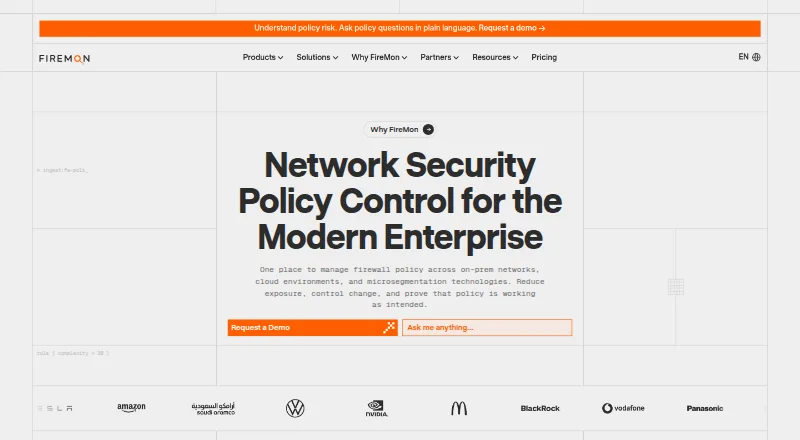
What FireMon is
FireMon helps organizations manage and analyze security policy across multi-vendor firewalls, cloud networks, and microsegmentation environments. Security Manager is the required foundation for policy visibility, compliance, and governance. Additional modules cover change workflow automation, rule optimization, pre-change risk simulation, and AI-powered analytics. Named integrations include Palo Alto Networks, Fortinet, Cisco, Check Point, AWS, Microsoft Azure, Google Cloud, Illumio, and ServiceNow. The ServiceNow connection links firewall change requests with policy validation, approvals, implementation status, and audit evidence. FireMon says it is certified to support over 15,000 devices and 25 million rules with sub-10-second response times. Its deployment model is hybrid; documentation describes server deployments and access through supported web browsers. FireMon offers a free trial and a free firewall assessment with a customized report and dashboard, but no free plan. Security Manager pricing depends on environment size, selected modules, and support tier, and is available on request. Cloud Defense Pro is listed at $200 a month per cloud account.
Good
- Manages policy across multiple firewall vendors and cloud networks.
- Offers modules for change workflows and rule optimization.
- Supports named integrations including ServiceNow and major cloud platforms.
- Free firewall assessment includes a customized report and dashboard.
- Free trial is available.
Watch out
- No free plan is offered.
- Security Manager pricing is available on request.
- Security Manager is required for all deployments.
- Deployment documentation describes server requirements.
Who it suits
FireMon suits global enterprises, government agencies, and service providers managing security policies across complex environments. It is intended for organizations working across firewall vendors, cloud networks, or microsegmentation.
Verdict
FireMon combines a required policy-management foundation with optional modules for change control, optimization, risk simulation, and analytics. There is a free trial and assessment, but no free plan and Security Manager pricing requires a request.
Plans and prices
From FireMon's own pricing page, checked 29 Sep 2026.
| Plan | Price | What it gives you |
|---|---|---|
| Cloud Defense Pro | $200 a month | Per cloud account · asset inventory, posture checks, real-time assessment, compliance reports, threat detection, automated response, IAM authorization control · custom checks, custom threat detectors, and prioritized/direct support not included · $200 / Cloud Account / Month |
| Cloud Defense Enterprise | Priced on request | Includes custom checks, custom threat detectors, and prioritized/direct support · Request Pricing |
| Security Manager | Priced on request | Required foundation for all deployments · quote depends on environment size, selected modules, and support tier |
The facts
Each one read from FireMon's own pages, with the date it was checked.
What it does
- API
- FireMon describes assistance for building bespoke integrations, APIs, and automations as a professional service.checked 29 Sep 2026
- Compliance context
- FireMon Insights runs on AWS servers in the United States and lists AWS assurance programs including SOC 2, FedRAMP, PCI DSS Level 1, and ISO 27001.checked 29 Sep 2026
- Deployment requirements
- FireMon's Security Intelligence Platform documentation describes server deployments and recommends access through supported web browsers; FMOS installation checks for at least 480 GB of hard drive space.checked 29 Sep 2026
- Integrations
- Supported technology integrations named by FireMon include Palo Alto Networks, Fortinet, Cisco, Check Point, AWS, Microsoft Azure, Google Cloud, Illumio, and ServiceNow.checked 29 Sep 2026
- Modules
- The platform offers Policy Planner for change workflow automation, Policy Optimizer for rule optimization, Risk Analyzer for pre-change risk simulation, and Insights for AI-powered analytics.checked 29 Sep 2026
- Scale
- FireMon says it is certified to support over 15,000 devices and 25 million rules with sub-10-second response times.checked 29 Sep 2026
- Security
- FireMon Insights says data in transit is encrypted using TLS with SHA-256 and RSA encryption, and user credentials are hashed and salted before storage.checked 29 Sep 2026
- Support
- FireMon offers business-hours support, 24×7 enterprise support, or a Technical Account Manager; its company page also describes 24/7/365 global support.checked 29 Sep 2026
- What it does
- FireMon helps organizations manage and analyze security policy across multi-vendor firewalls, cloud networks, and microsegmentation environments.checked 29 Sep 2026
- Who it serves
- FireMon says global enterprises, government agencies, and service providers rely on it to manage security policy across complex environments.checked 29 Sep 2026
- Workflow
- FireMon's ServiceNow integration connects firewall change requests with policy validation, approval workflows, implementation status, and audit evidence.checked 29 Sep 2026
Where it runs
- Core platform
- Security Manager is the required platform foundation for network security policy visibility, compliance, and policy governance.checked 29 Sep 2026
The company
- Founded
- 2004checked 23 Sep 2026
- Headquarters
- Lenexa, Kansas, United Stateschecked 23 Sep 2026
Money
- Free assessment
- FireMon offers a free firewall assessment and says evaluations include a free customized report and dashboard.checked 29 Sep 2026
- Free plan
- Nochecked 19 Sep 2026
The full review of FireMon
FireMon is network security policy management software for organizations working across firewalls, cloud networks, and microsegmentation. It suits teams that need policy governance across a complex, multi-vendor estate. Its modular approach lets teams add change control, optimization, risk simulation, and analytics around a required Security Manager foundation.
Overview
Security Manager provides policy visibility, compliance, and governance across supported environments. FireMon names integrations with Palo Alto Networks, Fortinet, Cisco, Check Point, AWS, Microsoft Azure, Google Cloud, Illumio, and ServiceNow. That breadth makes it a candidate for organizations managing mixed infrastructure rather than a single firewall estate.
FireMon says its platform is certified for more than 15,000 devices and 25 million rules, with response times under 10 seconds. Those figures suggest capacity for large deployments, though the required platform and custom pricing make it a more involved purchase than a standalone tool with a published entry price. A free firewall assessment includes a customized report and dashboard, offering a way to evaluate policy conditions before committing.
Key features
Policy management and change control
Security Manager is required for every deployment. Policy Planner adds change-workflow automation, while the ServiceNow integration connects change requests to policy validation, approvals, implementation status, and audit evidence. That connection is useful for teams already routing operational work through ServiceNow; it ties firewall changes to governance rather than leaving approval and evidence in separate processes.
Optimization, risk, and analytics
Policy Optimizer targets rule optimization, Risk Analyzer simulates risk before changes, and Insights adds AI-powered analytics. These optional modules let teams select capabilities around a common foundation, but they also mean the needed scope—and likely the eventual cost—depends on which modules the environment requires.
Security, deployment, and support
FireMon Insights says it encrypts data in transit using TLS with SHA-256 and RSA encryption, and hashes and salts credentials before storage. The service runs on AWS servers in the United States and lists AWS assurance programs including SOC 2, FedRAMP, PCI DSS Level 1, and ISO 27001. These details matter to organizations assessing security and compliance requirements, though they do not replace a review of the deployment's own obligations.
FireMon supports API, Linux, self-hosted, and web environments, and describes its deployment model as hybrid. Its documentation covers server deployments and recommends supported web browsers; FMOS installation checks for at least 480 GB of hard drive space. Bespoke API integrations and automations are offered as professional services, so teams needing custom connections should account for implementation support. Support options include business-hours service, 24×7 enterprise support, and a Technical Account Manager; the company also describes global 24/7/365 support.
Pricing
FireMon has no free plan, but offers a free trial and firewall assessment. Security Manager is the required foundation, with custom pricing based on environment size, selected modules, and support tier. That makes it difficult to estimate total cost without defining scope, and teams cannot buy the optional modules as a substitute for the platform foundation.
Cloud Defense Pro costs $200 a month, billed at $200 per cloud account per month. It includes asset inventory, posture checks, real-time assessment, compliance reports, threat detection, automated response, and IAM authorization control. Custom checks, custom threat detectors, and prioritized or direct support are excluded, making this the lower-cost cloud-account option for teams that can work without those additions.
Cloud Defense Enterprise uses custom pricing and includes custom checks, custom threat detectors, and prioritized or direct support. It is the better fit when those capabilities or support terms are necessary, but the price must be established for the deployment. The cloud plans do not remove Security Manager's role as the required foundation for FireMon deployments.
Platforms
FireMon supports API, Linux, self-hosted, and web environments. Its hybrid deployment model accommodates server deployments alongside browser access, but the documented 480 GB minimum hard-drive check for FMOS is a practical infrastructure consideration for self-hosted installations.
Who it's for
FireMon is aimed at global enterprises, government agencies, and service providers managing security policy across complex environments. It is particularly relevant when policy spans multiple firewall vendors and cloud networks, or when teams need changes validated and documented through an established workflow. Smaller teams seeking a free product, a clear total price, or a solution limited to one simpler environment may find the required foundation and custom scope harder to justify.
Pros and cons
- Broad multi-vendor reach: Named integrations span major firewall vendors, cloud providers, microsegmentation, and ServiceNow, supporting policy work across varied environments.
- Modular capabilities: Change automation, rule optimization, risk simulation, and analytics can be added around the required Security Manager foundation.
- Scale claims suit large estates: Certification for over 15,000 devices and 25 million rules addresses a scale that many smaller tools do not target.
- No free plan and opaque core cost: Security Manager pricing depends on environment, modules, and support, so buyers need a scoped quote to judge total cost.
- Self-hosting has infrastructure demands: FMOS installation checks for at least 480 GB of disk space, a material consideration for on-premises deployments.
- Cloud Pro excludes customization and priority support: Teams needing custom checks, custom threat detectors, or prioritized/direct support must consider Enterprise.
Alternatives
For a broader comparison, see Firewall Management Software.
- AlgoSec is another paid option for API, Linux, self-hosted, and web environments, with its AlgoSec Horizon Platform sold through demo or buying inquiries.
- Tufin is worth comparing for self-hosted or web deployments focused on policy visibility, change tracking, compliance reporting, and cleanup; it has no free plan.
- RedSeal offers paid web and API options, including Stratus plans for multi-cloud inventory, compliance checks, and internet-exposure checks.
- Palo Alto Networks Panorama is another paid firewall-management option, with API, self-hosted, and web platforms.
- FireWeave is another paid alternative.
- ManageEngine Firewall Analyzer may suit teams seeking a published annual entry price: its Standard Edition is $395 a year and supports up to 60 devices with traffic, bandwidth, firewall-rule, security, and network reports.
- Cisco Security Cloud Control Firewall Management offers a free trial and API and web platforms; its base subscription is term-based for one, three, or five years.
- Juniper Security Director offers subscription licensing with on-premises and SaaS options.
Verdict
Choose FireMon if your organization needs centralized policy governance across a large, mixed firewall and cloud estate, especially when change workflows, pre-change risk analysis, or rule optimization matter. Its scale, integrations, and optional modules make it a strong fit for complex operations. Look elsewhere if you need a free plan, predictable published pricing for the core platform, or a lighter deployment without the required Security Manager foundation.
Alternatives to FireMon
- 1

ManageEngine Firewall Analyzer
AndroidiOSWebAPI7.3From $395 a year - 2

NetBrain
WebAPILinuxSelf-hosted6.8 - 3
Nipper InfraSight
LinuxSelf-hostedWindows6.3From $1,995 a year - 4
Batfish
APILinuxmacOSSelf-hosted6.0 - 5

Forward Enterprise
WebAPISelf-hosted5.9 - 6

IP Fabric
WebAPILinuxSelf-hosted5.9