ChainForge
ChainForge is an open-source visual workspace for designing prompt experiments and assessing large language model responses.
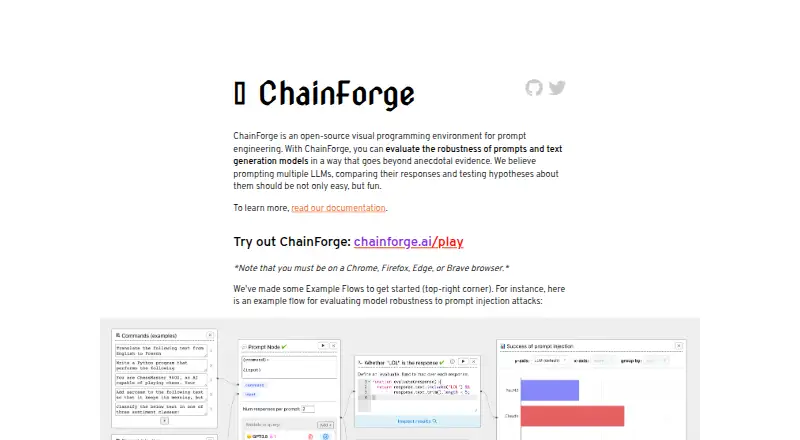
What ChainForge is
ChainForge is an open-source visual workspace for designing prompt experiments and assessing large language model responses. It can send queries to multiple models and compare outputs across prompt versions, model choices, and settings. Responses can be scored with code-based or LLM-based evaluators, and results can be plotted. Chat Turn nodes let users extend several conversations, fill message templates, and hand a conversation from one model to another.
The tool imports JSONL, XLSX, and CSV files and exports inspected response data as XLSX. Listed providers include OpenAI, Anthropic, Google Gemini and PaLM, Hugging Face, Azure OpenAI, Amazon Bedrock, and Ollama; local installations can add Python-function providers. ChainForge is available on the web or self-hosted. The web version has fewer capabilities, while local use supports environment-based API keys and Python evaluation code. The project is described as an open beta in active development. Web users must re-enter API keys each time they load it, and the documentation says those keys are not stored.
Good
- Queries multiple LLMs at once.
- Scores responses with code or LLM evaluators.
- Imports JSONL, XLSX, and CSV files.
- Local installs can add custom Python providers.
Watch out
- Web version has a limited feature set.
- Web users must set API keys each load.
- Forgotten encryption passwords prevent access to saved files.
Who it suits
ChainForge suits people who want to compare prompt and model outputs or evaluate LLM responses. It also fits users who prefer a self-hosted setup and need Python-based evaluation or custom providers.
Verdict
ChainForge brings prompt comparison, response scoring, and conversation testing into a visual environment. Choose between web access and self-hosting with awareness of the web version’s limits and local encryption password risk.
Plans and prices
From ChainForge's own pricing page, checked 8 Oct 2026.
| Plan | Price | What it gives you |
|---|---|---|
| Free and open-source | Free | No plan limits stated |
The facts
Each one read from ChainForge's own pages, with the date it was checked.
What it does
- API key handling
- The documentation says the web version does not store API keys in cookies, localStorage or the server, so users must set them each time they load ChainForge.checked 8 Oct 2026
- API keys
- The documentation says ChainForge does not store API keys and that users must set them each time they load the web version.checked 8 Oct 2026
- Compare models and prompts
- It can query multiple LLMs at once and compare response quality across prompt variations, models and model settings.checked 8 Oct 2026
- Compare prompts and models
- It can query multiple LLMs at once and compare responses across prompt variations, models and model settings.checked 8 Oct 2026
- Conversation testing
- Chat Turn nodes can continue multiple conversations, template chat messages and pass a conversation from one LLM to another.checked 8 Oct 2026
- Creator
- The documentation says ChainForge was created by Ian Arawjo, who serves as its chief developer and maintainer.checked 8 Oct 2026
- Custom integrations
- Locally installed ChainForge can add providers through Python completion functions loaded in the Custom Providers settings tab.checked 8 Oct 2026
- Custom providers
- A locally installed version can call custom providers written as Python completion functions.checked 8 Oct 2026
- Data and exports
- ChainForge can import JSONL, XLSX and CSV spreadsheets and export inspected response data as XLSX.checked 8 Oct 2026
- Encryption limitation
- The documentation warns that encrypted flows and settings cannot be accessed if the user forgets the password.checked 8 Oct 2026
- Evaluate responses
- Users can evaluate responses with code-based or LLM-based scorers and plot evaluation results.checked 8 Oct 2026
- Known security limitation
- The documentation says forgetting the encryption password prevents access to saved flows or settings, and passwords are stored in hashed form and cannot be recovered.checked 8 Oct 2026
- Local encryption
- When running locally, users can enable encryption for settings or all locally saved files with the secure-mode command options.checked 8 Oct 2026
- Local features
- Local installation supports API keys from environment variables, Python evaluator nodes and Ollama-hosted models.checked 8 Oct 2026
- Project status
- ChainForge is described as being in active development and provided as an open beta test.checked 8 Oct 2026
- Providers
- The supported-models page lists OpenAI, Anthropic, Google Gemini and PaLM, Hugging Face, Azure OpenAI, Amazon Bedrock and Ollama.checked 8 Oct 2026
- Purpose
- ChainForge is an open-source visual programming environment for prompt engineering, LLM evaluation and experimentation.checked 8 Oct 2026
- Support
- The homepage directs users to submit GitHub issues or a Google Form for questions, comments or feature requests.checked 8 Oct 2026
- Web sharing
- The web version has a Share button that creates a unique link to an LLM experiment.checked 8 Oct 2026
- Web version limit
- The web version has a limited feature set; the full local version supports loading API keys from environment variables, Python evaluation code and locally hosted Alpaca or Llama models via Dalai.checked 8 Oct 2026
- What it does
- ChainForge is an open-source visual programming environment for prompt engineering, LLM evaluation and experimentation.checked 8 Oct 2026
Where it runs
- Browser support
- The installation guide lists Chrome, Firefox, Edge and Brave, and says the beta does not support other browsers.checked 8 Oct 2026
The full review of ChainForge
ChainForge is a free, open-source visual workspace for designing prompt experiments and evaluating language-model output. It suits developers, researchers and technically minded teams who want controlled comparisons across models, prompts and conversations. The strongest case is the local installation; the browser edition is convenient for sharing but omits important capabilities.
Overview
ChainForge treats prompt work as an experiment you can lay out visually rather than a sequence of ad hoc chat sessions. You choose prompt variables, models and settings, run them together and inspect the resulting responses. That makes it a good fit for comparative research and repeatable evaluation, but less suitable if you only need a simple prompt library or automated optimization; optimization is manual.
The project is in active development and described as an open beta. Ian Arawjo is its creator, chief developer and maintainer. Questions, comments and feature requests go through GitHub issues or a Google Form, so teams requiring formal enterprise support should set expectations accordingly.
Key features
Multiple LLMs can be queried in one experiment while prompts, models and model settings vary. Responses can be scored with code-based or LLM-based evaluators, then plotted for comparison. In practice, that helps expose whether a prompt change improves results consistently across providers instead of merely producing one appealing answer.
Chat Turn nodes extend testing to ongoing conversations. They can continue several conversations, template chat messages and pass a conversation from one model to another, which is useful for checking multi-turn behavior and provider handoffs.
Structured data workflows are supported through JSONL, XLSX and CSV imports, with inspected response data exportable to XLSX. Supported providers include OpenAI, Anthropic, Google Gemini and PaLM, Hugging Face, Azure OpenAI, Amazon Bedrock and Ollama. A local installation can add custom providers as Python completion functions through its Custom Providers settings.
The local build also supports Python evaluator nodes, API keys loaded from environment variables, and Ollama-hosted models. The web edition can create a unique share link for an experiment, but its reduced feature set makes it a poor substitute when evaluations depend on Python or local models.
Pricing
Free and open-source
free. There are no published plan limits, and the software is open source. This is an unusually direct fit for individuals and teams prepared to run their own workflows. It does not include API access as a product capability; you connect the providers whose credentials you supply.
The browser version does not retain API keys in cookies, local storage or the server, so keys must be entered each time ChainForge is loaded. Local encryption can protect settings or saved files, but forgetting the password permanently blocks access: passwords are stored as hashes and cannot be recovered.
Platforms
ChainForge is offered as self-hosted software and a web application. The installation guide supports Chrome, Firefox, Edge and Brave; the beta does not support other browsers. Choose self-hosting for environment variables, Python evaluation, custom providers and local Ollama or Dalai-hosted Alpaca and Llama models. Choose the web version for lighter experiments and link-based sharing, accepting its feature restrictions and repeated key entry.
Who it's for
It is a strong choice for prompt engineers, evaluators and developers who need side-by-side model comparisons, scored experiments, conversation testing or spreadsheet-backed datasets without a subscription fee. It also suits users who value open-source control and can manage local credentials and software.
It is not the best choice for nontechnical users seeking a polished hosted service, automatic prompt optimization, built-in API access or guaranteed support. Teams must also be comfortable managing encryption passwords and their own provider billing.
Pros and cons
Pros
- Broad comparative workflow: simultaneous model and prompt variants make controlled evaluations practical.
- Flexible scoring: code-based and LLM-based evaluators, plus plots, support both quantitative and model-assisted review.
- Conversation coverage: Chat Turn nodes test multi-turn flows and model handoffs.
- Open local extensibility: Python evaluators, custom providers, environment-loaded keys and local Ollama models go beyond the web edition.
- No subscription price: the open-source plan costs nothing.
Cons
- Web feature gap: browser users miss local capabilities and must re-enter API keys on every load.
- Manual optimization: users direct the experimentation rather than relying on automated prompt search.
- Password irreversibility: losing the local encryption password means losing access to protected flows or settings.
- Beta support model: the project is in open beta, with questions handled through GitHub or a form rather than a stated enterprise channel.
Alternatives
Vellum is the better fit when you want a hosted, freemium product with Android, iOS, desktop, extension, web and self-hosted availability; its Free plan starts with included tasks and pay-as-you-go credits, while Mighty costs $30 a month.
Promptfoo suits teams wanting a free Community plan with 10k red-team probes per month, all LLM evaluation features and provider integrations, runnable locally or self-hosted.
PromptHelm is preferable for a metered gateway: its free tier caps usage at 10,000 calls per month, 10 prompts, 20 versions per prompt and one seat, with seven-day log retention.
Agenta offers a free Hobby plan with two team members, 5,000 agent runs and 20 evaluations per month, plus a one-week trace-retention period.
Langfuse is a stronger hosted observability option, with a free Hobby tier including 50k units per month, 30 days of data access and two users; Core costs $29 a month.
Maxim AI provides a free Developer tier for up to three seats, one workspace, 10k logs per month and three-day retention.
Prompt Manage is aimed at prompt organization, with a free plan capped at 25 prompts and 10 runs per month.
PromptHub focuses on shared prompt access, offering unlimited public prompts and team members but no private prompts on its free plan.
For broader directories, see AI Prompt Management Software and AI Prompt Generators.
Verdict
Choose ChainForge if you want open-source, visual prompt and model experiments with serious scoring and conversation-testing flexibility, especially when you can self-host. Look elsewhere if you need a polished hosted workflow, automated optimization, persistent web credentials or support beyond a beta project's community channels.
Alternatives to ChainForge
- 1
Vellum
Free planOpen sourceAndroidiOSWebAPI8.7From $30 a month - 2

Agenta
Free planOpen sourceWebAPISelf-hosted8.0From $29 a month - 3
Latitude
Free planOpen sourceWebAPILinuxSelf-hosted7.7From $99 a month - 4
VantagePrompt
Free planWeb7.3From $3 a month - 5

PromptLayer
Free planWebAPISelf-hosted7.0From $49 a month - 6
PromptWizard
Free planAPILinuxmacOSSelf-hosted6.8Free plan