
Casely
Casely turns software requirements into QA test cases through a conversation with Claude.
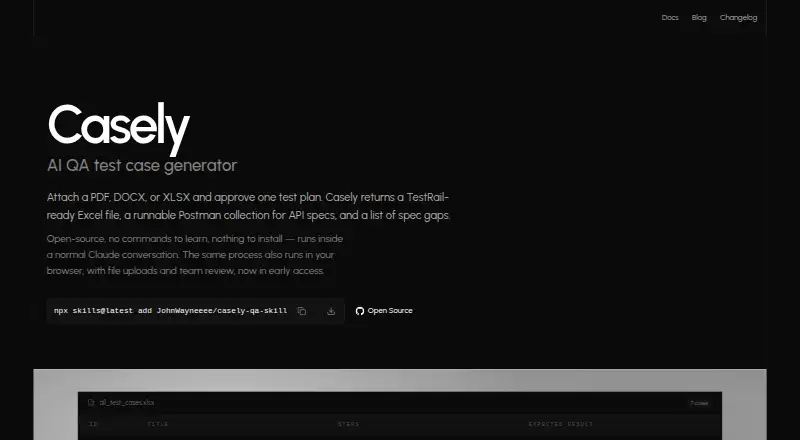
What Casely is
Casely turns software requirements into QA test cases through a conversation with Claude. Users can provide PDF, DOCX, XLSX, TXT, or Markdown files, or paste text. Casely proposes coverage by module, estimates case counts, and identifies gaps in the specification, then waits for approval before writing test cases. Its design methods include equivalence partitioning, boundary value analysis, decision tables, state transitions, and error guessing. It exports cases to one Excel file and separate Markdown files, and can follow the columns, order, tone, and ID scheme of an existing test-case file. Excel exports are described as importable into TestRail, Qase, Zephyr, and Xray. When requirements specify API endpoints, Casely can produce a Postman collection with an environment file and run instructions; it asks for API documentation rather than guessing missing endpoints. The QA skill is free and open source under the MIT license, and runs with Claude Code, claude.ai, or the Claude desktop app. A browser version with file uploads and team review is in early access. Image-only scanned PDFs may not extract cleanly.
Good
- Accepts common document formats or pasted requirements.
- Flags specification gaps before generating test cases.
- Can match an existing test-case file's structure.
- Free, open-source QA skill under the MIT license.
Watch out
- Image-only scanned PDFs may not extract cleanly.
- Postman exports require specified API endpoints.
- Browser version with uploads and team review is in early access.
Who it suits
Casely is aimed at QA engineers and the leads who review their work. It suits teams that want approval of proposed coverage before cases are generated and need exports for their test-management workflow.
Verdict
Casely offers a review step between requirements and generated test cases, with structured exports and API-case support when endpoints are specified. Its open-source skill is available for Claude, while the browser version remains in early access.
The facts
Each one read from Casely's own pages, with the date it was checked.
What it does
- API limit
- Casely only generates a Postman collection when the requirements identify API endpoints; otherwise it asks for API documentation rather than guessing endpoints.checked 3 Oct 2001
- API testing
- When requirements specify API endpoints, Casely can export API cases as a Postman collection with an environment file and run instructions.checked 2 Oct 2001
- Availability
- The open-source skill runs with Claude Code, claude.ai, and the Claude desktop app; a browser version with file uploads and team review is described as early access.checked 3 Oct 2001
- Claude availability
- The skill can be installed for Claude Code and uploaded to claude.ai or the Claude desktop app.checked 2 Oct 2001
- Exports
- It exports one Excel workbook and a Markdown file per case; API cases can also be exported as a Postman collection with an environment file and run instructions.checked 3 Oct 2001
- Hosted version
- A browser version with file uploads and team review is described as being in early access.checked 2 Oct 2001
- Input limitation
- The repository README says image-only scanned PDFs without selectable text may not extract cleanly.checked 3 Oct 2001
- Inputs
- It accepts PDF, DOCX, XLSX, TXT, and Markdown files, or pasted text.checked 3 Oct 2001
- Integrations
- The Excel output is described as importable into TestRail, Qase, Zephyr, and Xray, and API collections can run in Postman or Newman.checked 3 Oct 2001
- Intended users
- Casely says it is made for QA engineers and the leads who review their work.checked 2 Oct 2001
- License
- The QA skill is described as free and open source under the MIT license.checked 2 Oct 2001
- Purpose
- Casely turns software requirements into QA test cases and exports them in a TestRail-ready Excel file.checked 3 Oct 2001
- Review step
- Casely proposes test coverage and flags spec gaps, then waits for approval before writing test cases.checked 3 Oct 2001
- Security
- The docs say generated API collections exclude credentials and use environment variables for secrets such as tokens.checked 3 Oct 2001
- Test design
- It generates cases using equivalence partitioning, boundary value analysis, decision tables, state transitions, and error guessing.checked 3 Oct 2001
Money
- Cost and license
- The QA skill is described as free and open source under the MIT license.checked 3 Oct 2001
- Test planning
- Casely proposes coverage by module, estimates case counts, identifies spec gaps, and waits for approval before generating cases.checked 2 Oct 2001
The company
- Team format
- It can copy the columns, their order, tone, and ID scheme from an existing test-case file.checked 3 Oct 2001
Alternatives to Casely
- 1

Katalon Studio
Free planAndroidiOSWebAPI8.3From $83.33 a month - 2

Testsigma
Open sourceAndroidiOSWebAPI8.1From $14 a month - 3

aqua
Free planWebAPIExtensionLinux7.7From €19 a month - 4

WalnutAI
AndroidiOSWebExtension7.0From $18 a month - 5

QAEverest
Free planAndroidiOSWebAPI6.9Free plan - 6

TestQuality
Free planWebAPI6.8From $8 a month