
aqua
aqua is a test management tool for testers, developers, project managers, and business owners working on quality assurance, software testing, and workflow ma…
What aqua is
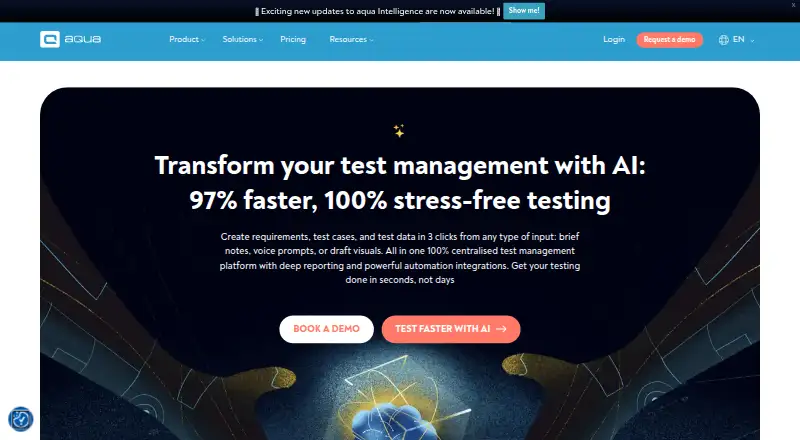
aqua is a test management tool for testers, developers, project managers, and business owners working on quality assurance, software testing, and workflow management. It centralizes manual and automated testing, and a requirements view helps teams identify requirements without test coverage. Its AI can generate requirements, test cases, and test data from user input. Integrations include Jira, Confluence, Jenkins, Ranorex, UFT, Selenium, JMeter, SoapUI, MSSQL, Oracle, PowerShell, and UnixShell, alongside a REST API. Deployment options are cloud and on-premise. aqua supports LDAP authentication, Single Sign-On, and permissions controlling more than 100 actions. The maker states that it is ISO 27001 certified, GDPR compliant, and DORA ready; subscriptions include continuous support. The FAQ says there is no dedicated mobile app. The free Guest plan offers unlimited seats with read-only access. Test Runner DEV costs €19 a month billed annually or €29 a month billed monthly. Requirement Management costs €89 a month billed annually or €119 a month billed monthly. A 30-day trial is advertised.
Good
- Centralizes manual and automated tests
- Requirements view identifies gaps in test coverage
- AI can generate requirements, test cases, and test data
- Offers cloud and on-premise deployment
- Free Guest plan includes unlimited read-only seats
Watch out
- No dedicated mobile app
Who it suits
aqua suits teams managing requirements and manual or automated testing across projects. Its cloud and on-premise deployment options and integrations may fit teams with varied testing and authentication needs.
Verdict
aqua combines requirements management, test execution, integrations, and deployment choices in one testing tool. Teams should note the lack of a dedicated mobile app and check which license matches their access needs.
Plans and prices
From aqua's own pricing page, checked 14 Oct 2026.
| Plan | Price | What it gives you |
|---|---|---|
| Guest | Free | unlimited seats · read-only access · included with every plan |
| Test Runner DEV — Full TR license, billed annually | €19 a month | Test execution · Read-only Agile and Dashboard access · Guest licenses included · Billed annually |
| Test Runner DEV — Full TR license, billed monthly | €29 a month | Test execution · Read-only Agile and Dashboard access · Guest licenses included · Billed monthly |
| Test Runner DEV | €29 a month | test execution · bug management · integrations · read-only Agile and dashboards · monthly |
| Requirement Management — Full RM license, billed annually | €89 a month | Unlimited projects & requirements · Unlimited file storage · Guest licenses included · Billed annually |
| aqua Suite | €99 a month | private cloud or on-premise · full ALM package · SSO · backups and rollbacks · dedicated support manager |
| aqua Suite License | Priced on request | Complete all-in-one ALM license · In Private Cloud or On-Premise |
| Test Management | €119 a month | AI test-case and test-data generation · unlimited projects, plans and runs · API result submission · automation launching · monthly |
| Requirement Management — Full RM license, billed monthly | €119 a month | Unlimited projects & requirements · Unlimited file storage · Guest licenses included · Billed monthly |
| Requirement Management | €119 a month | AI requirements generation · unlimited projects and requirements · integrations · dashboards · bug management · monthly |
| Concurrent License, billed annually | Priced on request | Named user pool with shared access · Includes all features of the All-in-One license · Billed annually |
| Floating License, billed annually | Priced on request | Named user pool with shared concurrent access · Includes all features of the All-in-One license · Billed annually |
| Floating License, billed monthly | Priced on request | Named user pool with shared concurrent access · Includes all features of the All-in-One license · Billed monthly |
| Concurrent License, billed monthly | Priced on request | Named user pool with shared access · Includes all features of the All-in-One license · Billed monthly |
The facts
Each one read from aqua's own pages, with the date it was checked.
What it does
- AI features
- aqua says its AI can generate requirements, test cases, and test data from user input.checked 7 Oct 2026
- AI test generation
- The product can generate requirements, test cases and test data from project input.checked 14 Oct 2026
- API
- The REST API can create and modify items, users and test runs and submit automated results.checked 14 Oct 2026
- API caveat
- The current internal API may change without notice; the documentation describes a forthcoming public Bearer-authenticated API.checked 14 Oct 2026
- API limits
- The documentation states a limit of 20 API or agent requests per second and 20 attachment or image uploads per minute.checked 14 Oct 2026
- Authentication
- aqua supports LDAP authentication and Single Sign-On.checked 7 Oct 2026
- Defect capture
- aqua Capture records screenshots, video, browser events and logs for visual defect reports.checked 14 Oct 2026
- Deployment
- aqua is offered as public cloud, private cloud or on-premise software.checked 14 Oct 2026
- Desktop compatibility
- The maker's on-premise server requirements list Windows Server 2016, 2019, or 2022.checked 7 Oct 2026
- Documentation
- The documentation site contains more than 600 pages covering product use, integrations, automation and installation.checked 14 Oct 2026
- Integrations
- Documented integrations include Jira, Confluence, Azure DevOps, Jenkins, Selenium, JMeter, Ranorex, SoapUI and other testing tools.checked 14 Oct 2026
- Limit: integrations and automation
- Capterra reviewers report missing integrations and say built-in automation is limited because external tools are needed.checked 14 Oct 2026
- Limit: interface and onboarding
- Reviewers describe the interface as dated, request more onboarding videos and say dashboarding could be improved.checked 14 Oct 2026
- Limit: reporting and documentation
- Reviewers mention that the report editor needs training and that some wiki or SSO documentation is incomplete or outdated.checked 14 Oct 2026
- Mobile availability
- The FAQ says there is no dedicated mobile app; the browser client works on devices but desktop browsers are recommended.checked 14 Oct 2026
- News: product update
- A product update dated 27 March 2026 added multilingual AI Copilot, document-grounded RAG, expanded Jira synchronization, Confluence linking and API execution-status updates.checked 14 Oct 2026
- Permissions
- The maker says users can be assigned permissions controlling more than 100 actions.checked 7 Oct 2026
- Praise: support
- Reviewers describe customer support as fast, responsive and effective.checked 14 Oct 2026
- Praise: usability and integrations
- G2 reviewers repeatedly praise quick setup, an intuitive interface, Jira and test-tool integrations, dashboards and AI-generated test cases that save QA time.checked 14 Oct 2026
- Product
- aqua is an AI-powered requirements, test and defect management system for regulated industries, agencies and SaaS companies.checked 14 Oct 2026
The company
- Company
- LinkedIn lists aqua cloud as a privately held software-development company founded in 2016 with 11–50 employees and headquarters in Cologne, Germany.checked 14 Oct 2026
- Headquarters
- Cologne, Germanychecked 28 Sep 2026
- Legal maker
- The legal entity is aqua cloud GmbH, a subsidiary of the andagon Group, registered in Cologne.checked 14 Oct 2026
Where it runs
- Mobile app
- The FAQ states that aqua does not have a dedicated mobile app.checked 7 Oct 2026
The full review of aqua
aqua is a test management and quality assurance platform for teams coordinating requirements, manual and automated testing, and QA workflows. It is best suited to organizations that need broad lifecycle coverage, integrations, and a choice of cloud or on-premise deployment. Its scope is compelling, but the right license depends on whether a team needs execution, requirements management, or the full suite.
Overview
aqua connects requirements, test cases, planning, execution tracking, and QA reporting in one platform. Its requirements view can flag items without test coverage, giving teams a practical way to identify verification gaps. Manual and automated testing share a centralized workflow, which is useful for QA groups spanning both approaches.
AI can generate requirements, test cases, and test data from user input. That offers a way to accelerate drafting, though teams still need to ensure generated material matches their product and testing standards.
Key features
Requirements and test execution
Requirements linking, test case management, test planning, run tracking, and QA reporting cover the path from defining what to validate to reviewing execution. This breadth suits teams that want traceability and reporting alongside test management; groups seeking only a small test-case repository may find the platform more expansive than they need.
Integrations and administration
Integrations span Jira and Confluence, Jenkins, Ranorex, UFT, Selenium, JMeter, SoapUI, MSSQL, Oracle, PowerShell, and UnixShell, with a REST API as well. That range can help fit aqua into established development and testing environments. LDAP authentication, Single Sign-On, and permissions covering more than 100 actions support controlled access, while the maker states that aqua is ISO 27001 certified, GDPR compliant, and DORA ready.
Deployment and access
Cloud and on-premise deployment give organizations a choice about where to run the platform. On-premise server requirements include Windows Server 2016, 2019, or 2022. The FAQ says aqua has no dedicated mobile app, so teams that rely on a purpose-built phone app should look elsewhere. Subscriptions include continuous support.
Pricing
aqua uses a freemium model, with paid plans from €19/user/mo (annual) and a 30-day trial. The free Guest plan costs nothing, is included in each plan, and offers unlimited seats with read-only access. It is useful for stakeholders who need visibility, but not for people who need to execute tests or edit work.
The Test Runner DEV full license costs €19 a month billed annually, or €29 a month billed monthly. It includes test execution, read-only Agile and Dashboard access, and Guest licenses. This is the focused choice for users who need to run tests without buying the fuller requirements-management license.
Requirement Management full license costs €89 a month billed annually or €119 a month billed monthly. It includes unlimited projects and requirements, unlimited file storage, and Guest licenses, making it the more suitable option for teams prioritizing requirements work at scale. The aqua Suite License costs from €99 (priced on request) for Private Cloud or On-Premise and includes a complete all-in-one ALM license.
Concurrent and Floating licenses are offered with monthly and annual billing, but have custom pricing. Both include all features of the All-in-One license and use a named-user pool; Concurrent provides shared access, while Floating specifies shared concurrent access. Teams choosing among these models should confirm which arrangement fits their usage. The cheaper Test Runner DEV plan is narrower than Requirement Management, while Guest access is read-only; buyers should match the license to the work each user must perform.
Platforms
aqua supports API, extension, Linux, self-hosted, web, and Windows. Its lack of a dedicated mobile app makes it a less suitable choice for teams whose regular workflows depend on mobile-app access.
Who it's for
aqua is a strong fit for testers, developers, project managers, and business owners who need coordinated quality assurance across requirements, test design, execution, and reporting. It is particularly relevant to teams with established tools to integrate or organizations that need cloud and on-premise deployment choices. It is less appropriate for mobile-first teams or buyers who want broad editing access through the free tier.
Pros and cons
Pros
- Requirements coverage, test planning, execution tracking, and QA reporting connect several stages of the testing workflow.
- Manual and automated tests, plus a broad set of integrations and a REST API, accommodate varied QA environments.
- Cloud and on-premise deployment, LDAP, SSO, and detailed permissions support different infrastructure and access-control needs.
- Unlimited-seat, read-only Guest access gives stakeholders visibility without requiring full licenses.
Cons
- No dedicated mobile app limits suitability for teams that need app-based mobile workflows.
- Guest users are read-only, so stakeholders needing to contribute require a different license.
- Requirement Management costs substantially more than Test Runner DEV, and custom-priced license options make costs less straightforward to compare.
Alternatives
For a free starting point with stated caps of one project, 500 test cases, 200 defects, three users, and 20 AI credits per month per domain, consider Kualitee. Klaros-Testmanagement is another freemium option for readers comparing test management tools. Testiny offers a free plan and trial for teams considering another freemium test-management option. Qase has a free plan with caps of four users, two projects, 500 MB storage, and two active test runs, making those limits relevant for smaller teams. Squash TM is another freemium option to compare. Tesbo offers a free forever self-hosted Community plan with unlimited projects, team members, test cases, plans, and runs. TestMu AI may suit readers seeking an AI-focused alternative, with its KaneAI Starter plan priced at $17 a month billed annually. Testomat.io offers a free plan capped at two users and two projects, with no read-only users and 2 MB attachments. For broader comparisons, see Test Management Software and AI Test Case Generators.
Verdict
Choose aqua if your team needs linked requirements, test execution, reporting, integrations, and a choice of cloud or on-premise deployment in one platform. Its strongest case is breadth across the QA lifecycle; look elsewhere if mobile-app access is essential or the license structure does not match the access your team needs.
Getting started
- Visit the aqua website.
- Choose cloud or on-premise deployment.
- Start with Guest access for free, or select a paid license and billing term.
- Use the advertised 30-day trial.
- Connect supported tools through an integration or the REST API.
Limits worth knowing
The free Guest plan provides read-only access, not test execution. Test Runner DEV includes test execution; the listed annual price is €19/mo and its monthly-billed price is €29/mo.
Questions
Is aqua free?
The free Guest plan includes unlimited seats and read-only access.
What does Test Runner DEV cost?
It costs €19/mo billed annually or €29/mo billed monthly.
Does aqua offer a free trial?
Yes, a 30-day trial is advertised.
Which platforms are supported?
Listed platforms include API, extension, Linux, self-hosted, web and Windows.
Can aqua be hosted on-premise?
Yes. The maker offers cloud and on-premise deployment.
Does aqua have a mobile app?
No dedicated mobile app is available.
Alternatives to aqua
- 1

TestMu AI
Free planAndroidiOSWebAPI8.3From $17 a month - 2

TestQuality
Free planWebAPILinuxmacOS7.9From $8 a month - 3
Klaros-Testmanagement
Free planAndroidWebAPILinux7.6Free plan - 4
Kualitee
Free planAndroidiOSWebWindows7.5From $292 a year - 5
Tuskr
Free planAndroidiOSWebAPI7.5From $90 a year - 6
Meliora Testlab
WebAPILinuxmacOS7.3